

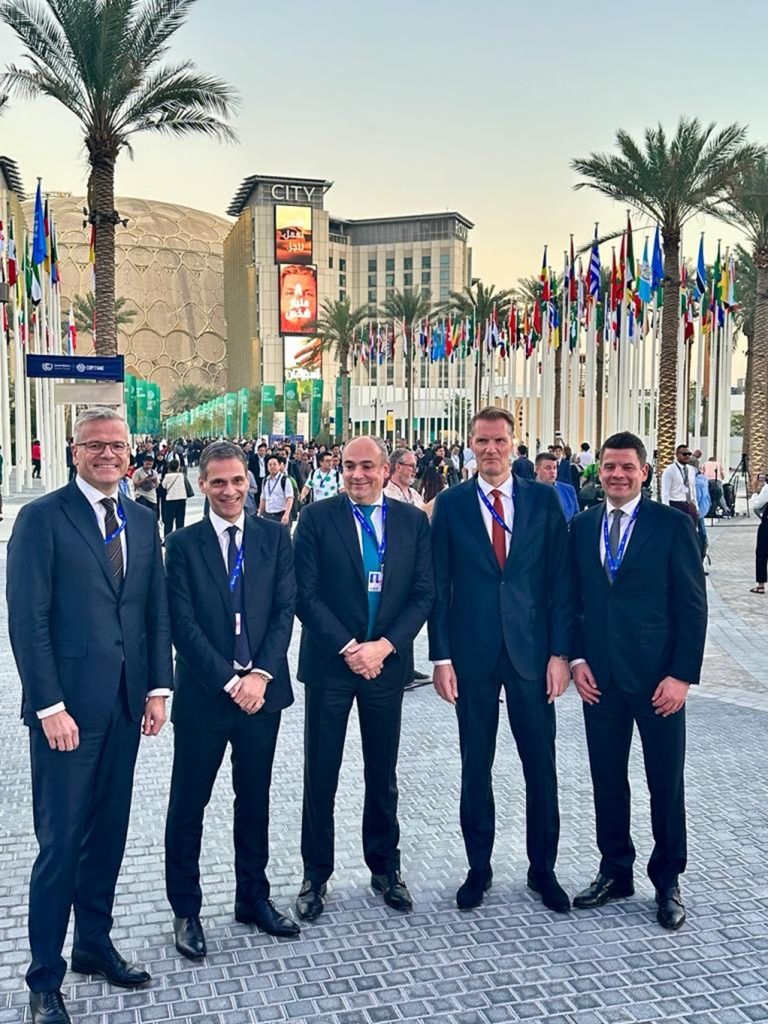
The World Shipping Council (WSC), liner shipping’s lobby group, has taken on the rallying call made at COP28 a week ago by some of its largest members and sent the International Maritime Organization (IMO) a paper outlining its four “cornerstones” critical to an effective IMO greenhouse gas agreement.
In arguably the single largest shipping headline-grabbing moment of the United Nations-convened COP28 event in Dubai so far, the CEOs of leading global shipping lines, MSC, Maersk, CMA CGM, Hapag-Lloyd and Wallenius Wilhelmsen (pictured), issued a joint declaration calling for an end date for fossil-only powered newbuilds and urging the IMO to create the regulatory conditions to accelerate the transition to green fuels.
The WSC has since then published its first contribution to negotiations at IMO’s next gathering of its Marine Environment Protection Committee (MEPC), in which it details the four items it believes are critical to an effective global legal instrument, as a formal contribution to IMO climate negotiations.
The paper calls for the swift implementation of GHG fuel intensity standards, some form of a carbon levy, regulations that are based on well-to-wake life cycle analysis of all fuels and most interestingly the WSC is urging for greater vessel pooling.
In a joint statement earlier from COP28, the heads of two of the world’s largest shipowners, Maersk and Mitsui OSK Lines (MOL), warned that the huge price gap between existing bunker fuel and alternatives posed a huge problem for shipping’s decarbonisation.
The statement from Vincent Clerc, CEO of Maersk, and Takeshi Hashimoto, his counterpart at MOL, noted the price of green fuels are “at least 3-4 times more expensive” than traditional bunker fuel.
The next MEPC is due to be held at the London headquarters of the IMO in March.
Recent Posts
Ammonia
Reliance Industries Limited (RIL) has signed a binding long-term supply and purchase agreement (SPA) with Samsung C&T Corporation for the export of green ammonia over a 15-year period.
Bunkering
Ofiniti Raises $6.8 Million to Scale Digital Bunkering Platform for Global Shipping
Hydrogen
Hefring Marine and Ecomar Propulsion partner to deploy monitoring system on hydrogen-electric vessel