
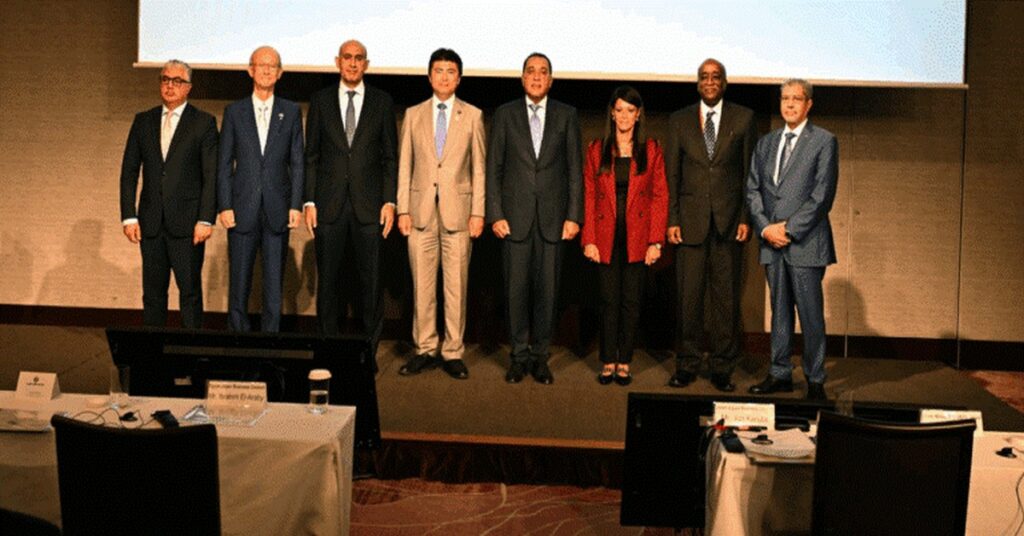
The General Authority for the Suez Canal Economic Zone (SCZONE) has engaged with public and private sector representatives in Japan to explore new opportunities in industrial development and green fuel bunkering.
Talks were held during a recent event in Tokyo, attended by Egyptian and Japanese companies alongside government officials, with the aim of strengthening bilateral economic ties and joint investment partnerships.
Two agreements were signed during the occasion. The first, between Japan’s ITOCHU Corporation and Egypt’s Orascom Construction, covers the design, development, and operation of integrated sites for ammonia bunkering at East Port Said and Sokhna ports. The second agreement, with the Tokyo Metropolitan Government, focuses on cooperation in green hydrogen for ship bunkering through knowledge exchange, demand stimulation, and the promotion of clean energy applications.
The Egyptian delegation also met with Sumitomo Corporation to discuss the creation of a new industrial zone under the developer model within SCZONE. The discussions included potential investments in bunkering services for multiple fuel types, green hydrogen production, and applications such as green steel. Possible participation by Sumitomo in infrastructure projects within SCZONE was also examined, including water desalination plants and hydrogen service corridors.
Waleid Gamal El-Dien, Chairman of SCZONE, said: “Egyptian-Japanese relations extend over decades and are characterized by mutual respect and a shared vision for achieving sustainable development.” He added that SCZONE was “one of Egypt’s most important national projects” due to its strategic location on both banks of the Suez Canal, linking the Red Sea and the Mediterranean, which makes it a “central hub” for global trade routes.
Recent Posts
Marine
Singapore Unveils Ammonia Bunkering Standard, First Ethanol Bunkering and LNG Storage Plans
Ammonia
Singapore Launches TR 148 Ammonia Bunkering Standard and Model Contract to Prepare for Ammonia-Fuelled Ships
Policy
China Targets Doubling New Energy Inland Vessels by 2028 Under 2026-2030 Action Plan