
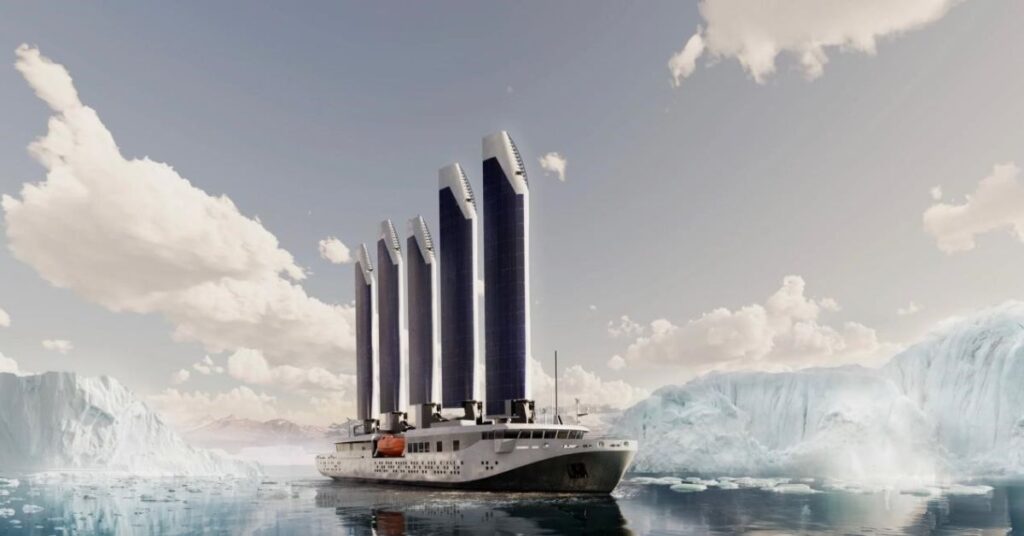
Dubai, UAE — Goltens Dubai has announced the successful launch of the Captain Arctic, a near-zero-emission exploration vessel designed to operate in some of the world’s most environmentally sensitive regions. The launch follows the completion of hull fabrication, marking a major step toward sustainable vessel operations in polar waters.
Developed through a collaboration between the vessel’s French owner SELAR, Chantier Naval de l’Océan Indien (CNOI) in Port Louis, and Goltens Dubai, the project combines advanced shipbuilding technologies with a focus on decarbonization and responsible marine design.
Renewable Energy Integration
The Captain Arctic, measuring 69 meters in length, has been engineered to achieve up to a 90% reduction in CO₂ emissions compared to conventional ships. Its design integrates multiple renewable energy systems, including rigid wind sails and photovoltaic solar panels, to enable efficient, low-emission cruising.
The vessel’s hybrid energy configuration is expected to minimize reliance on fossil fuels, making it one of the most environmentally advanced expedition ships of its class.
Goltens’ Role in the Project
Goltens Dubai oversaw the complete hull fabrication, along with the fabrication of the king post and the supply and installation of watertight doors. With hull construction completed, the project will now move into the outfitting, systems integration, and commissioning phase, leading up to the vessel’s maiden voyage in Arctic waters.
“The successful launch of the Captain Arctic underscores Goltens’ leadership in delivering practical engineering solutions that advance maritime sustainability,” said Sandeep Seth, CEO of Goltens Worldwide. “This vessel is not only a technological triumph but also a symbol of what can be achieved when innovation, craftsmanship, and environmental responsibility align.”
Toward Sustainable Exploration
Once operational, the Captain Arctic will serve as a platform for sustainable exploration and luxury hospitality, demonstrating how renewable energy systems can support long-range maritime operations without compromising safety or passenger experience.
The project reflects a broader shift in the maritime industry toward low-emission vessel design, as shipbuilders and operators align with global decarbonization targets set by the International Maritime Organization (IMO) and other international frameworks.
Industry Significance
The Captain Arctic project highlights the growing role of regional shipyards and engineering specialists in delivering complex, sustainability-driven vessels for international clients. By integrating wind-assisted propulsion, solar power, and optimized hull fabrication techniques, the initiative contributes to the evolving blueprint for green shipbuilding and expedition vessel design.
Recent Posts
HYBRID
GRSE Signs ₹1,032-Crore ONGC Contract for Four Hybrid Offshore Supply Vessels
EV
Energy In Motion Opens ₹500-Crore Electric Truck Plant in Pune
Fuels
Aegis Logistics Commissions 35,000-Tonne LPG Bottling Plant at JNPA