
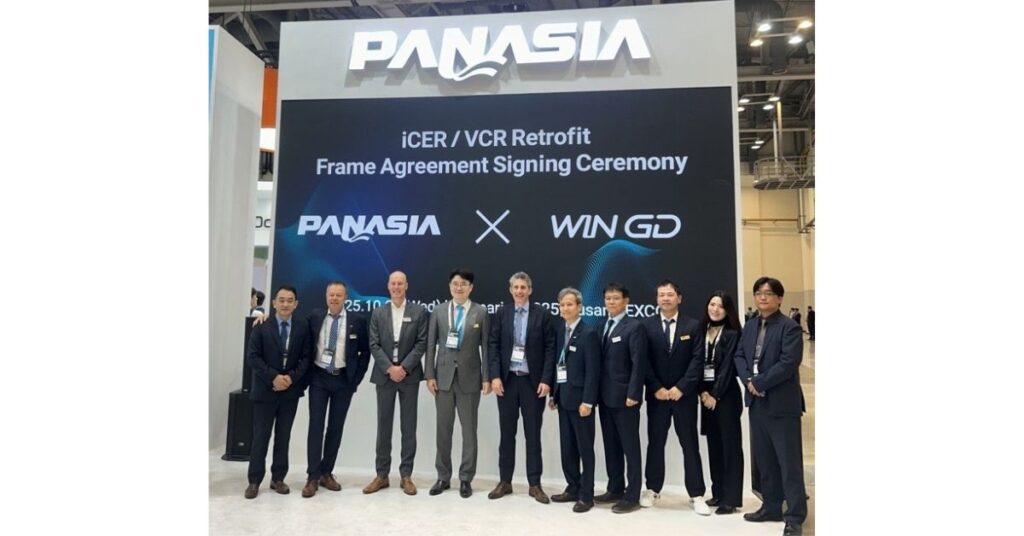
Swiss marine power company WinGD has signed a frame agreement with South Korea–based Panasia to retrofit in-service X-DF dual-fuel LNG engines with the latest emissions reduction and fuel efficiency technologies. The agreement, concluded during Kormarine 2025, aims to help ship operators lower operating costs and manage exposure to tightening maritime carbon pricing mechanisms.
Partnership to Support Global Retrofit Demand
Panasia, known for its system integration work across major shipyards, will support WinGD in delivering retrofit projects tailored to specific vessel configurations. The collaboration is expected to enable faster, cost-effective upgrades for shipowners seeking to improve vessel efficiency and extend competitiveness.
WinGD, as the original developer of the X-DF platform, will provide technical expertise and oversee full retrofit packages, including fuel conversions and energy efficiency enhancements. The company’s existing supplier and partner network will support project execution.
Company Statements
René Baart, WinGD Head of Retrofit & Upgrade Solutions, said:
“Korea has been the biggest market for X-DF engines since they were introduced in 2016. It was therefore natural that we start here as we aim to upgrade our installed base to the latest efficient technologies. We are delighted to have found a partner, in Panasia, with so much expertise in the equipment and system integration of both Chinese and Korean built vessels.”
Joseph Ohg, Head of Sales at Panasia, added:
“This agreement builds on our strong system integration capabilities developed through supporting newbuild projects, and will allow us to deliver X-DF upgrades alongside our current ballast water treatment, scrubber and other retrofits for existing vessels. In partnership with WinGD we are looking forward to revisiting many of those vessels to ensure they can benefit from the advantages of cutting-edge dual-fuel LNG technology.”
Focus on Upgrading to X-DF2.0 Technology
The retrofit programme will initially target solutions that allow first-generation X-DF engines to operate at efficiency and emissions levels similar to WinGD’s latest newbuild engines. Key upgrade options include:
- iCER (Intelligent Control by Exhaust Recycling) – improves combustion stability when operating on LNG.
- VCR (Variable Compression Ratio) – adjusts compression ratios dynamically to enhance fuel efficiency depending on fuel type and engine load.
Combined, iCER and VCR technologies can cut methane slip to around 0.7% of fuel gas volume, more than halving levels associated with early X-DF engines. The upgrades also lower fuel consumption and reduce compliance costs under EU and proposed IMO emissions frameworks.
Growing Interest Among Shipowners
WinGD and Panasia are already in discussions with several shipowners regarding future retrofits. WinGD recently completed its first retrofit of VCR technology on a CMA CGM vessel, with initial performance results presented at the CIMAC World Congress in June.
Recent Posts
Biofuels
WinGD Ethanol-Fuelled Engine Completes First In-Service Voyage on Maersk Vessel
Power & Propulsion
Norsepower Rotor Sails Installed on Airbus Cargo Ship Spirit of Toulouse
EV
Estonia Electric Ferry to Combine Steerprop Propulsion with Battery Power