

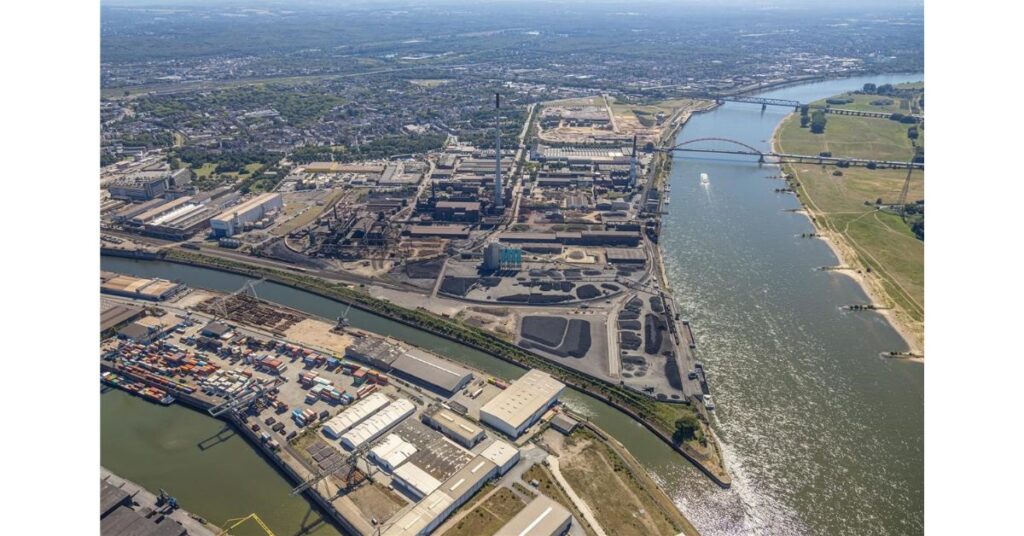
LBC Tank Terminals Group B.V. (LBC) and Duisburger Hafen AG (duisport) have signed a memorandum of understanding to explore the joint development of a new inland ammonia and CO₂ terminal in Duisburg, Germany. The agreement supports both organisations’ strategies to expand low-carbon logistics infrastructure and strengthen critical supply chains for emerging energy carriers.
Proposed Terminal to Extend LBC’s Vlissingen Energy Hub
The planned facility would be located in Europe’s largest inland port, offering direct access to the industrial Ruhr region. It is intended to operate as a satellite terminal for LBC’s flagship ammonia import, storage, and cracking hub in Vlissingen, the Netherlands.
Under the proposal, ammonia would be transported by barge from Vlissingen to Duisburg, where on-site cracking capabilities and distribution infrastructure would support inland supply of ammonia and hydrogen. The site would also enable the collection and export of captured CO₂ for offshore sequestration.
Strengthening Cross-Border Energy Logistics
Frank Erkelens, CEO at LBC Tank Terminals, said:
“We look forward to joining forces with duisport in building a resilient connection between Vlissingen and Duisburg, supporting Europe’s hydrogen and CO₂ supply chains. This partnership unites leading logistics and terminal operations expertise to support the European industry in advancing sustainable solutions, and reflects our shared commitment to driving growth while accelerating decarbonisation across the region.”
For duisport CEO Markus Bangen, the collaboration reinforces efforts to position the Rhine corridor as a sustainable logistics route:
“Ports are key players in the energy transition. They create sustainable infrastructure and resilient supply chains. The joint project with LBC complements the already known plan to build a tank farm at Rheinkai Nord and opens up new opportunities for handling the energy sources of the future in the Port of Duisburg. This sends a strong signal for transformation in North Rhine-Westphalia.”
Timeline
The development aims to be operational by 2030, subject to further agreements, permitting, and investment decisions.
Recent Posts
Uncategorized
Test P 100 na Inname: Wat Je Moet Weten
Uncategorized
Clenbuterol y Ciclo de Preparados de Insulina: Lo que Debes Saber
Uncategorized
Efectos del SR9009 10 10 mg de Deus Medical