

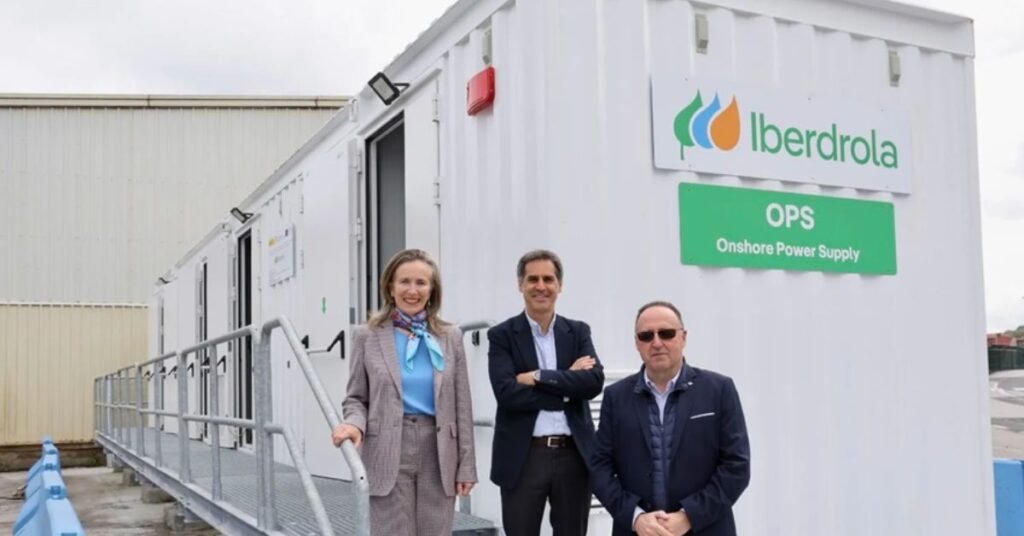
Iberdrola España has completed the installation of an Onshore Power Supply (OPS) system at the Port of Pasaia in Guipúzcoa, Spain, allowing docked vessels to draw electricity from the onshore grid instead of running auxiliary engines while in port.
The infrastructure has been installed at the Kaputxinos pier and will primarily serve hybrid Ro-Ro vessels operated by shipping company UECC. These ships, which carry wheeled vehicles, account for one of the main traffic flows through the Basque port.
OPS systems — sometimes called cold ironing — replace the diesel-fired auxiliary generators that ships typically run during port stays. When connected to the onshore grid, vessels can shut down their auxiliary engines entirely while still powering onboard systems for loading, unloading, and crew operations.
Because the electricity drawn from Iberdrola’s grid is sourced from renewable generation, the emissions profile of the port stay shifts substantially compared with combusting marine diesel at berth.
The benefits cited by the project partners include:
• Reduced greenhouse gas emissions in the port area
• Improved local air quality
• Noise reduction of up to 16 decibels, based on International Maritime Organization estimates
• Elimination of auxiliary engine noise during loading and unloading
• Lower vibration during docking
• Reduced wear on auxiliary engines
• Fuel cost savings compared with conventional bunker use
The noise reduction is particularly relevant for ports such as Pasaia, where residential areas sit close to operational quays.
Izaskun Goñi, president of the Pasaia Port Authority (APP), said: “Having this infrastructure in place will make it possible to substantially reduce greenhouse gas emissions and improve air quality in the port area. Through initiatives like this, we aim to establish Pasaia as an eco-sustainable port committed to decarbonizing its operations.”
Eduardo Lobato, Iberdrola España’s commercial representative in the Basque Country, framed shore power as a building block of broader maritime decarbonisation, stating that port electrification “enables more efficient, cleaner and autonomous energy management.”
The Pasaia installation is part of a broader Iberdrola initiative covering OPS deployment at the ports of Pasaia, Vigo, and Alicante. The project received €1.9 million in grant funding from Spain’s Ministry of Transport and Sustainable Mobility (MITMS), routed through the Sustainable and Digital Transport Support Programme under the Recovery, Transformation, and Resilience Plan and ultimately funded by the European Union’s Next Generation Funds.
Shore power infrastructure is moving from optional to mandatory across European ports. The FuelEU Maritime regulation and amendments to the Alternative Fuels Infrastructure Regulation (AFIR) require core European Union ports to provide shore power for container and passenger ships at major berths by 2030.
For ports such as Pasaia, deploying OPS ahead of regulatory deadlines provides a competitive position with shipping lines under their own decarbonisation pressure — particularly operators like UECC, which has already invested in hybrid tonnage and stands to benefit operationally from shore power availability at frequently-called ports.
The economic case depends heavily on electricity pricing relative to marine fuel, port dwell times, and the carbon cost of running auxiliary engines under FuelEU compliance accounting.
Recent Posts
EV
Maharashtra Signs ₹150 Crore MoU to Build Electric Boat Manufacturing Facility for Mumbai Water Metro
Hydrogen
Samskip’s SeaShuttle Joins EU HyShip Project to Advance Hydrogen-Powered Short-Sea Shipping
Methanol
Maritime Technologies Forum Releases Safety Management Guidelines for Methanol-Fuelled Ships