

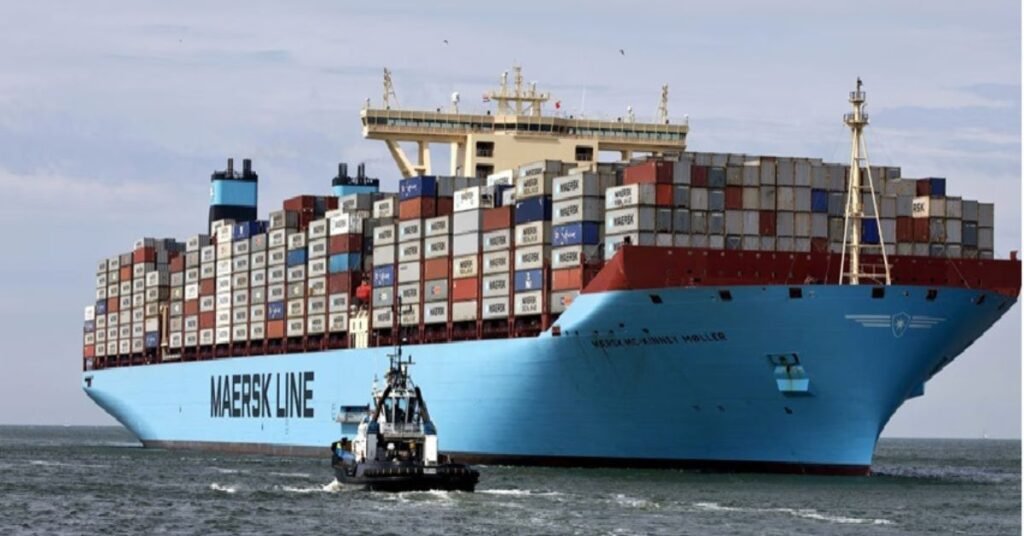
The world’s second-largest container carrier has taken delivery of its second methanol-powered vessel — and the race to decarbonise global shipping is accelerating.
Danish shipping giant A.P. Moller-Maersk has taken delivery of its second 9,000-TEU methanol dual-fuel container vessel from Yangzijiang Shipbuilding in China, marking another concrete step in what the carrier has positioned as one of the most ambitious fleet decarbonisation programmes in global maritime history.
The new vessel joins a growing fleet of alternative-fuel ships that Maersk has been commissioning as part of its stated goal to achieve net-zero emissions by 2040 — a decade ahead of the International Maritime Organization’s revised target of net-zero by 2050. The 9,000-TEU capacity class is increasingly recognised as a versatile mid-range workhorse suitable for both intra-Asia services and longer east-west trade lanes, where the balance of cargo volume and fuel efficiency is critical.
Methanol as a shipping fuel has attracted significant interest from carriers because it is liquid at ambient temperature and pressure, making it easier to store and handle than liquefied natural gas (LNG) or compressed hydrogen. Dual-fuel engines — capable of running on either methanol or conventional heavy fuel oil — provide operational flexibility during a transition period when methanol bunkering infrastructure is still being developed at major ports globally.
Yangzijiang Shipbuilding, which delivered the vessel, has emerged as one of China’s most technically sophisticated private shipyards. The yard has built a strong pipeline of eco-friendly vessel orders as the global fleet renewal cycle accelerates in response to environmental regulations. China’s shipyards — led by names like Yangzijiang, CSSC, and COSCO Shipping Yards — now dominate global order books, particularly for the next-generation container ship segment.
The delivery comes at a moment of heightened regulatory pressure on the shipping industry. The IMO’s Carbon Intensity Indicator (CII) framework, which came into force in 2023, requires vessels to demonstrate continuous improvement in their emissions efficiency ratings or face operational restrictions. The European Union’s Fuel EU Maritime regulation, which began phasing in from 2025, sets progressively tighter limits on the greenhouse gas intensity of fuels used by ships calling at EU ports.
For Maersk’s shipping line customers — which include a significant base of Indian exporters and importers using services through JNPA and other Indian ports — the shift towards greener vessels has implications for the sustainability credentials of their own supply chains. Indian manufacturers seeking to comply with EU carbon border adjustment mechanisms and multinational buyers’ scope-three emissions requirements will increasingly demand shipping services with lower carbon footprints.
The Maersk-Yangzijiang partnership also reflects a broader geopolitical and commercial dynamic: global shipping’s decarbonisation investment is flowing substantially through Chinese yards. India, which has declared ambitions to become a major shipbuilding nation under its Maritime Amrit Kaal Vision 2047 and has allocated dedicated funding through the Maritime Development Fund, will need to compete for this high-value segment of the orderbook if it is to realise those aspirations.
For now, the second methanol delivery reinforces Maersk’s reputation as the industry’s standard-bearer in green shipping — and signals to the rest of the sector that alternative fuel adoption is no longer a pilot programme but an accelerating commercial reality.
Recent Posts
Marine
WinGD Orders Four Dual-Fuel Engines for Polaris Shipping’s Newcastlemax Fleet
EV
Jio-bp, DRIVN sign MoU to expand commercial EV charging infrastructure in India
Policy
DGMA discusses marine engine manufacturing partnership with WinGD in India