

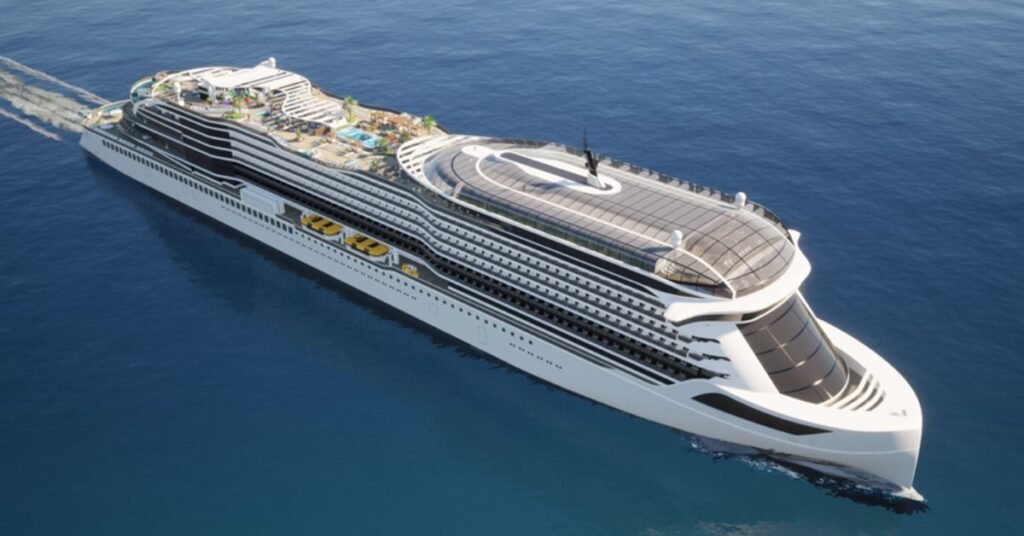
Meyer Werft is developing plans for what it says could become the world’s first fully electric battery-powered cruise ship as part of its “Project Vision” initiative aimed at reducing greenhouse gas emissions by 95%.
The proposed vessel would operate entirely on battery-electric propulsion, replacing conventional engine rooms with large-scale battery systems designed to power the ship throughout its voyages.
Battery-electric cruise ship concept
According to Meyer Werft, advances in battery technology have reached a point where fully electric cruise operations are becoming technically viable for certain regional routes.
Johannes Bade, Project Engineer at Meyer Werft, said:
“Batteries are now in a state with the energy density and other aspects, safety, life cycle and so on, where we say, now this is the most energy efficient way to do cruises.”
The battery system for the concept vessel has been developed by Corvus Energy, whose battery technology is already used on electric ferries operating globally.
The proposed cruise ship would recharge at ports, operating similarly to a large-scale electric vehicle. Meyer Werft stated that the technology required for the vessel is already available and that delivery could be possible by 2031 if a shipbuilding contract is secured this year.
Port infrastructure remains a key challenge
While vessel technology is progressing, shore-side charging infrastructure remains limited. According to Meyer Werft, cruise ships currently call at approximately 1,500 ports annually, but only 41 ports are currently capable of supplying electrical power to a single cruise vessel.
The company estimates that around 100 European ports could have the necessary infrastructure to support battery-powered cruise ships by 2030 as investments in shore power and port electrification expand.
The concept is considered particularly suitable for short- and medium-range cruise itineraries where ports are located relatively close together.
Potential operating regions identified include:
- The Mediterranean
- Northern Europe
- Norwegian fjords
- The Baltic Sea
- Florida and the Bahamas
Cruise sector exploring multiple decarbonisation pathways
The cruise industry is evaluating a range of technologies and fuel pathways as operators seek to align with international emissions reduction targets.
Charles “Bud” Darr of Cruise Lines International Association said:
“It is going to take a mosaic or bundle of solutions to get to net zero for 2050.”
He added:
“So every innovation, I think, is something that we add to that mosaic or toolkit or box of solutions that we’re going to use.” The project reflects growing interest in electrification within the maritime sector, particularly for vessel segments operating on shorter routes where charging infrastructure and battery range requirements are more manageable.
Recent Posts
Marine
WinGD Orders Four Dual-Fuel Engines for Polaris Shipping’s Newcastlemax Fleet
EV
Jio-bp, DRIVN sign MoU to expand commercial EV charging infrastructure in India
Policy
DGMA discusses marine engine manufacturing partnership with WinGD in India