

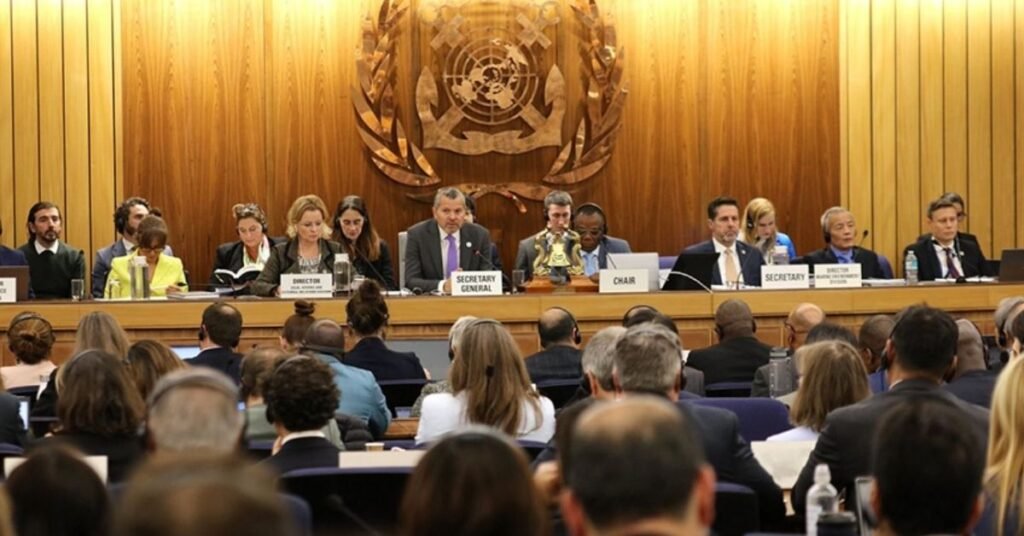
Shipping’s carbon bill returns to the table next week. The IMO Intersessional Working Group on Reduction of Greenhouse Gas Emissions from Ships meets in London from September 1 to 4 and will report its findings to MEPC 85, scheduled for November 30 to December 3. The framework was adopted at MEPC 83, but formal approval slipped by a year after an aggressive campaign led by the United States.
Four rival proposals are in play. Liberia would tie greenhouse gas fuel intensity requirements to the availability and affordability of commercially viable fuels, and proposes transferable “Surplus Units” in place of the IMO Fund; together with Panama it argues those units should be issued for verified efficiency gains. Brazil wants a softer start, with reductions of 3% in 2029 and 4% in 2030, and sets Remedial Unit prices between $100 and $380 per tonne of CO2e.
Tuvalu takes a harder line: $300 per tonne for Tier 1, $380 for Tier 2, and a 30% direct compliance reduction by 2035. Australia, Canada, South Africa and the United Kingdom largely preserve the existing structure. China is asking for technology-neutral language that recognises shore power, wind propulsion and solar energy in the GFI calculation. Norway, the Pacific Island states and European countries oppose any weakening of the price mechanism, while Saudi Arabia and the United Arab Emirates argue that a uniform carbon price would fall unevenly on trade.
Industry expectations are clear enough. Höegh Autoliners Chief Executive Andreas Enger said laying the regulatory foundation now is critical. Port of Rotterdam Chief Executive Boudewijn Siemons called for a global framework and a worldwide level playing field. The economic mechanism is expected to raise roughly $10-15 billion a year, although it remains unsettled whether the structure will be a “Fund” or a lighter “Facility.”
Key takeaways:
- The IMO working group meets in London September 1-4; MEPC 85 follows on November 30 to December 3.
- Liberia and Panama back transferable Surplus Units instead of the IMO Fund.
- Brazil proposes a phased start with 3% reduction in 2029 and 4% in 2030.
- Tuvalu seeks $300 per tonne for Tier 1, $380 for Tier 2 and a 30% direct cut by 2035.
- The mechanism is expected to generate $10-15 billion a year.
Recent Posts
Bunkering
Singapore awards new LNG bunkering licences to strengthen Singapore’s multi-fuel bunkering hub
Dual-Fuel
Furetank and partners place order for four dual-fuel tankers
Ammonia
Exmar unveils two more ammonia-capable vessels