

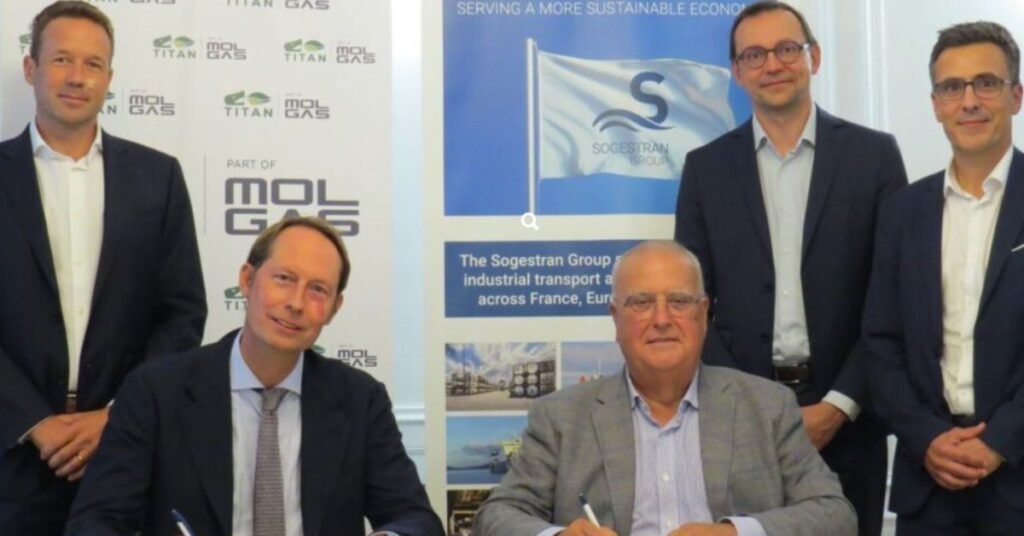
Titan Clean Fuels, part of the Molgas group, has entered into a long-term agreement with shipowner Sogestran Group covering the construction, charter, and operation of a new 6,000 cbm LNG bunker vessel, expanding LNG and LBM bunkering capacity into the Western Mediterranean.
Where will the new vessel operate?
Titan plans to deploy the LNG bunker vessel (LNGBV) across the Western Mediterranean, where it will load LNG from a series of regional terminals and offer LNG and Liquified Bio Methane (LBM) bunkering, along with gas-up and cool-down services, to LNG-fuelled vessels calling at major ports including Fos-Marseille, Barcelona, and Genoa. The addition extends the Molgas Group’s Mediterranean presence beyond its existing truck-to-ship and onshore LNG distribution capabilities into ship-to-ship bunkering.
What makes this vessel purpose-built for the region?
The LNGBV was jointly developed and designed by Titan and Sogestran to match the navigational, operational, and commercial characteristics of Western Mediterranean ports and LNG reloading terminals. Notably, its low-air-draft design will allow it to bunker cruise ships without requiring a pontoon, a practical advantage in ports with heavy cruise traffic. The vessel itself will run on LNG/LBM fuel, aligning its own operations with the decarbonisation goals of the cargo it delivers. It will be built by CIMC SOE, a leading Chinese shipyard specialising in small and medium-sized gas carriers.
How does this fit into Molgas Group’s broader fleet?
The new vessel will join Molgas Group’s existing fleet of eight LNG bunker vessels operating across Northern Europe, six under Titan and two trading for Molgas Norway. Commercial Director Grégoire Hartig said the expansion reflects Titan’s ambition to grow bunkering capacity in both volume and geography, positioning LNG and LBM as leading alternative fuels as the shipping industry continues its energy transition.
Sogestran Shipping Managing Director Benoist Grosjean highlighted the value of co-developing the vessel using in-house engineering capability alongside Titan’s technical teams from the earliest project stages, calling the low-air-draft design a tailored solution for Mediterranean operational needs.
Why does this matter for Mediterranean shipping now?
The timing is significant. The Mediterranean became a sulphur oxide and particulate matter Emission Control Area (ECA) on 1 May 2025, tightening compliance requirements for vessels operating in the region. LNG and LBM pathway fuels can nearly eliminate SOx and PM emissions compared to oil-based fuels, positioning them as a compliance-friendly option as regional regulations tighten. Titan brings over 15 years of experience delivering cleaner bunker fuels, while Sogestran contributes decades of conventional bunkering operations across Marseille, Spain, and Algeria, giving the partnership both technical and regional operational depth.
What does this signal for the alternative fuels bunkering market?
The agreement adds to a broader pattern of LNG and LBM infrastructure build-out across European bunkering hubs, as operators position ahead of tightening emissions regulation and rising demand for methane-pathway fuels, with anticipated future extension toward e-methane as the maritime energy transition progresses.
Recent Posts
Power & Propulsion
Kongsberg Maritime to extend range of Elegance Pods for large cruise vessels
LNG
Qatari, UAE LNG cargoes transferred via ship-to-ship outside Strait of Hormuz
Power & Propulsion
Anemoi Marine Technologies to install first Rotor Sail on a Maersk container vessel