
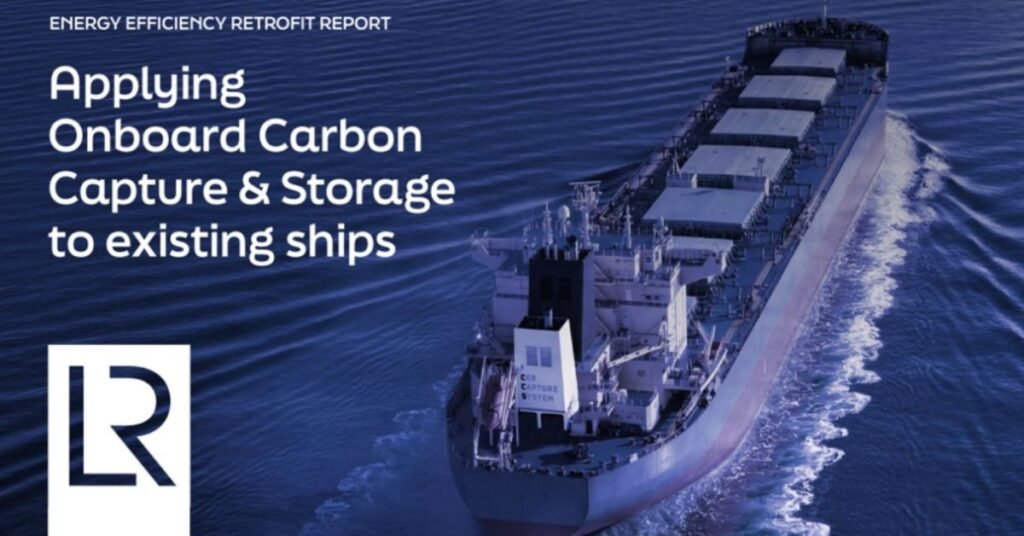
Lloyd’s Register (LR) has identified onboard carbon capture and storage (oCCS) as a potential CO₂ emissions reduction option for parts of the global shipping fleet, particularly vessels that are expected to remain in service through the 2030s.
The findings are contained in LR’s latest report, Applying Onboard Carbon Capture & Storage to Existing Ships, released at SMM in Hamburg. The report assesses the potential for retrofitting existing vessels with carbon capture systems as the shipping industry develops alternative fuel supply chains and faces tighter emissions regulations.
Why onboard carbon capture is gaining attention
The report comes as the availability of low- and near-zero-emission fuels remains limited. LR estimates that only around 4% of the near-zero greenhouse gas emission fuel production capacity required by 2030 has reached final investment decision.
At the same time, the proportion of contracted vessel tonnage capable of using alternative fuels declined from 45% in 2024 to 37% in 2025.
Against this backdrop, LR expects a significant share of vessels already in service or on order to continue using conventional petroleum-based fuels well into the 2030s. oCCS could provide these vessels with an additional means of reducing CO₂ emissions alongside energy-efficiency measures and alternative fuels.
The technology captures CO₂ from a vessel’s exhaust gases before the gas is processed, stored onboard and subsequently offloaded for transport and permanent storage.
Current capture technology
LR’s research indicates that some oCCS technologies have progressed beyond the development stage and are moving towards commercial deployment.
Full-scale installations currently achieve CO₂ capture rates of approximately 30-40%, while larger pilot projects are targeting capture rates of around 70%.
However, the technology can increase fuel consumption. According to LR, current oCCS applications can impose fuel consumption penalties of approximately 15-30%. Capture equipment and onboard CO₂ storage can also require substantial space.
As a result, LR says the commercial case for retrofitting needs to be evaluated for individual vessels rather than applied across the fleet.
Which ships are best suited to oCCS?
LR identifies vessels with more than 10 years of remaining trading life as potential candidates where several conditions are met.
These include significant exposure to carbon pricing, access to a reliable CO₂ offloading chain and adequate onboard space for capture and storage equipment without creating unacceptable commercial penalties.
The report highlights three segments as particularly suitable for near-term deployment:
- MR and chemical tankers operating on European Economic Area (EEA) routes
- LNG-fuelled vessels that can use cryogenic cold energy from LNG vaporisation to cool and liquefy captured CO₂
- Short-sea and feeder vessels with frequent access to EEA ports and exposure to carbon pricing
For these vessel types, oCCS could help reduce emissions and manage carbon-related costs while alternative fuel availability and associated infrastructure continue to develop.
Port infrastructure remains a key constraint
Despite advances in carbon capture technology, LR identifies CO₂ offloading infrastructure as one of the principal obstacles to wider adoption.
Captured CO₂ needs to be transferred from vessels to suitable ports, terminals or offshore facilities before it can be transported and permanently stored. While carbon storage projects are progressing in north-west Europe, including networks connected to North Sea storage sites, the availability of port reception facilities remains limited.
The report therefore identifies the ability to offload captured CO₂ as a critical link in the emerging carbon capture and storage value chain.
Regulatory uncertainty could affect investment
Regulatory clarity is another factor that could influence the adoption of onboard carbon capture.
Under the EU Emissions Trading System (EU ETS), captured and permanently stored CO₂ can reduce a vessel’s compliance obligations. However, the treatment of onboard carbon capture under FuelEU Maritime and future International Maritime Organization (IMO) regulations remains subject to further development.
LR highlights three developments that could influence wider deployment: the outcome of the FuelEU Maritime Article 30 review, recognition of captured CO₂ under a future global IMO pricing framework, and the expansion of CO₂ offloading infrastructure.
Panos Mitrou, Senior Vice President of Shipping Strategy, Lloyd’s Register said: “The reality is that much of the fleet on order or in service today will still be operating well into the 2030s and beyond. While alternative fuels remain central to shipping’s long-term decarbonisation strategy, shipowners also need practical options for reducing CO₂ emissions from existing vessels.
“Onboard carbon capture has the potential to become an important part of shipping’s decarbonisation toolkit. For the right vessel types and trades, it offers a realistic pathway to reducing CO₂ emissions and managing carbon costs while fuel supply chains, infrastructure and regulations continue to evolve.”
Recent Posts
Ammonia
Maersk Tankers Ammonia Retrofit Project Advances Towards EU Support
Policy
EU Maritime Innovation Projects Advance in €3.4-Billion Funding Selection
Policy
Shanghai–Melbourne Green Shipping Corridor Sets 2035 Vessel Deployment Goal