

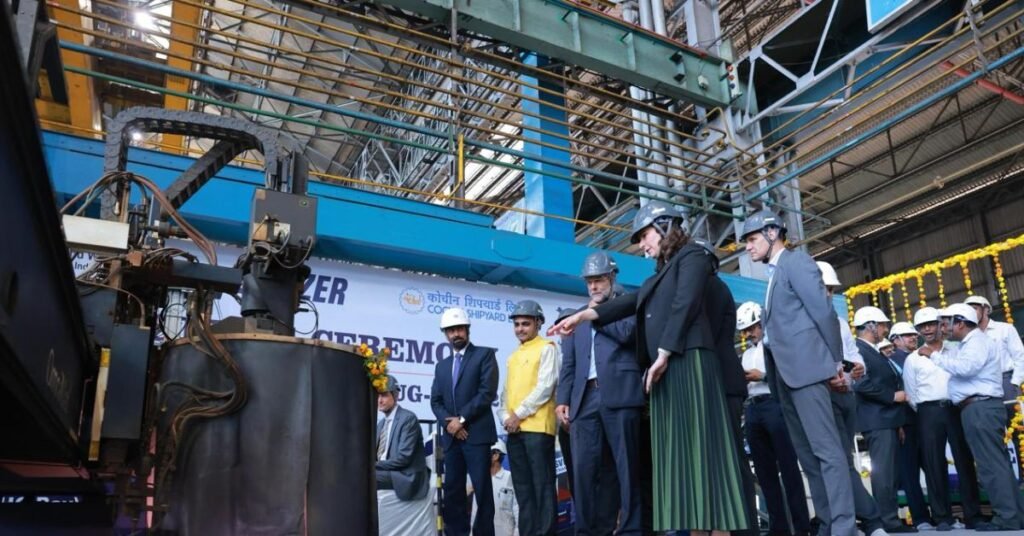
Svitzer is expanding its use of Indian shipbuilding capacity for its global fleet renewal programme, with eight next-generation battery-electric harbour tugs set to be built at Cochin Shipyard Limited (CSL) in Kerala and Swan Defence and Heavy Industries in Gujarat.
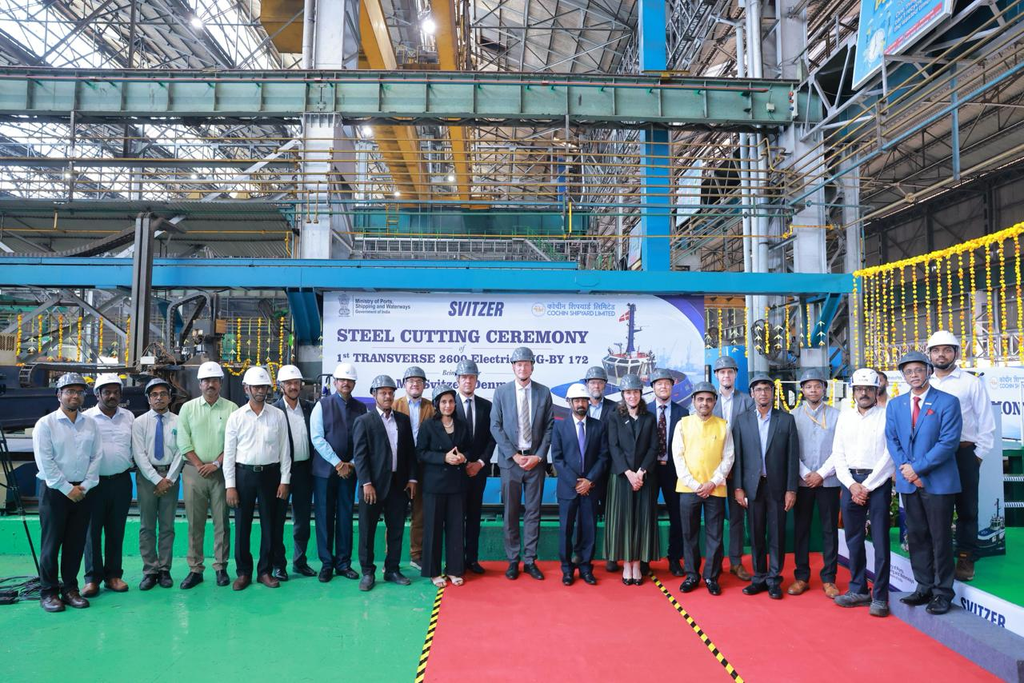
The company marked the steel-cutting ceremony for four TRAnsverse 2600e battery-electric harbour tugs at CSL in Kochi on September 2. The vessels form part of an eight-tug global fleet renewal programme, with a second four-vessel contract awarded to Swan Defence and Heavy Industries.
Deniz Kirdar True, a Svitzer board member, said the projects demonstrate the capabilities being developed within India’s shipbuilding sector.
“The steel cutting matters for a straightforward reason: the most advanced green tug being built today is being built in India.”
Indian shipyards selected through global evaluation
According to Kirdar True, Svitzer selected CSL following a competitive assessment of shipyards worldwide that considered capability, quality, price, yard availability and delivery experience.
“Indian yards were chosen on merit, and we have now done so twice — the second contract being with Swan Defence and Heavy Industries in Gujarat. Between them, eight Svitzer tugs will soon be under construction in India.”
He said the projects could help develop expertise in electric propulsion and high-specification vessel construction within India’s shipbuilding ecosystem.
“For India’s maritime sector, the significance is that the capability being developed here does not leave. Expertise in electric propulsion, high-specification construction and the associated skills is being built at Cochin, and stays at Cochin.”
Svitzer already operates in India at Pipavav and intends to maintain a long-term presence in the country’s port sector, according to Kirdar True.
Electric tug designed for harbour operations
The four tugs being built in India are intended for Svitzer’s global fleet renewal programme, although the company also sees potential for the TRAnsverse platform in Indian ports and terminals.
Kirdar True said the vessel was designed to improve operational flexibility rather than simply increase towing power.
“On operations, the TRAnsverse was designed to remove constraints rather than simply to pull harder. It delivers faster and more predictable vessel movements, which protects berth productivity and turnaround times, and it can work at any position around the ship without repositioning.”
He said the resulting operational flexibility could allow ports to make greater use of existing berths, channels and pilotage infrastructure without necessarily requiring a proportional increase in tug fleet size.
When charged using green electricity, the battery-electric vessels can operate without direct emissions during harbour operations.
Cost advantage depends on port operating profile
Kirdar True said the economics of battery-electric tugs vary according to individual port conditions, including vessel utilisation, electricity costs and charging infrastructure.
“On total cost of ownership, the honest answer is that it depends on the port. A battery-electric tug may cost more to build than a conventional one, and less to run.”
He said factors such as duty cycle, number of vessel assists, availability and cost of electricity, and the configuration of shore-side charging infrastructure determine the overall economics.
Svitzer has also accumulated operational experience with the TRAnsverse design. According to Kirdar True, more than 3,000 commercial towage jobs have been completed using the class, while 18 vessels based on the design are currently under construction worldwide.
Shipyards, ports and suppliers seen as key partners
Svitzer sees international operators, Indian shipyards, ports and equipment suppliers as important components of the transition towards lower-emission harbour craft.
“International operators bring demand, operating experience, technology requirements and international standards. Indian shipyards bring industrial capability, skilled people, infrastructure and delivery.”
Kirdar True said complex projects can accelerate capability development within shipyards, while export contracts can provide the reference credentials needed to secure further international work.
“Export contracts matter for a second reason. They give a yard the reference credentials that open the next contract, and the one after that. India’s shipbuilding ambitions will not be met on domestic demand alone.”
He identified three areas where partnerships will be particularly important: shipyards willing to adopt new technologies, ports and terminals that coordinate vessel and shore infrastructure planning, and equipment and service providers capable of supporting vessels locally.
Electric, hybrid and biofuel options
Svitzer’s approach to tug propulsion depends on the operating characteristics of each port rather than a single technology pathway.
“The questions that matter are how many assists a day, over what distances, with what idle time in between, and what power is available at the berth.”
According to Kirdar True, intensive harbour operations involving short distances and regular returns to a fixed berth are well suited to full electrification. Longer-distance operations or locations without reliable shore power may be better suited to hybrid or biofuel-capable configurations.
The TRAnsverse platform is available in battery-electric, hybrid and conventional diesel configurations that are biofuel drop-in ready.
“The TRAnsverse platform was built for precisely this variation.”
He said Svitzer does not intend to prescribe one propulsion solution for all Indian ports, with the appropriate technology depending on individual operating and infrastructure conditions.
Shore-side charging identified as key bottleneck
The availability of berth-side charging infrastructure is currently one of the main constraints to wider adoption of electric harbour tugs, according to Svitzer.
“Charging infrastructure at the berth is the clearest near-term bottleneck. An electric tug performs to the standard of the power available to it, and adoption will move at the speed that infrastructure is installed.”
Kirdar True said vessel deployment and shore infrastructure need to be planned together. He also identified commercial structures as another important consideration because electric tugs typically require higher upfront capital expenditure.
Lifecycle support is a further requirement, particularly for battery monitoring, maintenance and eventual replacement. Local availability of technical expertise, spare parts and crew training will therefore be important as electric tug fleets expand.
Electric propulsion expected to become standard
Over the next five to 10 years, Svitzer expects electric propulsion to become increasingly common in harbour towage.
“Over the next five to ten years, we expect electric propulsion to become normal in harbour towage rather than exceptional.”
Kirdar True also expects vessel and charging infrastructure planning to become more closely integrated, while tug performance will increasingly be assessed by its contribution to overall port operations rather than bollard pull alone.
He said Indian shipyards already have experience building vessels for international customers and that projects such as the Svitzer programme provide an opportunity to demonstrate their ability to deliver advanced, lower-emission workboats for global fleets.
“We would also like to see these tugs, or their successors, working in Indian ports. Building them here is a good start.”
Kirdar True currently chairs the board of Svitzer Tanger Med SA and is a board member of Nakilat Svitzerwijsmuller Company W.L.L. Previous board roles include chair of Svitzer Idku SAE and Batangas Bay Towage Inc., and board member of Svitzer Sohar LLC, Svitzer Egypt LLC and Svitzer Angola Shipowners BVI Ltd.
Recent Posts
Tugboats
Svitzer highlights India’s role in building next-generation electric harbour tugs
Methanol
China completes first green methanol bunkering of international-voyage bulker
Power & Propulsion
Kongsberg Maritime to equip two Cadeler wind turbine installation vessels