
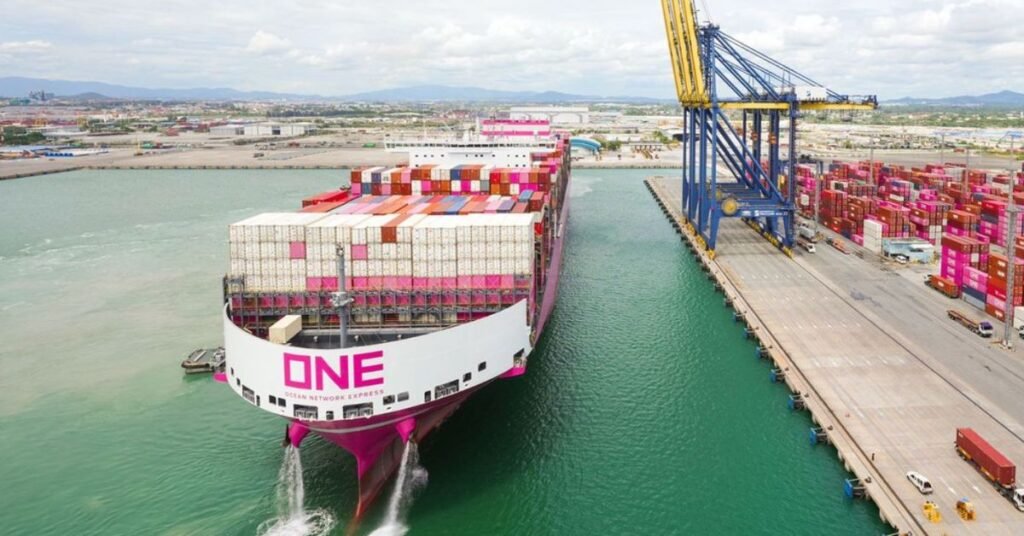
Ocean Network Express (ONE) has reduced the intensity of its Scope 1 greenhouse gas emissions by 65% from its 2008 baseline, according to its Sustainability Report 2026. The company has retained its target of achieving a 70% reduction in Scope 1 emissions intensity per TEU-km by 2030 and net-zero emissions across Scopes 1, 2 and 3 by 2050.
The report covers ONE’s fiscal year from April 1, 2025, to March 31, 2026, and was published on September 18, 2026.
Scope 1 emissions intensity falls as absolute emissions rise
ONE reported Scope 1 emissions intensity of 35.68 grams of CO2e per TEU-km in FY2025, down from 37.21 grams in FY2024 and 38.63 grams in FY2023.
The company measures this indicator against the amount of cargo transported and the distance travelled. ONE notes that a reduction in emissions intensity represents improved efficiency but does not necessarily mean that total emissions have declined.
Absolute Scope 1 emissions increased during the same period, rising from 10,430,487 tonnes of CO2e in FY2023 to 11,711,820 tonnes in FY2024 and 12,185,456 tonnes in FY2025.
ONE attributed the increase primarily to higher fuel consumption, particularly as vessels continued to take longer routes around the Cape of Good Hope instead of transiting the Suez Canal because of the Red Sea crisis. The company also cited an increase in its operational fleet, from 276 vessels in FY2024 to 312 in FY2025.
Fuel consumption and alternative fuels
ONE’s fuel oil consumption increased from 138,823 terajoules in FY2024 to 143,526 TJ in FY2025, while diesel consumption rose from 11,116 TJ to 11,672 TJ.
Biofuel energy consumption increased substantially, from 299 TJ to 2,013 TJ. The figure represents the pure biofuel fraction contained in B24 and B30 blends.
The company received 14 vessels from its ONE S-Series during 2025 as part of its fleet renewal programme. The vessels incorporate fuel-efficiency measures and are designed to be capable of using methanol and ammonia in the future.
ONE’s decarbonisation programme also covers carbon management, operational efficiency, fleet and technology investments, and collaboration across the maritime supply chain.
Operational initiatives include voyage and port-call planning, reducing port stay times, using artificial intelligence and weather data for route optimisation, shore power where infrastructure is available, and improving stowage, auxiliary machinery, hulls, propellers and propulsion systems.
ONE LEAF+ and green shipping initiatives
ONE continues to offer ONE LEAF+, a maritime transport service using UCOME biofuel. According to the company, the service can deliver an approximate 84% reduction in lifecycle CO2e emissions from well to wake compared with conventional fuel.
ONE said the emissions savings are independently verified and that the biofuel used is ISCC certified. The company is also participating in green maritime corridors and conducting studies into emerging marine fuels through the Global Centre for Maritime Decarbonization (GCMD).
Other emissions and environmental indicators
Scope 2 emissions, calculated using the market-based method, stood at 10,561 tonnes in FY2025. Scope 3 category 3 emissions, covering fuel- and energy-related activities, reached 2,622,837 tonnes.
For the first time, ONE also reported 2,165,615 tonnes under Scope 3 category 4, covering upstream transportation and distribution. The company said this figure is based only on information from its global headquarters and does not represent consolidated data for the entire group.
ONE reported 100% compliance with the IMO 2020 sulphur limit during FY2025. It also recorded no significant spills, with significant spills defined by the company as incidents involving more than 150 litres discharged into the sea.
Fleet and digitalisation
At the end of FY2025, ONE’s fleet had a combined capacity of approximately 2.2 million TEUs. It included 12 container ships with capacities of at least 20,000 TEUs, while the company’s network covered more than 240 port calls and 165 services across more than 120 countries.
Digital adoption also increased, with 93% of customer reservations made through ONE’s digital platform. Electronic bills of lading accounted for 10% of bills issued during the fiscal year.
The Sustainability Report 2026 was prepared in accordance with Global Reporting Initiative (GRI) standards. ONE said its reported data underwent internal review, while selected information received external independent assurance in accordance with applicable standards in Singapore.
Recent Posts
Fuels
Golden Island and Qingdao Port Sign Agreement on Sustainable Marine Fuels
Hydrogen
J-ENG Completes Land-Based Testing of Hydrogen Engine for Large Commercial Vessels
Biofuels
PetroChina International Blends More Than 30,000 mt of Marine Biofuel