
Summary
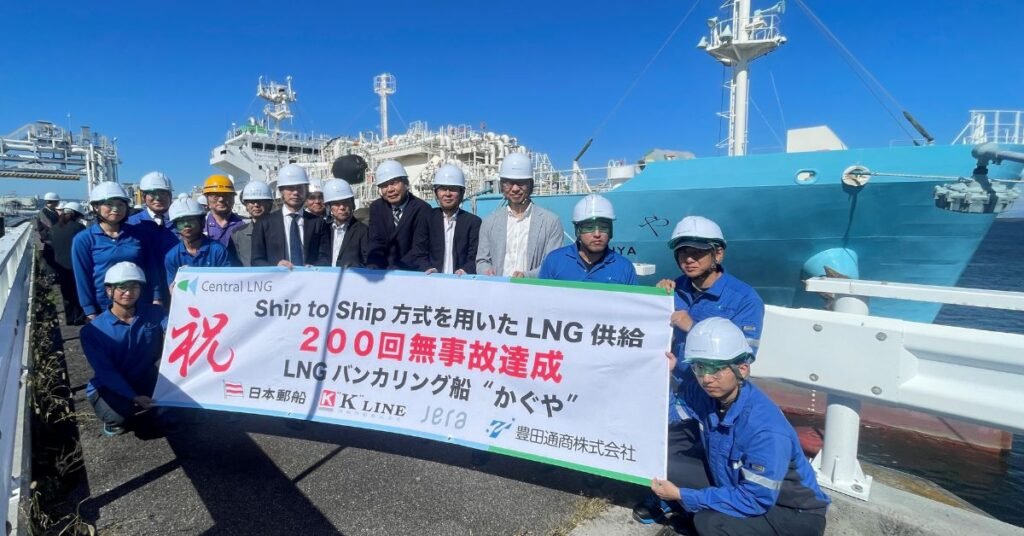
Japan’s LNG bunkering vessel Kaguya has completed its 200th ship-to-ship fuel delivery, maintaining an accident-free record since starting service in October 2020. The milestone operation at Mikawa Port supplied NYK’s car carrier Sweet Pea Leader, marking another step in the development of marine LNG supply infrastructure in Japan’s Chubu region.
Milestone delivery at Mikawa Port
Kaguya LNG bunkering operations reached their 200th delivery on September 30, 2026, when the vessel supplied liquefied natural gas to Sweet Pea Leader at Mikawa Port. JERA and JERA Global Energy Solutions announced the achievement on October 8, highlighting six years of operations without an accident.
Sweet Pea Leader is operated by Nippon Yusen Kabushiki Kaisha, better known as NYK Line. The delivery adds to Kaguya’s operating record as Japan’s first LNG bunkering vessel, supporting ships that use LNG as an alternative to conventional marine fuels.
Kaguya is owned by Central LNG Shipping and operated by Central LNG Marine Fuel. JERA Global Energy Solutions holds investments in both joint ventures and intends to continue strengthening LNG bunkering services and fuel supply reliability across the Chubu region.
Joint venture connects energy and shipping
The regional bunkering business brings together companies across the energy, shipping and trading sectors. Its partners include Toyota Tsusho, NYK, Kawasaki Kisen Kaisha, known as “K” Line, and JERA Global Energy Solutions.
Kaguya operates from JERA’s Kawagoe Thermal Power Station in Mie Prefecture. This arrangement connects an established LNG receiving location with a vessel capable of distributing the fuel to ships at regional ports.
Under the ship-to-ship method, the bunkering vessel positions alongside a receiving ship and transfers LNG into its fuel tanks. Deliveries can take place while the customer vessel is alongside a quay or pier, or at anchor.
The approach enables fuel distribution beyond the loading base, giving LNG-powered ships access to supplies at suitable locations within the service area. Kaguya has used this method throughout its work in the Chubu region.
Infrastructure developed before the first delivery
The latest milestone builds on a project launched several years before commercial operations began. JERA and its partners established the Central LNG venture in May 2018 to prepare the regional bunkering business.
Modifications to existing facilities at Kawagoe Thermal Power Station began in July that year. These changes enabled the station to load LNG onto Kaguya, creating the shore-to-vessel connection needed for subsequent marine fuel deliveries.
Kaguya performed Japan’s first ship-to-ship LNG bunkering operation on October 20, 2020. The receiving vessel was NYK’s Sakura Leader, then under construction at Shin Kurushima Toyohashi Shipbuilding.
For that initial delivery, Kaguya loaded LNG at Kawagoe on October 16–17. The sequence established the supply chain linking JERA’s energy infrastructure, the dedicated bunkering vessel and an LNG-powered car carrier. That same regional operating model underpins the service’s continuing development.
Second hundred deliveries completed in under two years
Kaguya reached its earlier 100-delivery milestone on November 5, 2024, when it refuelled Sakura Leader at Mikawa Port in Aichi Prefecture.
The progression from that operation to the 200th delivery in September 2026 means the vessel completed its second hundred transfers in less than two years. This compares with approximately four years between the start of service and its first hundred deliveries.
The figures show a faster accumulation of completed operations, although delivery counts alone do not establish changes in total LNG volumes or average quantities supplied.
Built at Kawasaki Heavy Industries’ Sakaide Works, Kaguya has an LNG cargo capacity of 3,500 cubic metres. The vessel measures 81.7 metres in length and 18 metres in breadth, with gross tonnage of 4,044.
Its operating history illustrates how dedicated bunkering vessels can support the development of alternative-fuel supply chains alongside shipping companies’ investments in LNG-powered tonnage.
Environmental assessment extends beyond exhaust emissions
LNG offers reductions in several exhaust pollutants compared with heavy fuel oil. However, its overall climate performance requires assessment across the complete fuel supply chain.
The International Maritime Organization’s lifecycle methodology considers emissions from fuel production and transport through to consumption aboard a ship. It covers carbon dioxide, methane and nitrous oxide.
This broader framework matters when evaluating LNG because lower carbon dioxide emissions during combustion are only one component of its greenhouse gas footprint. For shipowners and fuel suppliers, the practical challenge is therefore to combine dependable bunkering infrastructure with careful management of emissions across production, delivery and vessel operation.
FAQs
1. When did Kaguya complete its 200th LNG delivery?
On September 30, 2026, supplying NYK’s Sweet Pea Leader at Mikawa Port.
2. When did Kaguya begin bunkering operations?
It began service in October 2020 and performed Japan’s first ship-to-ship LNG bunkering operation on October 20 that year.
3. Where is Kaguya based?
The vessel operates from JERA’s Kawagoe Thermal Power Station in Mie Prefecture.
4. What is Kaguya’s LNG capacity?
Its LNG cargo tanks have a capacity of 3,500 cubic metres.
5. What does ship-to-ship LNG bunkering mean?
A bunkering vessel comes alongside another ship and transfers LNG into its fuel tanks, either at a berth or at anchor.
Recent Posts
Hydrogen
Hydrogen-electric bulk carriers drive PowerCell’s repeat order
EV
Tanjung Pelepas Puts Full Fleet of 52 Electric Prime Movers into Service
Battery Tech
Global Fleet of Battery-Powered Vessels Crosses 2,000 as Installations Scale Up