
Summary
Galveston’s port board has approved a lease and development agreement with Power LNG for a production, storage and marine bunkering facility on Pelican Island. Initial output is planned at 400,000 gallons daily, with potential expansion to twice that capacity. Commercial production is targeted for late 2028, subject to approvals and financing.
Agreement establishes development framework
The Pelican Island LNG facility has moved forward following the Galveston Wharves Board of Trustees’ approval of a lease and development agreement with Power LNG LLC on 8 October 2026.
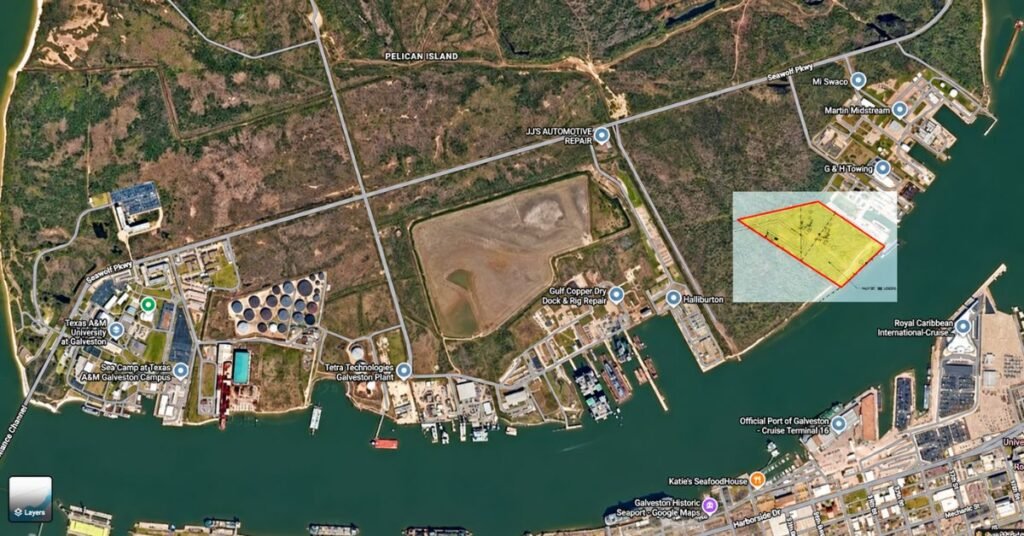
The proposed development will occupy 30 acres on the eastern side of an approximately 82-acre port-owned property fronting deep-water Galveston Harbor. It combines liquefied natural gas production, storage and bunkering infrastructure intended to serve marine customers.
Power LNG plans two parallel liquefaction trains, each producing approximately 200,000 gallons daily. Their combined initial output would reach 400,000 gallons a day, with modular expansion potentially increasing production to 800,000 gallons daily.
The proposed infrastructure also includes an underground natural gas feedstock pipeline, a three-million-gallon LNG storage tank and a shore-to-ship pier capable of supplying ships and bunker vessels.
Commercial production targeted for late 2028
The project is expected to begin commercial production in the fourth quarter of 2028. That timetable depends on completing required approvals and agreements, rather than representing an unconditional commissioning commitment.
The port agreement addresses government permits, project financing, rent and other charges, together with the commercial and operating arrangements necessary to advance development.
Port director and chief executive Rodger Rees said the investment would diversify Galveston’s operations and position it to serve increasing demand from LNG-powered vessels. Power LNG chief executive Austin Terry described the proposal as an integrated fuel-supply development encompassing liquefaction, storage, bunkering and vessel loading.
Lease approval is therefore a development milestone. It does not mean the plant is already operating or that all regulatory and financial requirements have been completed.
Bunkering could serve neighbouring ship channels
Power LNG’s partners and customers are expected to arrange bunkering through appropriately qualified vessels operating under US Coast Guard requirements and applicable Jones Act provisions.
The intended service area extends beyond Galveston. Bunker vessels could supply ships in the Galveston, Houston and Texas City ship channels, giving the project a regional marine-fuel role.
Further arrangements remain under discussion. These include LNG or ISO tank-container loading at a future port-owned dock adjoining the leased property. Potential activities at other locations include container loading and exports at portions of Pier 34, and truck-to-ship fuelling or early bunkering operations at portions of Pier 39. These are prospective developments requiring additional arrangements.
Cruise expansion provides commercial context
Galveston already operates four cruise terminals and identifies itself as the fourth-ranked cruise homeport in the United States. Its wider business includes cargo handling, commercial leasing and marine activities, providing several potential customer segments for fuel infrastructure.
The port is also pursuing further cruise-terminal expansion. On 22 September, its board unanimously supported continuing negotiations for a fifth terminal at Pier 14.
Those discussions involve Royal Caribbean Group and had been underway for approximately two years. The proposal remained at the negotiation stage in the port’s 2 October update, with financial, property and legal matters still requiring agreement.
The terminal discussions and LNG lease concern separate projects. Together, however, they illustrate Galveston’s efforts to expand both passenger infrastructure and the services supporting maritime operations.
Earlier deployment announcements also point to continued cruise activity. Carnival’s planned 2027–28 Galveston lineup includes Carnival Horizon and Carnival Spirit joining Carnival Breeze and Carnival Jubilee. These vessel commitments provide background to the port’s wider growth plans, without establishing dedicated fuel-purchase commitments for the proposed LNG plant.
Environmental performance depends on operating technology
LNG can substantially reduce sulphur oxide and particulate emissions compared with conventional marine fuel oil. Nitrogen oxide reductions vary with engine technology, while greenhouse-gas performance requires consideration of both carbon dioxide and methane.
Methane slip—the release of unburned methane from engines—can reduce LNG’s climate advantage. Its extent differs between engine designs, making vessel technology and operating performance important to assessing emissions outcomes.
The proposed facility’s immediate commercial purpose is to improve access to marine LNG. Its eventual environmental contribution will depend on the vessels supplied, the fuel’s production and delivery chain, and methane management throughout those operations.
FAQs
Who will develop the facility?
Power LNG LLC plans to develop it under an agreement with Galveston Wharves.
What production capacity is planned?
Initial capacity is approximately 400,000 gallons daily, potentially expanding to 800,000 gallons.
When could production begin?
The target is the fourth quarter of 2028, subject to required approvals, financing and agreements.
Will it serve only Galveston?
No. Planned bunkering could also serve vessels in the Houston and Texas City ship channels.
Recent Posts
Hydrogen
Hydrogen-electric bulk carriers drive PowerCell’s repeat order
EV
Tanjung Pelepas Puts Full Fleet of 52 Electric Prime Movers into Service
Battery Tech
Global Fleet of Battery-Powered Vessels Crosses 2,000 as Installations Scale Up