
Summary
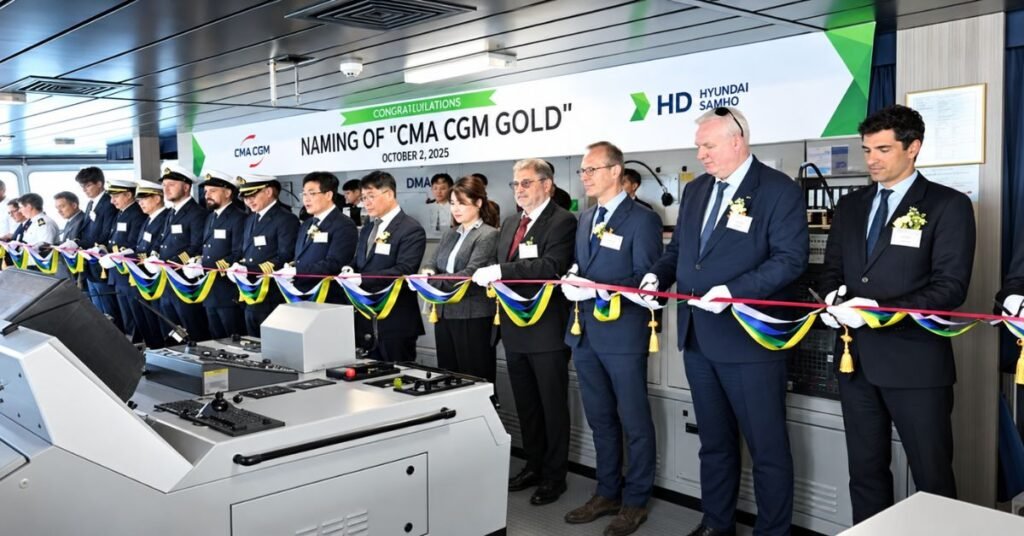
CMA CGM has taken delivery of CMA CGM Gold, a methanol-capable containership joining its 13,000-TEU newbuilding programme. The vessel will serve the Asia–Central and West Coast South America trade. Its arrival advances the carrier’s investment in fuel-flexible ships, alongside efforts to secure renewable methanol supplies and expand bunkering capability.
New vessel strengthens fuel-flexible capacity
The CMA CGM methanol fleet has expanded with the delivery of CMA CGM Gold, a dual-fuel containership capable of operating on methanol and conventional marine fuels. The vessel joins a planned series of 12 ships in the approximately 13,000-TEU capacity class.
Its deployment on the Asia–Central and West Coast South America trade adds methanol-capable capacity to a long-distance container corridor. The propulsion arrangement provides fuel flexibility, allowing operation on conventional fuels when suitable methanol supplies are unavailable.
Delivery of a methanol-capable vessel does not, by itself, establish that it will operate continuously on renewable methanol. Actual emissions performance will depend on the fuel used and its production pathway.
Gold joins an established vessel programme
The 12-ship programme began with CMA CGM Iron, whose maiden call in Singapore was announced in March 2025. The series is being built by South Korea’s Hyundai Samho Heavy Industries, with deliveries originally scheduled across 2025 and 2026.
The programme forms part of the group’s investment in alternative-fuel vessels and its stated ambition to achieve net-zero carbon emissions by 2050. Gold represents a further delivery within that existing strategy rather than the launch of a separate shipbuilding initiative.
CMA CGM’s published ACSA1 service information lists Gold with a nominal capacity of 13,128 TEUs, 2,100 refrigerated-container connections and a deadweight of 147,196 tonnes. The vessel is listed as Malta-flagged and built in 2026.
The weekly service connects Asian ports with gateways in Mexico, Colombia, Chile, Peru and Ecuador. Its published rotation includes Busan, Tianjin Xingang, Qingdao, Ningbo and Shanghai, alongside Manzanillo, Lázaro Cárdenas, Buenaventura, San Antonio, Chancay, Callao and Posorja.
Fleet investment includes newbuilds and conversions
The carrier’s stated methanol programme combines the 12 vessels in the 13,000-TEU series with six 15,000-TEU newbuildings and six existing 9,300-TEU ships planned for methanol dual-fuel conversion.
Together, these projects represent a planned fleet of 24 methanol-capable vessels. The combination of new construction and retrofits extends the fuel transition beyond newly ordered ships, although planned conversions should be distinguished from vessels already delivered or upgraded.
Supply agreement supports renewable fuel availability
Ship investment has been accompanied by fuel-supply partnerships. In March 2025, CMA CGM signed a long-term green methanol cooperation agreement with SIPG Energy and Shanghai Electric Group.
Under the arrangement, Shanghai Electric would provide medium- and long-term green methanol supplies. The partners also envisaged coordinated land and sea logistics linking the production base at Taonan with Shanghai’s Yangshan Port.
The agreement addresses a central requirement of alternative-fuel shipping: matching vessel capability with dependable production, transport, storage and delivery arrangements. These earlier supply-chain commitments provide background to the latest vessel delivery.
Shanghai bunkering demonstrates larger-scale supply
In August 2026, the partners completed an 8,016-tonne biomethanol bunkering operation for CMA CGM Osmium at Shanghai Port. The fuel was supplied by SIPG Energy’s bunkering vessel Hai Gang Zhi Yuan.
Much of the biomethanol originated from Shanghai Electric’s Taonan project in Jilin province. It moved to Dalian for consolidation, storage and onward shipment to Shanghai.
The operation exceeded the 3,643 tonnes supplied to the same vessel earlier in 2026. It demonstrated a larger integrated delivery chain supporting methanol-powered container operations, rather than simply adding another fuel-capable ship.
CMA CGM’s August announcement also outlined a broader ambition to deploy 200 ships capable of using low-carbon fuels by 2031, spanning multiple fuel technologies.
Fuel economics remain central to adoption
Methanol engines and associated ship systems have reached high technical readiness, but renewable fuel cost and availability remain significant constraints. Fossil-derived methanol and renewable methanol have different lifecycle emissions profiles.
The commercial significance of Gold therefore lies in adding another fuel-flexible asset while the supporting supply chain develops. Sustained emissions reductions require both suitable vessels and access to verified low-greenhouse-gas fuel, making procurement and bunkering infrastructure as important as the delivery programme itself.
FAQs
What is CMA CGM Gold?
It is a methanol-capable dual-fuel containership in CMA CGM’s approximately 13,000-TEU newbuilding series.
Where will the vessel operate?
It will serve the Asia–Central and West Coast South America trade.
Can it use conventional marine fuel?
Yes. Its dual-fuel engine can operate on methanol and conventional fuels.
Does methanol capability guarantee lower carbon emissions?
No. Lifecycle emissions depend on the methanol production pathway and the fuel actually consumed. Renewable methanol can offer substantial reductions compared with fossil-derived fuel.
Recent Posts
Hydrogen
Hydrogen-electric bulk carriers drive PowerCell’s repeat order
EV
Tanjung Pelepas Puts Full Fleet of 52 Electric Prime Movers into Service
Battery Tech
Global Fleet of Battery-Powered Vessels Crosses 2,000 as Installations Scale Up