
Summary
Malaysia’s Port of Tanjung Pelepas has completed the deployment of 52 electric prime movers, moving terminal electrification from pilot to full-scale operation. The locally built fleet, which runs around the clock, follows the first 21 units commissioned in August and supports the port’s target of cutting carbon emissions by 45% by 2030.
Article
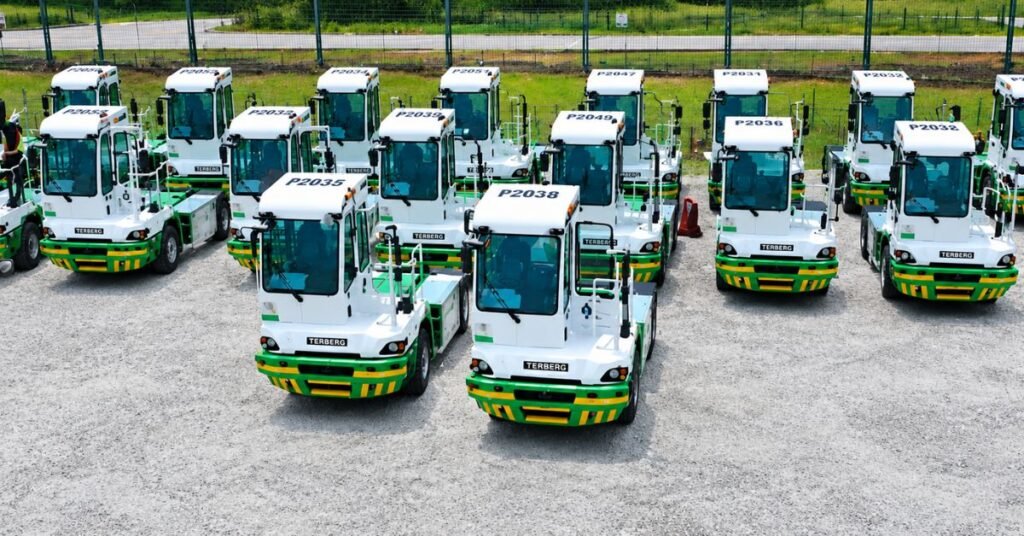
Johor: The Port of Tanjung Pelepas (PTP) has completed the rollout of its 52 electric prime movers (e-PMs), the first such fleet at any Malaysian port, as it steps up efforts to decarbonise container handling while improving yard efficiency.
Malaysia’s Transport Minister Anthony Loke said the fully deployed fleet, which operates 24 hours a day, marks a move away from trial projects towards complete electrification of terminal haulage. “That is the difference between a demonstration and a transition,” he said, as reported by Business Today Malaysia.
How was the fleet rolled out?
PTP signed an agreement with Terberg Tractors Malaysia (TTM) in December 2025 for 52 electric units, part of a larger order of 94 prime movers, with the rest powered by conventional fuel. TTM will also provide maintenance for 24 months.
The first 21 e-PMs entered service on August 11, 2026, to handle horizontal container movement within the terminal. The remaining 31 units were delivered in batches through the end of September. The vehicles are manufactured locally by TTM in Pasir Gudang, Johor.
What are the emissions benefits?
PTP tested the technology through a proof of concept in 2023 and 2024. The trial showed that each electric unit generates about 4,000 kg of CO2 equivalent a month, compared with around 7,600 kg for a conventional prime mover, a reduction of nearly half.
The fleet supports PTP’s goal of reducing carbon emissions by 45% by 2030 against a 2021 baseline. The port has been electrifying its rubber-tyred gantry crane fleet since 2011 and now operates 245 electric RTGs.
Loke said PTP is pairing electrification with artificial intelligence and Internet of Things tools to optimise berth allocation, improve vehicle routing and reduce idling.
What did Loke say about Malaysia’s maritime policy?
Loke noted that 96% of Malaysia’s trade moves by sea, making decarbonisation increasingly important to the country’s competitiveness as a trading hub.
He said the government is advancing a Green Bunkering Regulatory Roadmap developed with Australia, and preparing the Malaysia Maritime Masterplan 2026-2040, which will focus on decarbonisation, digitalisation and national fleet development. A committee reviewing federal port and maritime law aims to finish its work by the end of 2026.
How large is PTP’s operation?
PTP is a joint venture between Malaysia’s MMC Group and APM Terminals, the Netherlands-based terminal arm of the Maersk group. It closed 2025 with a record 14,028,375 TEUs, becoming the first single container terminal in Malaysia to cross 14 million TEUs. Volumes have risen from 11.2 million TEUs in 2021 and 12.3 million TEUs in 2024.
The port serves as a key Asian hub for the Gemini Cooperation between Maersk and Hapag-Lloyd. Alphaliner named PTP the world’s fastest-growing port this year, with growth of 14.5%. Its expansion programme aims to lift annual handling capacity to 16.3 million TEUs by 2029, with the e-PM fleet forming part of that plan.
Why does it matter for the port industry?
Terminal tractors are among the most fuel-intensive pieces of equipment in a container yard, running continuously between quay and stack. A full-scale, 24-hour electric fleet at a transshipment hub handling more than 14 million TEUs a year provides a real-world benchmark for other operators in Asia weighing the cost, charging and reliability trade-offs of electrifying horizontal transport.
For Malaysia, the deployment also highlights local manufacturing capability in port equipment, alongside the government’s broader push on green fuels and maritime regulation.
FAQs
How many electric prime movers does PTP operate?
PTP has deployed 52 electric prime movers, making it the first Malaysian port to run such a fleet.
Who supplied the electric prime movers?
The units were supplied and locally manufactured by Terberg Tractors Malaysia in Pasir Gudang, Johor, which will also maintain them for 24 months.
How much do the e-PMs reduce emissions?
PTP’s proof of concept found each electric unit produces about 4,000 kg CO2e a month, against roughly 7,600 kg for a conventional prime mover.
What is PTP’s emissions target?
The port aims to cut carbon emissions by 45% by 2030, measured against a 2021 baseline.
How much cargo does PTP handle?
PTP handled a record 14,028,375 TEUs in 2025 and plans to raise annual capacity to 16.3 million TEUs by 2029.
Recent Posts
Hydrogen
Hydrogen-electric bulk carriers drive PowerCell’s repeat order
EV
Tanjung Pelepas Puts Full Fleet of 52 Electric Prime Movers into Service
Battery Tech
Global Fleet of Battery-Powered Vessels Crosses 2,000 as Installations Scale Up