
Summary
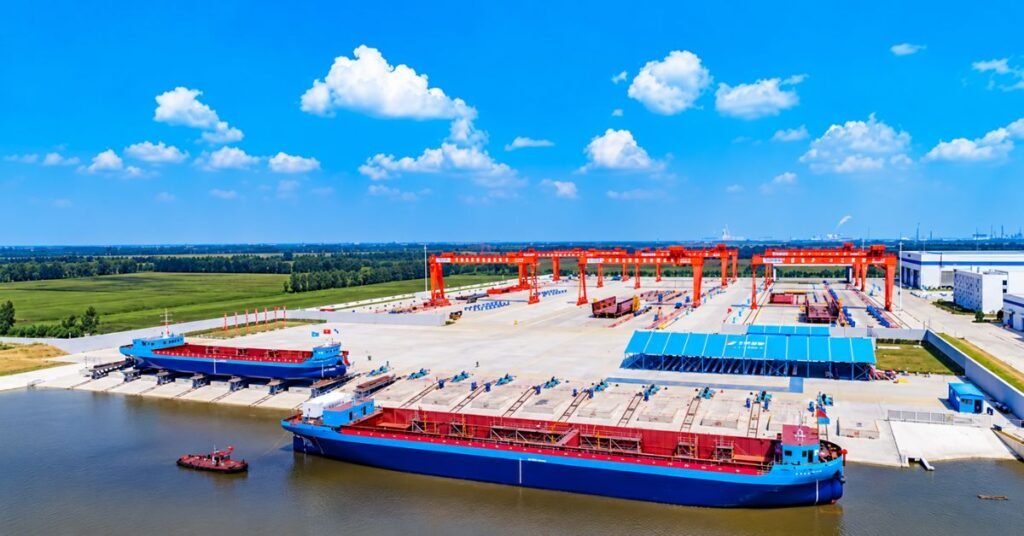
China’s Ministry of Transport, Ministry of Industry and Information Technology and National Energy Administration have issued a 2026-2030 action plan to scale up new energy vessels on inland waterways. It aims to double the fleet from 2025 levels by 2028, build methanol refuelling along the Yangtze and charging networks in the Yangtze River Delta, and create a 3,000 km zero-carbon waterway corridor.
Article
Beijing: China has issued a five-year roadmap to accelerate the adoption of new energy vessels on its inland waterways, with a focus on electric and methanol-powered ships.
The Ministry of Transport, the Ministry of Industry and Information Technology and the National Energy Administration jointly released the Action Plan for the Promotion and Application of New Energy Inland Waterway Vessels (2026-2030), according to China Transportation News Network.
What does the plan aim to do?
The plan seeks to support the restructuring of China’s industrial, energy and transport sectors. It combines a market-led approach with government guidance, and focuses on scenario-driven deployment and innovation.
Building on the existing growth of LNG-powered vessels, the plan prioritises the full-scenario application, supply chain support and high-standard development of electric and methanol-powered inland ships.
How big is China’s new energy inland fleet?
China ranks among the world leaders in the scale and application of new energy inland vessels. By the end of 2025, it had more than 1,200 new energy and clean energy vessels operating on inland waterways, including several high-tech vessels.
What are the targets?
The plan sets phased goals:
By 2028
- Double the number of new energy inland vessels compared with 2025
- Achieve initial full-scenario demonstration applications
- Fully establish methanol refuelling services along the Yangtze River main line
- Largely complete charging and battery-swapping facilities for vessels across the Yangtze River Delta waterway network
- Largely complete the “two horizontal and one vertical” green shipping channels and pilot zones for vessel electrification, forming a 3,000 km zero-carbon waterway transport corridor
By 2030
- Achieve initial large-scale application of new energy vessels
What are the key tasks?
The plan sets out 11 key tasks, including:
- Promoting multi-scenario use of new energy ships
- Improving energy supply security
- Encouraging innovative business models
- Strengthening shipbuilding and manufacturing support
- Optimising operation and management
- Improving standards, regulations and supervision
- Strengthening research on key technologies
It also calls for stronger policy support, pilot projects and organisational implementation.
How does it fit China’s wider fuel transition?
The plan complements China’s rapid build-out of alternative fuel bunkering at its coastal ports. Guangzhou Port recently completed its first terminal-based green methanol bunkering for a COSCO 16,000-TEU container ship, while Ningbo-Zhoushan has carried out LNG, methanol and biofuel bunkering on the same day.
Why does it matter?
China’s inland waterways, led by the Yangtze, form the world’s busiest river freight system. Electrifying and converting this fleet to methanol at scale would cut emissions from a major source of domestic freight, while building large markets for marine batteries, charging infrastructure, methanol engines and green fuel supply.
The plan is also relevant for India, which is expanding cargo movement on its National Waterways and has started deploying clean-energy vessels, including a hydrogen fuel cell inland waterway vessel built by Cochin Shipyard under the Harit Nauka initiative. China’s approach, which pairs fleet targets with refuelling, charging and standards, offers a model for scaling green inland shipping.
FAQs
Who issued China’s new energy inland vessel action plan?
The Ministry of Transport, the Ministry of Industry and Information Technology and the National Energy Administration.
How many new energy inland vessels did China have by end-2025?
More than 1,200 new energy and clean energy vessels.
What is the 2028 target?
To double the number of new energy inland vessels compared with 2025 and form a 3,000 km zero-carbon waterway corridor.
Which fuels does the plan prioritise?
Electric and methanol power, building on existing LNG-powered vessels.
How many key tasks does the plan include?
Eleven, covering vessel deployment, energy supply, business models, manufacturing, operations, standards, supervision and technology research.
Recent Posts
Marine
Singapore Unveils Ammonia Bunkering Standard, First Ethanol Bunkering and LNG Storage Plans
Ammonia
Singapore Launches TR 148 Ammonia Bunkering Standard and Model Contract to Prepare for Ammonia-Fuelled Ships
Policy
China Targets Doubling New Energy Inland Vessels by 2028 Under 2026-2030 Action Plan