
Summary
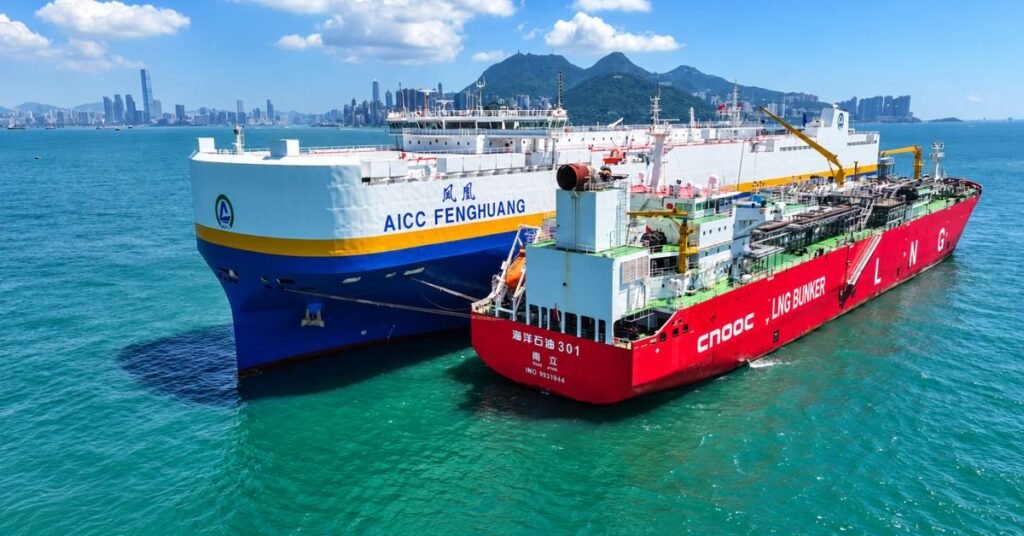
CLPe and CNOOC (Shenzhen) International Marine Clean Energy have completed Hong Kong’s first ship-to-ship LNG bunkering for a pure car and truck carrier. About 2,600 m³ of LNG was delivered to the 7,000-vehicle AICC Fenghuang at Western Anchorage No. 3 in around six hours, using CNOOC’s Haiyang Shiyou 301 before the ship sailed for the Mediterranean.
Article
Hong Kong: CLPe and CNOOC (Shenzhen) International Marine Clean Energy Co., Ltd have completed Hong Kong’s first ship-to-ship LNG bunkering operation for a pure car and truck carrier (PCTC).
The operation took place on September 26, 2026, and was announced on October 14.
What were the operation details?
The bunkering was carried out at Western Anchorage No. 3, west of Victoria Harbour. CNOOC’s Haiyang Shiyou 301, described as the world’s largest LNG bunkering and transport vessel, delivered about 2,600 m³ of LNG to the AICC Fenghuang in around six hours. That works out to an average transfer rate of roughly 430 m³ per hour (calculated from the reported figures).
What is the AICC Fenghuang?
The LNG dual-fuel PCTC is about 200 m long and 38 m wide, with 12 decks and capacity for 7,000 standard vehicles. It is owned by Anhui Port and Shipping Group, based in Anhui, the Chinese Mainland’s leading automotive manufacturing province.
Immediately after bunkering, the vessel departed for the Mediterranean carrying vehicles exported from the Mainland.
Why was the operation challenging?
As a large, high-sided vessel with significant windage, the PCTC presented greater challenges in berthing, stability control, coordination and safety management during bunkering.
Because the two large vessels had to remain steadily alongside while maintaining a safe separation, the project team carried out detailed planning covering anchorage selection, weather and sea conditions, vessel positioning, berthing procedures and emergency arrangements.
What did CLPe say?
Ringo Ng, Managing Director of CLPe, said close collaboration and detailed planning allowed the two companies to complete the operation, demonstrating their capability in “serving a diverse range of oceangoing vessels.” He said CLPe would continue to promote green marine fuels and support the green transformation of Hong Kong’s maritime industry.
Why does it matter?
The operation shows Hong Kong can bunker more challenging vessel types with LNG, strengthening its ambition to become a green marine fuel bunkering centre and supporting its position as an international maritime hub.
It also reflects the growth of China’s vehicle export trade, which has driven a wave of new PCTC orders, many of them LNG dual-fuel. Ports along car carrier routes are competing to offer LNG supply, with Singapore expanding its LNG bunkering licences and nearby Ningbo-Zhoushan recently completing LNG, methanol and biofuel bunkering on the same day.
For Indian ports handling growing automobile exports, the operation highlights the need for alternative fuel bunkering to serve the next generation of car carriers.
FAQs
What did CLPe and CNOOC achieve?
They completed Hong Kong’s first ship-to-ship LNG bunkering for a pure car and truck carrier.
Which vessel was bunkered?
The AICC Fenghuang, an LNG dual-fuel PCTC with capacity for 7,000 vehicles, owned by Anhui Port and Shipping Group.
How much LNG was delivered?
About 2,600 m³, delivered in around six hours.
Which bunker vessel was used?
CNOOC’s Haiyang Shiyou 301, described as the world’s largest LNG bunkering and transport vessel.
Where did the operation take place?
At Western Anchorage No. 3, west of Victoria Harbour, on September 26, 2026.
Recent Posts
HYBRID
GRSE Signs ₹1,032-Crore ONGC Contract for Four Hybrid Offshore Supply Vessels
EV
Energy In Motion Opens ₹500-Crore Electric Truck Plant in Pune
Fuels
Aegis Logistics Commissions 35,000-Tonne LPG Bottling Plant at JNPA