
Summary
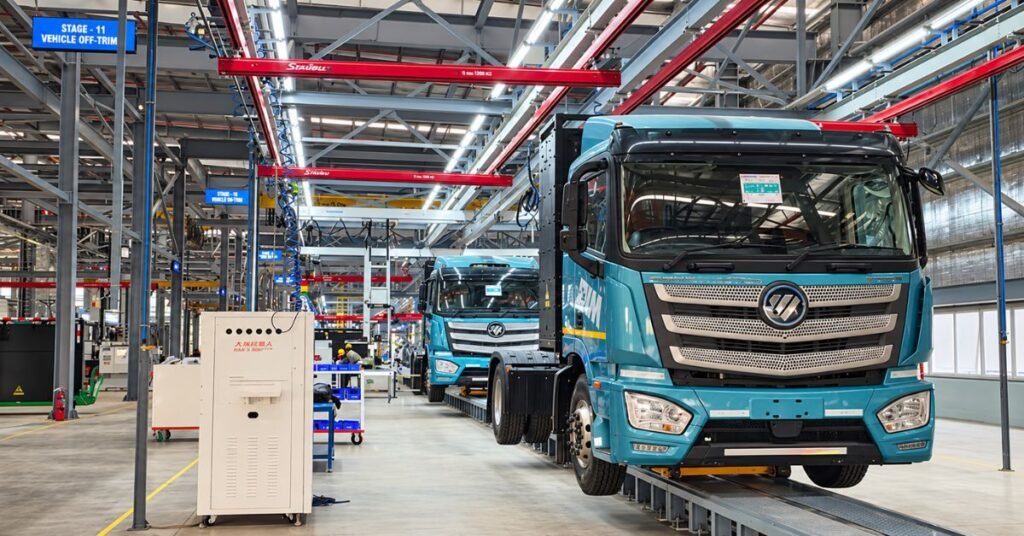
Energy In Motion (EIM) has inaugurated a ₹500-crore electric heavy commercial vehicle manufacturing complex at Ambi in Talegaon, Pune, Maharashtra. The facility integrates vehicle assembly, lithium-ion battery-pack production and battery testing, with an initial annual assembly capacity of 5,000 vehicles per shift. The project marks the first phase of a planned ₹1,000-crore investment in Maharashtra, as the company develops battery-swapping and charging infrastructure for freight operations.
Article
EIM Opens Electric Heavy Commercial Vehicle Plant in Talegaon
Energy In Motion inaugurated its new electric heavy commercial vehicle manufacturing complex at Ambi in Talegaon, near Pune, on October 14, 2026. Maharashtra Chief Minister Devendra Fadnavis inaugurated the facility, which represents the first phase of the company’s planned ₹1,000-crore investment in the state.
According to EIM, the plant has an initial assembly capacity of 5,000 vehicles per shift annually and is expected to generate more than 2,000 direct and indirect jobs across engineering, research, information technology and related functions.
The complex combines electric truck assembly, lithium-ion battery-pack production and an independent battery-testing laboratory. Actual production volumes will depend on customer orders and the pace at which manufacturing operations are scaled up.
Company Plans Electric Tipper and Rigid-Body Truck
EIM plans to introduce two additional heavy commercial vehicle models over the next 15 months, Managing Director Narendra Murkumbi said at the inauguration.
The planned models include a heavy electric tipper for mining and road construction applications and a rigid-body electric truck aimed at freight transportation. The additions would expand the company’s portfolio beyond its existing Ashwa electric tractor, which is intended for applications such as container movement and port logistics.
The proposed expansion targets different segments of the commercial vehicle market, where operating requirements vary according to payload, route length, terrain and vehicle utilisation. Mining and construction operations, for example, have different energy and duty-cycle requirements from scheduled freight movements between ports, warehouses and industrial centres.
Battery-Pack Production Capacity Set at 2.4 GWh
The battery-pack assembly unit at the new complex has a stated annual capacity of 2.4 GWh, equivalent to approximately 6,000 battery boxes, according to the company.
EIM is also working towards higher-capacity battery packs through its partnership with Contemporary Amperex Technology Co. Limited (CATL). In July 2026, the company signed an agreement covering 500 MWh of lithium iron phosphate (LFP) cells and battery-pack kits.
The arrangement supports EIM’s plans to assemble battery packs locally while continuing to source cells and kits from CATL. Domestic pack assembly and domestic cell manufacturing are distinct stages of the battery supply chain, making the sourcing arrangement relevant when evaluating the extent of localisation.
The battery-testing laboratory is intended to validate battery systems under demanding operating conditions. For heavy commercial vehicles, testing can help assess performance under repeated charging cycles, vibration, elevated temperatures and intensive daily utilisation.
Battery Swapping and Charging Infrastructure to Support Fleet Operations
EIM is developing a network of charging and battery-swapping facilities along highways and near ports and industrial centres to support the deployment of its electric heavy commercial vehicles.
The company says its robotic battery-swapping systems can replace batteries in compatible vehicles in less than seven minutes. It is also planning fast-charging infrastructure for vehicles equipped with CCS-2 connectors.
Its technology partnerships include BAIC Foton Motor for heavy vehicles, CATL for batteries and Shanghai Enneagon Energy Technology for robotic battery swapping.
The strategy combines battery swapping with conventional charging to provide fleet operators with different energy replenishment options. The operational value of these systems will depend on station availability, vehicle compatibility, battery capacity and the reliability of infrastructure along freight routes.
The company is still developing its network. The inauguration of the manufacturing complex does not, by itself, confirm that all planned charging and swapping corridors are operational.
Proposed 500-Truck Deployment Covers Three Freight Corridors
EIM’s manufacturing expansion follows a previously announced deployment plan involving Oil Field Warehouse & Services and Radiance Green Mobility.
In September 2026, the companies signed a memorandum of understanding covering a proposed deployment of 500 electric heavy commercial vehicles. The identified corridors were Mumbai–Pune, Mundra–Morbi–Ahmedabad and Mumbai–Delhi.
The plan envisaged an initial deployment of 50 vehicles on the Mumbai–Pune route in October, followed by expansion to other corridors as the required battery-swapping infrastructure became available.
Under the proposed arrangement, EIM would supply vehicles and energy infrastructure, while its partners would support fleet deployment and operations.
The 500-vehicle figure represents the scale envisaged under the agreement, rather than confirmation that the entire fleet has entered commercial service. Progress will depend on vehicle deliveries, infrastructure readiness and the implementation of the proposed deployment schedule.
Fleet Economics and Infrastructure Readiness Will Shape Adoption
The new manufacturing facility gives EIM a production base for electric heavy commercial vehicles and their associated battery systems. For port operators, logistics companies and freight fleet owners, the availability of suitable vehicles is only one factor in determining whether electrification is commercially viable.
Operating economics will also depend on payload capacity, daily kilometres travelled, electricity prices, maintenance costs, battery performance and vehicle downtime. Battery swapping could reduce the time required to replenish energy, particularly for vehicles operating on demanding schedules, but its benefits will depend on the availability and utilisation of swapping stations.
The next indicators to watch include production and customer deliveries, the commissioning of charging and swapping facilities along the proposed corridors, and operating data from deployed fleets.
These developments will help establish whether EIM can translate its manufacturing capacity and infrastructure plans into reliable, commercially viable electric freight operations.
FAQs
Where is Energy In Motion’s new electric truck plant located?
The manufacturing complex is located at Ambi in Talegaon, near Pune, Maharashtra.
How much has Energy In Motion invested in the facility?
EIM has invested ₹500 crore in the complex, representing the first phase of a planned ₹1,000-crore investment in Maharashtra.
What is the plant’s annual vehicle assembly capacity?
The company states that the plant has an initial assembly capacity of 5,000 vehicles per shift annually.
Which electric truck models does EIM plan to introduce?
The company plans to introduce a heavy electric tipper for mining and road construction and a rigid-body truck for freight transportation within the next 15 months.
What is the battery-pack assembly capacity?
The battery-pack assembly unit has a stated annual capacity of 2.4 GWh, equivalent to approximately 6,000 battery boxes.
Which freight corridors are included in EIM’s proposed 500-vehicle deployment?
The proposed deployment covers Mumbai–Pune, Mundra–Morbi–Ahmedabad and Mumbai–Delhi.
Is EIM’s battery-swapping network fully operational?
No. The company is developing charging and battery-swapping infrastructure along selected highways and near ports and industrial locations. The proposed network’s operational coverage will depend on the completion of individual facilities.
Recent Posts
HYBRID
GRSE Signs ₹1,032-Crore ONGC Contract for Four Hybrid Offshore Supply Vessels
EV
Energy In Motion Opens ₹500-Crore Electric Truck Plant in Pune
Fuels
Aegis Logistics Commissions 35,000-Tonne LPG Bottling Plant at JNPA