
Summary
Maersk Tankers’ RIPPLE project has been selected for potential EU Innovation Fund support to retrofit four very large ammonia carriers with ammonia-capable engines. The proposed conversions could avoid more than 1.2 million tonnes of CO₂-equivalent emissions over ten years, but proceeding remains conditional on customer commitments.
Four-vessel conversion programme proposed
The Maersk Tankers ammonia retrofit initiative would equip four very large ammonia carriers, or VLACs, with two-stroke dual-fuel engines capable of operating on ammonia.
Selection for the Innovation Fund moves RIPPLE into grant-agreement preparation. It provides a potential source of financial support while leaving the project’s final funding terms and implementation commitments to be settled.
The distinction is commercially important: selection does not establish that conversion work has been contracted or that the vessels have begun operating on ammonia.
Maersk Tankers has made customer support a condition for proceeding. That places charterers and other commercial counterparties alongside technology providers and funding institutions in determining whether the programme advances.
Grant terms remain to be finalised
The European Commission selected 77 projects for approximately €3.4 billion in support under its latest Innovation Fund round on 19 October 2026.
Selected promoters have been invited to prepare grant agreements with the European Climate, Infrastructure and Environment Executive Agency, CINEA. That process will determine funding amounts, budgets, schedules, deliverables and legal responsibilities.
Results of the agreement process are expected in the first quarter of 2027. The overall funding envelope covers the selected portfolio; it is not the amount allocated to RIPPLE. A project-specific grant value has not been disclosed in the available announcement.
Customer commitments underpin the investment decision
The company’s condition highlights a central challenge in alternative-fuel shipping: technical capability and public support must be matched by a viable operating business.
Commercial commitments could give an operator greater visibility over vessel employment and the recovery of conversion expenditure. Without such certainty, an owner must assess the risk of investing before sufficient demand for the resulting service develops.
For RIPPLE, the next investment decision therefore depends on more than eligibility for a grant. It requires alignment between the proposed vessel capability and customers prepared to support its commercial use.
The announcement does not disclose the required contract duration, pricing structure or number of customers needed to proceed.
Ten-carrier fleet provides the wider setting
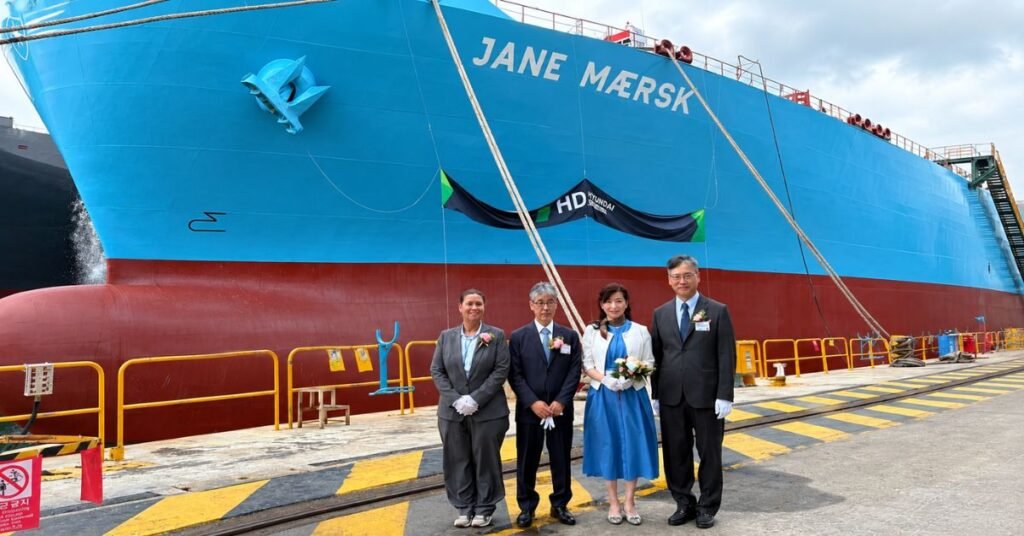
Maersk Tankers has ten VLACs joining its fleet, giving the four-vessel retrofit proposal significance within a broader gas-shipping expansion.
The company’s ammonia-carrier programme dates to 2023, when an affiliated company ordered four 93,000-cubic-metre vessels from Hyundai Samho Heavy Industries, with options for six additional ships. Mitsui & Co. was identified as a co-investor in the initial vessels.
At that stage, Maersk Tankers was already examining ammonia propulsion with engine and shipbuilding partners, subject to regulatory and customer support.
The fleet programme and RIPPLE have different scopes. Ten carriers are associated with the wider expansion, while the funding proposal described here concerns four conversions. The selection should consequently not be interpreted as approval to retrofit the entire fleet.
Emissions estimate describes projected performance
The project assessment estimates that the conversions could avoid more than 1.2 million tonnes of CO₂-equivalent emissions over a decade.
This is a projected cumulative benefit, rather than an emissions reduction already achieved. Actual performance would depend on implementation, vessel activity and the fuels used.
The reference to CO₂-equivalent also matters because it expresses greenhouse-gas impacts through a common measure. It should not be shortened to a claim that the project will eliminate all vessel emissions.
The available summary does not provide the detailed assessment assumptions or a vessel-by-vessel allocation of the projected savings.
Safety framework accompanies technology development
Ammonia propulsion is developing within an evolving maritime safety framework. IMO’s Maritime Safety Committee approved interim guidelines for ships using ammonia as fuel in December 2024.
The organisation maintains these guidelines within its wider work on alternative fuels and technologies. Their existence provides regulatory context, while individual conversions still require the applicable engineering assessments and approvals.
For RIPPLE, the decisive milestones are now grant preparation and customer commitments. Progress on both would provide a clearer basis for confirming the conversion scope, expenditure and delivery programme.
FAQs
What is RIPPLE?
It is Maersk Tankers’ proposed project to retrofit four VLACs with ammonia-capable two-stroke dual-fuel engines.
Has EU funding been finalised?
No. Selection is followed by grant-agreement preparation, which establishes the final terms.
What emissions benefit is projected?
More than 1.2 million tonnes of CO₂-equivalent emissions avoided over ten years.
What condition has Maersk Tankers specified?
Proceeding with the conversions depends on securing commercial commitments from customers.
Will all ten VLACs be converted under RIPPLE?
The project described for potential funding covers four vessels.
Recent Posts
Ammonia
Maersk Tankers Ammonia Retrofit Project Advances Towards EU Support
Policy
EU Maritime Innovation Projects Advance in €3.4-Billion Funding Selection
Policy
Shanghai–Melbourne Green Shipping Corridor Sets 2035 Vessel Deployment Goal