
Summary
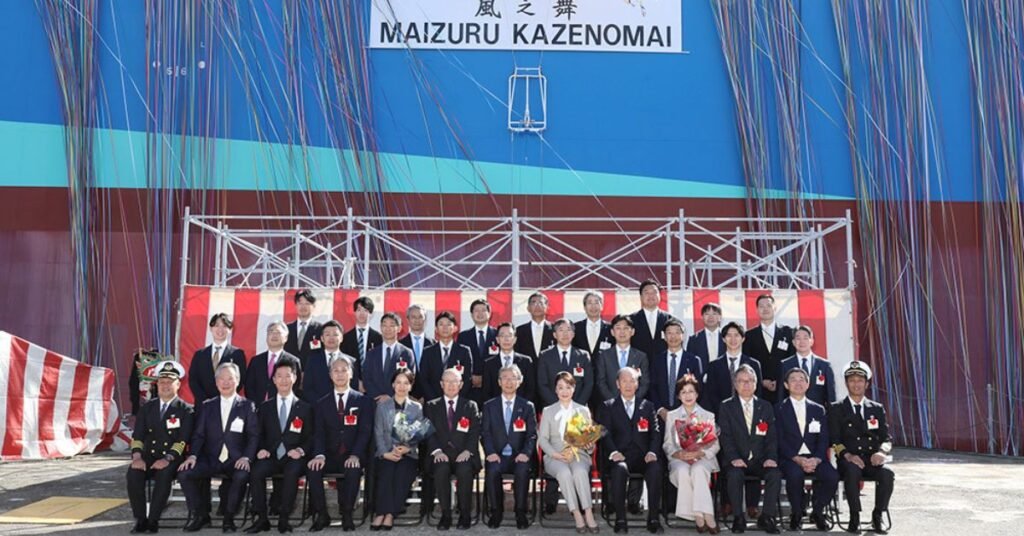
Mitsui O.S.K. Lines has taken delivery of Maizuru Kazenomai, an LNG dual-fuel coal carrier equipped with its Wind Challenger hard-sail system. Built by Oshima Shipbuilding for Kansai Electric Power’s coal transportation, the vessel combines fuel switching and wind assistance, with projected CO₂ reductions of up to approximately 30%.
New carrier begins dedicated coal service
Maizuru Kazenomai has entered service transporting coal for Kansai Electric Power, adding another commercial application of wind-assisted propulsion to Mitsui O.S.K. Lines’ fleet.
MOL announced the delivery on 28 October 2026 following a naming and handover ceremony at Oshima Shipbuilding. The vessel will supply Kansai Electric Power’s Maizuru Power Plant.
The Liberian-flagged carrier has a deadweight capacity of 95,311 tonnes. It measures 234.98 metres in length and 38 metres in breadth.
Its propulsion arrangement combines an LNG dual-fuel main engine with Wind Challenger, the hard-sail system jointly developed by MOL and Oshima Shipbuilding. MOL expects the combination to reduce CO₂ emissions by up to approximately 30% compared with conventional heavy-fuel-oil vessels.
That figure is a projected benefit from the combined technologies, rather than a measured operating result for the newly delivered ship.
Wind assistance complements engine propulsion
Wind Challenger uses telescoping hard sails to convert wind energy into additional propulsive force. Automated controls adjust sail extension, retraction and rotation according to prevailing wind conditions.
The system supplements the engine, helping reduce the fuel needed to maintain vessel speed. Its contribution varies with weather, route and operating conditions.
For a dedicated cargo carrier, combining wind assistance with an alternative-fuel engine offers two approaches to reducing transport emissions: changing the fuel used and reducing the amount required.
The commercial assessment will depend on actual voyage performance. Fuel consumption, equipment reliability and the ability to maintain delivery schedules will determine the value achieved during regular service.
Earlier voyages provide performance evidence
MOL’s deployment builds on operating experience with Shofu Maru, delivered in October 2022 as the first coal carrier equipped with Wind Challenger.
Over approximately 18 months, the vessel completed seven round-trip voyages carrying coal to Japan, mainly from Australia, Indonesia and North America.
MOL reported that the sail reduced daily fuel consumption by as much as 17%, with average savings of 5–8% per voyage.
These results demonstrate the distinction between peak performance and voyage averages. A strong daily saving under favourable conditions does not necessarily translate into the same percentage across an entire voyage.
They also provide useful background for Maizuru Kazenomai without establishing its eventual performance. The new vessel combines a different propulsion arrangement with its own operating profile.
Retrofit broadens application to existing ships
MOL has also extended Wind Challenger beyond newbuild installations.
In April 2026, the company announced completion of a retrofit on Kurotakisan Maru III, a coal carrier serving Electric Power Development, known as J-Power.
MOL described the project as the first retrofit of Wind Challenger on an in-service vessel. It followed installations on Shofu Maru and the Ultramax bulk carrier Green Winds.
The retrofitted carrier operates under a long-term arrangement transporting thermal coal from overseas to J-Power facilities.
That project is commercially relevant because fleet efficiency improvements must address vessels already trading as well as ships under construction. Retrofitting creates another deployment route, subject to vessel suitability and the practical requirements of installation.
Fleet targets support wider deployment
MOL plans to deploy 25 Wind Challenger-equipped vessels by 2030, increasing to 80 by 2035, as part of its environmental strategy and ambition to achieve net-zero greenhouse gas emissions by 2050.
Its wider development work includes applications for LNG carriers and a liquefied CO₂ carrier design. The latter has received approval in principle for a configuration incorporating three Wind Challenger units.
Maizuru Kazenomai adds an operating vessel to that programme. The immediate significance is the integration of LNG propulsion and wind assistance in dedicated industrial transport.
As operating experience accumulates, measured results will provide a clearer basis for assessing fuel savings, maintenance requirements and the suitability of similar arrangements for other cargo vessels.
FAQs
What is Maizuru Kazenomai?
A 95,311-dwt LNG dual-fuel coal carrier operated by MOL.
Who built the vessel?
Oshima Shipbuilding.
What cargo service will it perform?
Coal transportation for Kansai Electric Power’s Maizuru Power Plant.
What emissions reduction is expected?
MOL projects up to approximately 30% lower CO₂ emissions from the combined LNG engine and Wind Challenger system compared with conventional heavy-fuel-oil vessels.
Does Wind Challenger replace the engine?
No. It provides additional propulsion from wind, reducing the fuel required by the vessel.
Recent Posts
Dual-Fuel
Wallenius Wilhelmsen Fleet Renewal Adds Four LNG Dual-Fuel Carriers
Bunkering
Europe and Africa Bunker Availability Tightens at Key Refuelling Ports
Power & Propulsion
Valencia Shore Power Plans Advance with €18.7 Million Substation Tender