
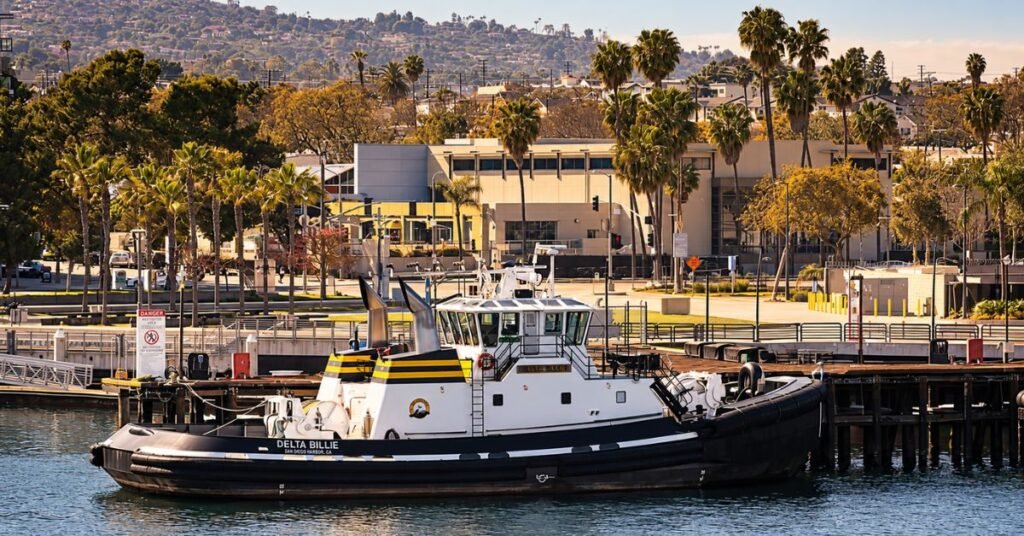
Summary
Sanmar has secured a €45 million financing package arranged by Akbank, with €22.5 million provided by the European Bank for Reconstruction and Development. The funding will support working capital for fully electric tugboat production and delivery, alongside a proposed solar installation to supply electricity for the Turkish shipbuilder’s own operations.
Financing supports electric tug production
The Sanmar electric tug financing package combines commercial-bank lending with development-finance support to help the shipbuilder expand production and delivery of battery-powered vessels.
The European Bank for Reconstruction and Development (EBRD) is providing €22.5 million through its risk-sharing arrangement with Akbank. Akbank is contributing the other €22.5 million.
The package includes a €5 million uncommitted tranche intended to support a 5 MW solar photovoltaic installation for Sanmar’s own electricity consumption. That component remains distinct from committed funding because an uncommitted facility does not guarantee that the lender will provide the funds.
The transaction addresses two parts of the company’s environmental investment programme: financing electric vessel construction and introducing renewable power into its industrial operations.
Working capital bridges the construction cycle
The proceeds will meet working capital requirements as Sanmar builds and delivers fully electric tugboats.
For shipbuilders, access to working capital is important because expenditure on equipment, materials and labour occurs throughout construction, while customer payments follow agreed contractual milestones.
The commercial significance therefore extends beyond funding an individual technology. Production growth requires sufficient liquidity to manage several vessels moving through different stages of construction and commissioning.
The announcement does not specify how many tugboats the package will finance. Its stated purpose is to support production and delivery, rather than establish a separate order for a defined fleet.
Project assessments identify emissions benefits
According to the project assessment, each electric tugboat is expected to reduce greenhouse gas emissions by approximately 1,800 tonnes of CO₂ equivalent annually compared with a conventional diesel-powered alternative.
The proposed solar installation is expected to avoid a further 2,600 tonnes of CO₂ emissions annually. These are projected benefits rather than measured results from the financing programme.
Actual performance will depend on vessel operations, electricity supply and the assumptions used in the assessment.
For port operators considering electric towage, the practical requirement is to match battery capacity and charging access with vessel-assistance schedules. Shipyard capacity is one element of deployment; dependable shoreside energy infrastructure is another.
Earlier BOTAŞ deliveries demonstrate commercial activity
The financing follows Sanmar’s delivery of electric tugboats to customers in Türkiye and overseas.
In March 2026, the shipbuilder held a ceremony marking delivery of four fully electric ElectRA tugs to BOTAŞ, Türkiye’s state-owned crude oil and natural gas pipelines and trading company.
The vessels were named BOTAŞ Hilal, BOTAŞ Bayrak, BOTAŞ Ay and BOTAŞ Yıldız.
That earlier delivery provides relevant context for the financing: Sanmar is supporting an established electric-tug product line, rather than funding an initial concept alone.
For customers, repeat construction can provide a broader base of operational experience. It also increases the importance of consistent equipment supply, commissioning procedures and after-sales support as more vessels enter service.
International projects provide further experience
Sanmar’s electric-tug development also includes vessels built for Canada’s HaiSea Marine.
HaiSea Wamis, delivered in 2023, was the first of three ElectRA 2800 battery-electric tugs designed by Robert Allan Ltd for the operator.
The naval architect said its installed battery capacity would allow regular operations at Kitimat on battery power alone. At the time, projected annual CO₂ savings were approximately 1,700 tonnes compared with an equivalent conventional diesel tug.
That earlier estimate relates to a specific design and operating application. It should be distinguished from the broader per-vessel assessment accompanying the new financing.
Finance becomes part of the deployment challenge
The Akbank–EBRD package illustrates how maritime electrification increasingly involves industrial finance alongside vessel technology.
For Sanmar, the immediate benefit is access to funding supporting construction activity. The solar component adds a separate opportunity to reduce emissions associated with the company’s electricity consumption.
The next practical measure will be how effectively the financing supports completed vessels and operating capacity. As electric towage develops, shipbuilders must combine technical capability with the financial resources needed to deliver reliably.
FAQs
How much financing has Sanmar secured?
A €45 million package, with €22.5 million each from Akbank and EBRD.
What will the funding support?
Working capital for fully electric tugboat construction and delivery, alongside a proposed solar investment.
Is the solar financing fully committed?
The package includes a €5 million uncommitted tranche for that purpose.
How large is the proposed solar installation?
5 MW, intended for Sanmar’s own electricity consumption.
Has Sanmar already delivered electric tugs?
Yes. Its deliveries include vessels for BOTAŞ in Türkiye and HaiSea Marine in Canada.
Recent Posts
Dual-Fuel
Wallenius Wilhelmsen Fleet Renewal Adds Four LNG Dual-Fuel Carriers
Bunkering
Europe and Africa Bunker Availability Tightens at Key Refuelling Ports
Power & Propulsion
Valencia Shore Power Plans Advance with €18.7 Million Substation Tender