
Summary
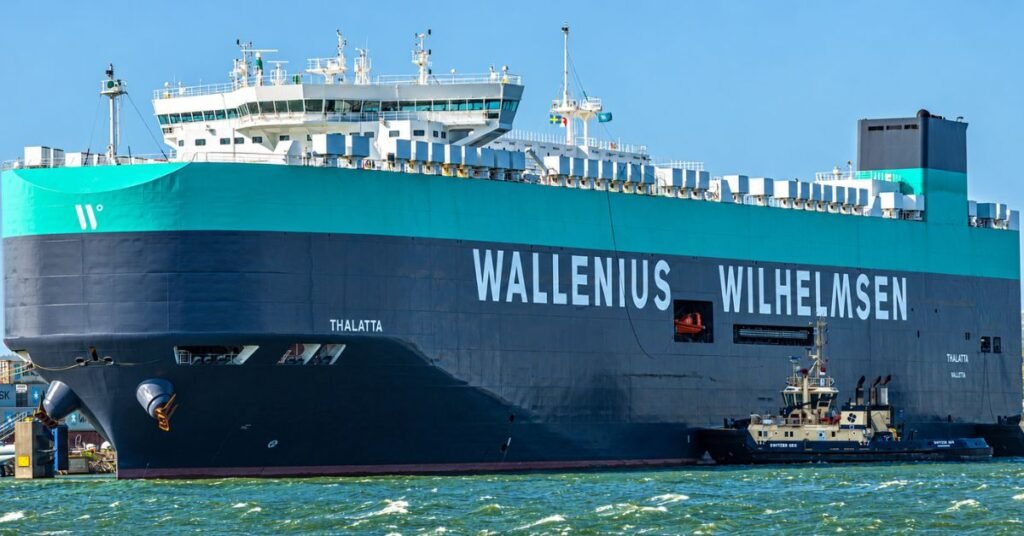
Wallenius Wilhelmsen has agreed to acquire four 9,900-car-equivalent-unit vessels from Jinling Shipyard, with options for eight more. Firm deliveries begin in mid-2030. The expansion brings its fleet renewal programme to 26 vessels, including options, with the latest package potentially requiring around $1.5 billion if all options are exercised.
Four firm vessels and eight options
The Wallenius Wilhelmsen fleet renewal programme is expanding through agreements with Jinling Shipyard in Jiangsu for four dual-fuel pure car and truck carriers, supported by options for further construction.
Announced on 28 October 2026, the firm vessels will each have capacity for 9,900 car equivalent units (CEU) and LNG dual-fuel engines. Deliveries are scheduled to begin in mid-2030.
The options cover four additional ships in 2031 and another four in 2032. If all eight options are exercised, the latest package would involve approximately $1.5 billion in capital expenditure.
The company reached the agreement following a private placement announced earlier in October. Its overall renewal programme now comprises 26 vessels, including options.
The distinction between firm commitments and options is important: four vessels are contracted, while the additional eight remain subject to future decisions.
Cargo flexibility supports investment case
The expansion builds on the Shaper Class programme launched in 2023.
Its design incorporates hoistable decks, strong ramps and adaptable cargo spaces, allowing the vessels to accommodate different cargo requirements across the company’s trading network.
Chief Operating Officer Shipping Services Xavier Leroi linked the investment to long-term demand, customer growth and the need for operational flexibility.
For a deep-sea roll-on/roll-off operator, nominal vehicle capacity is only one consideration. Deck configuration, ramp capability and the ability to accommodate different cargo dimensions influence how effectively available space can be used.
The later delivery slots also make this a capacity-planning decision extending into the next decade. The options provide scope for further expansion as market requirements become clearer.
First Shaper Class delivery provides background
The latest agreements follow delivery of Arctic Tern, the first vessel in the Shaper Class series, on 9 July 2026.
Wallenius Wilhelmsen said the ship would be deployed through EUKOR Car Carriers, its jointly owned shipping business with Hyundai Motor Group, on services between Asia and Europe.
The delivery announcement highlighted dual-fuel capability, methanol readiness and improved operational efficiency. Wallenius Marine oversaw shipyard site management and delivery preparation, while Wilhelmsen Ship Management prepared the vessel for commercial operation and assumed ship-management responsibilities.
That earlier delivery marks the programme’s transition from construction commitments to operating assets. The new October agreements extend the investment horizon beyond the vessels already entering service.
The specifications should nevertheless be kept separate. The latest four-ship announcement identifies LNG dual-fuel engines; features described for an earlier vessel should not automatically be attributed to every subsequent order.
Efficiency programme includes existing vessels
Fleet renewal is one part of Wallenius Wilhelmsen’s wider work on vessel efficiency.
In July 2026, the company announced completion of a wing-sail installation on Tirranna, providing a full-scale platform for testing wind-assisted propulsion during commercial operations.
The installation took place at Damen Shipyard in Rotterdam between 22 and 24 June. Sea acceptance testing was completed on 1 July, after which the vessel was to operate normally while performance data was collected.
The project forms part of the EU-funded Orcelle Horizon initiative involving eleven partners. Its purpose is to build practical operating experience and assess the technology’s contribution to lower fuel consumption and emissions.
This provides a separate route for improving fleet performance alongside newbuild investment. It also illustrates why measured operating results matter when evaluating technologies intended for wider deployment.
Delivery execution becomes the next priority
The expanded programme gives Wallenius Wilhelmsen a longer pipeline of potential capacity, but its commercial value will depend on delivery execution and effective deployment.
For customers, additional vessels can support service planning and cargo flexibility. For the operator, the challenge is to match investment with demand while introducing new ships into established schedules.
The firm orders establish the next construction phase. Decisions on the eight options will determine the eventual scale of the latest expansion, while operating experience from the ships already delivered will help inform the programme’s continued development.
FAQs
How many vessels are firmly contracted?
Four, with options for eight additional vessels.
What is their capacity?
Each vessel will have capacity for 9,900 CEU.
When will deliveries begin?
The four firm vessels are scheduled for delivery from mid-2030.
What does the $1.5 billion figure cover?
The latest four firm vessels and eight options, assuming all options are exercised.
How large is the overall renewal programme?
It now totals 26 vessels, including options.
Recent Posts
Dual-Fuel
Wallenius Wilhelmsen Fleet Renewal Adds Four LNG Dual-Fuel Carriers
Bunkering
Europe and Africa Bunker Availability Tightens at Key Refuelling Ports
Power & Propulsion
Valencia Shore Power Plans Advance with €18.7 Million Substation Tender