
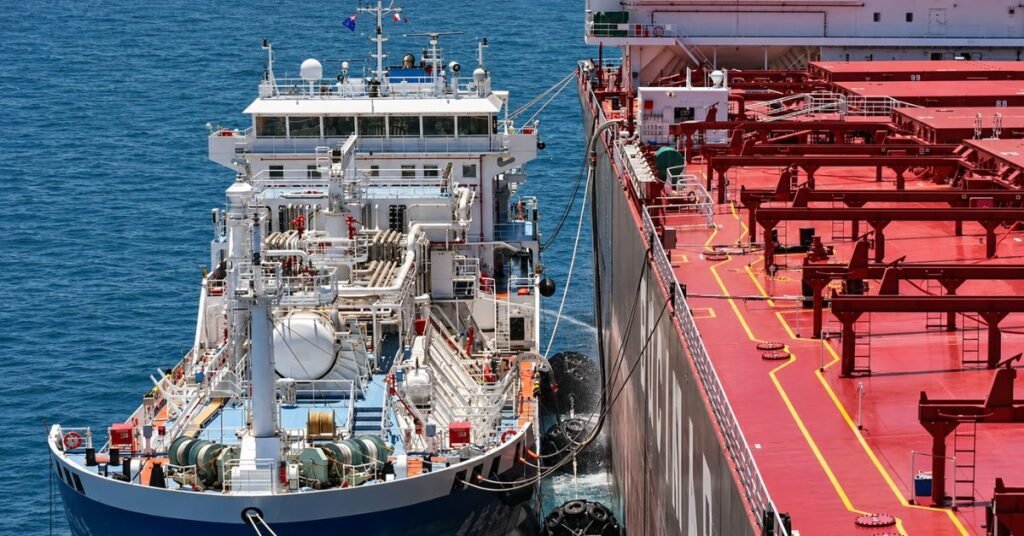
Australia has completed its first green ammonia bunkering operation involving an ammonia-powered dry bulk carrier, with Mineral Europa receiving fuel at Port Hedland in Western Australia on 2 November 2026.
The 300-metre vessel, chartered by Fortescue, took on certified green ammonia from a bunker vessel before entering port to load iron ore for customers in China. Pilbara Ports said the two-hour trial was confirmed successful at 8.42 am Australian Western Standard Time.
How was the bunkering operation conducted?
The operation involved Pilbara Ports, Fortescue and vessel owner CMB.TECH, working with regulators and operational teams.
Preparations included hazard assessments, vessel compatibility studies, ammonia dispersion modelling and emergency response planning. The partners also established pilotage, towage and vessel-readiness requirements.
Weather and sea-state limits, additional marine support and vessel traffic controls formed part of the operating framework. Pilbara Ports said the transfer proceeded after the safety and operational requirements had been satisfied.
The findings will inform subsequent ammonia bunkering operations and development of the proposed Pilbara Clean Fuel Bunkering Hub. Neither the port authority nor Fortescue disclosed the volume transferred in their announcements.
What is Mineral Europa’s role in ammonia shipping?
CMB.TECH identifies Mineral Europa as the world’s first ammonia-powered dry bulk vessel. The company announced on 9 October that the 210,000-deadweight-tonne ship had departed on its maiden voyage to Australia.
Its deployment introduces ammonia propulsion into large-scale ocean-going bulk transport, with the Fortescue charter connecting the vessel to the Australia–China iron ore trade.
The ship is the first in a broader CMB.TECH delivery programme. In its October announcement, the company scheduled 21 ammonia-powered vessels for delivery through 2029, comprising 18 dry bulk carriers, one container ship and two chemical tankers. Most were expected within the following nine months.
CMB.TECH also said it was investing in ammonia storage and bunker barges to support fuel delivery to ocean-going ships. These investments address the supply infrastructure required alongside the introduction of ammonia-capable vessels.
How does the trial build on earlier Pilbara operations?
The Port Hedland operation follows ammonia transfer trials conducted at the Port of Dampier in September 2024.
A consortium led by the Global Centre for Maritime Decarbonisation (GCMD) completed ship-to-ship transfers between the gas carriers Green Pioneer and Navigator Global. The programme involved approximately 2,700 tonnes of liquid ammonia, transferred at rates of 700–800 cubic metres per hour.
Those operations demonstrated lightering and simulated bunkering, providing experience in transferring ammonia between vessels at anchorage. GCMD subsequently published its operational findings in June 2025 to support the development of ammonia bunkering procedures.
The latest operation advances that work by supplying fuel to an ammonia-powered bulk carrier engaged in iron ore transportation.
What regulatory framework supports ammonia fuel use?
International safety guidance has developed alongside these vessel and infrastructure projects. The International Maritime Organization’s Maritime Safety Committee approved interim guidelines for ships using ammonia as fuel at its December 2024 meeting.
The guidelines establish goals and functional requirements for the design, construction and operation of ammonia-fuelled ships. They provide a common safety framework as operators introduce the fuel into commercial fleets.
For the Pilbara, the wider objective is to establish clean-fuel bunkering infrastructure near major export ports, prospective ammonia production projects and international shipping routes.
Pilbara Ports’ proposed hub would draw on this existing industrial and maritime base. The Port Hedland trial adds practical operating experience to that programme, linking fuel transfer procedures with the requirements of an ocean-going iron ore carrier.
Recent Posts
Marine
KONGSBERG Reports 50% Revenue Growth in Q3 2026 as Order Backlog Reaches NOK 174.2 Billion
Marine
Sarbananda Sonowal visits Hanwha Ocean shipyard in South Korea to explore shipbuilding capabilities
Policy
Denmark Explores Maharashtra Cooperation in Green Shipping, Energy and Technology