
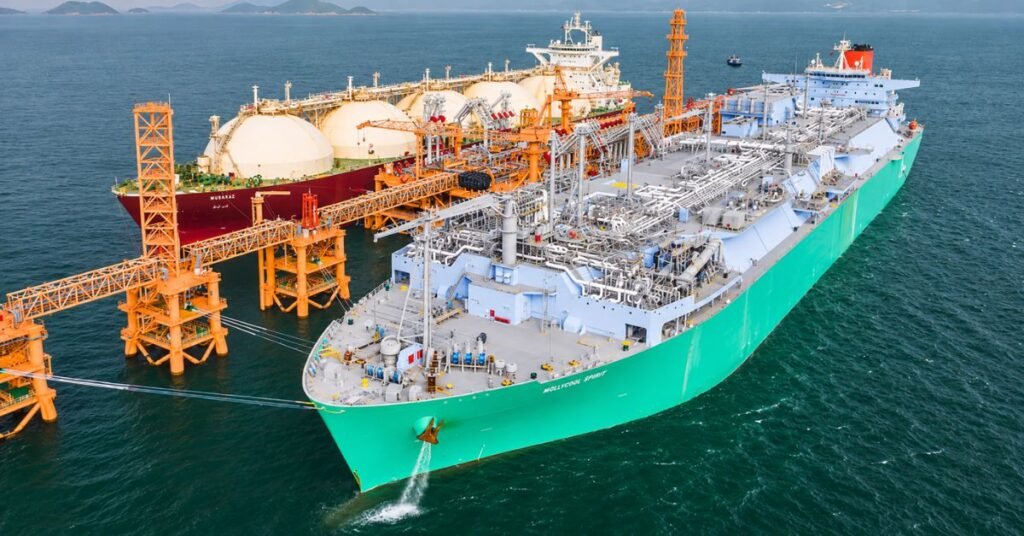
The Maritime and Port Authority of Singapore (MPA) opened applications on 12 November 2026 for five-year licences to operate up to two liquefied natural gas (LNG) floating storage units in Singapore’s anchorages. Each unit must have at least 130,000 cubic metres of storage. The initiative will give bunker suppliers another way to store LNG and reload bunker vessels as Singapore expands its marine fuel supply network.
Who can apply for a floating LNG storage licence?
Applications are open to companies that already hold an LNG bunker supplier licence in Singapore. They can partner with third-party terminal operators for storage and operating expertise. Applicants must own or charter at least one qualifying floating storage unit (FSU), register it with the Singapore Registry of Ships and meet MPA’s safety and operating requirements.
Operators must set aside most of the unit’s storage capacity for LNG bunkering. They must also make a minimum amount of capacity available to other LNG bunker suppliers on open-access terms and disclose to MPA the maximum fees they intend to charge for reloading. The public announcement did not specify the minimum open-access allocation.
How will floating storage support Singapore’s LNG bunker suppliers?
Storage at anchorage gives suppliers a sea-based option for reloading the bunker vessels that deliver LNG to ships. MPA has been examining sea-based reloading since a December 2024 call for industry proposals. The authority identified it as a way to complement shore-based infrastructure and diversify supply as more companies enter the market.
The storage call follows MPA’s award of eight new LNG bunker supplier licences in July 2026, which took effect on 1 September. Those licences cover services from securing and storing fuel to transferring and delivering it to ships. The new call addresses the storage and reloading part of that supply chain.
Will the storage units handle bio-LNG and e-LNG?
The units must obtain certification under the International Sustainability and Carbon Certification European Union (ISCC-EU) framework to handle liquefied biomethane (bio-LNG) and liquefied synthetic methane (e-LNG). The framework provides for sustainability and supply-chain traceability checks. The requirement is intended to let the same infrastructure handle these fuels as they become more widely available.
When are applications due?
MPA will hold a briefing for prospective applicants on 4 December 2026. Applications must reach greenport@mpa.gov.sg by 5 pm Singapore time on 4 February 2027. MPA has published the briefing and application details through its
FAQs
How many floating LNG storage units does Singapore plan to license?
MPA is inviting applications for up to two units in Singapore’s anchorages. Each licence will be valid for five years.
Can a terminal operator apply without an LNG bunker supplier licence?
Applicants must already hold an LNG bunker supplier licence. Third-party terminal operators can participate as partners to eligible applicants.
Can other bunker suppliers use the floating storage capacity?
Yes. Operators must make a minimum amount of storage available to other LNG bunker suppliers on open-access terms.
Recent Posts
Marine
Singapore’s Smart Port Challenge more than doubles submissions as 28 companies explore pilots
Biofuels
Hercules Angelica to carry Malaysian biodiesel cargo on maiden voyage
Methanol
US ethanol could help fill fuel gap for methanol-capable ships, study finds