
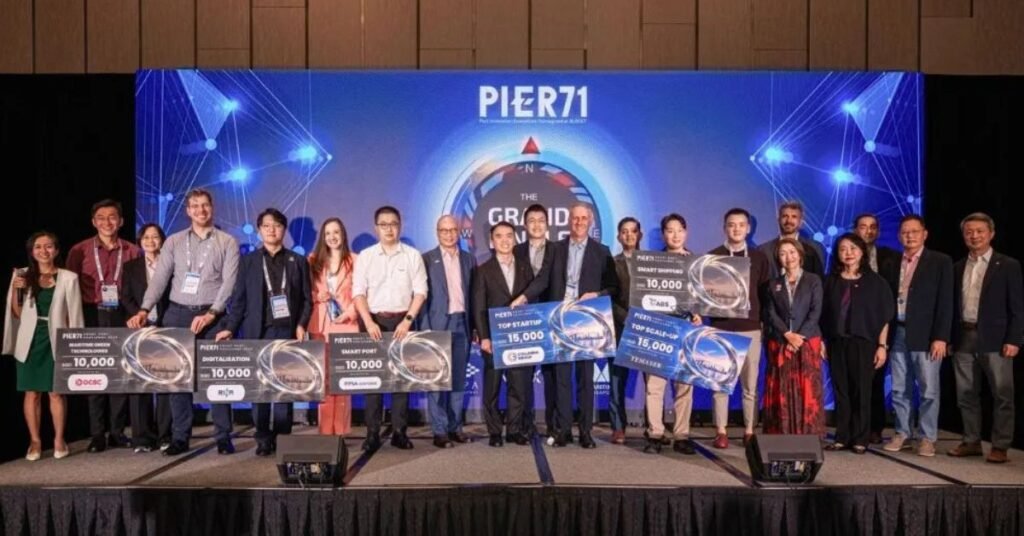
Singapore’s Smart Port Challenge received a record 586 proposals from 281 start-ups across 39 countries in 2026, more than double the 288 submissions a year earlier. The Maritime and Port Authority of Singapore (MPA) and NUSX, the entrepreneurship arm of the National University of Singapore, announced the winners of the 10th edition on 11 November. Australia’s Ocean Intelligence took the top start-up award for fuel-efficient voyage planning, while South Korea’s Vueron Technology won the top scale-up award for its autonomous mobility and industrial safety technology.
Which technologies won the Smart Port Challenge?
Ocean Intelligence uses artificial intelligence (AI) to analyse weather, ocean currents and vessel characteristics when recommending routes. Its software integrates with existing navigation systems without additional onboard hardware. Vueron uses light detection and ranging (LiDAR) and AI to help autonomous systems interpret their surroundings. The two main prizes were worth S$15,000 each, sponsored by Columbia Group and Temasek respectively.
Four thematic awards carried S$10,000 each. Ocean Intelligence also won the Maritime Green Technologies Prize, while Vueron took the Smart Shipping Prize. South Korea’s Underwater Solution won the Digitalisation Prize for remotely operated systems that inspect, clean and maintain submerged vessel surfaces. China’s Trunk Technology (Beijing) received the Smart Port Prize and a special mention from the judges.
How will start-ups test their technology with maritime companies?
Organisers selected 21 start-ups from 11 countries for the 10-week Smart Port Challenge Accelerate programme. Eight reached the finale. Participants worked on 20 problems and opportunities identified by maritime companies, covering areas such as port automation, vessel operations and environmental monitoring. Participating start-ups signed letters of intent with 28 maritime companies to explore proof-of-concept work and pilot projects.
Projects included robots designed to clean cargo holds and inspect confined spaces, reducing the need for crew to enter hazardous areas. Another proposal used the biological responses of molluscs to provide early warning of changes in port water quality. Separately, MPA selected six partners for co-funded trials of robotic hull inspection and cleaning in Singapore’s port waters.
How is Singapore helping maritime start-ups reach new markets?
Since the first challenge in 2017, the competition has drawn more than 2,100 proposals. Its parent initiative, PIER71, has supported more than 200 start-ups since 2018. Those companies have collectively raised around S$180 million. This year, PIER71 added partnerships in Hamburg, Rotterdam and Los Angeles to give selected companies access to overseas industry networks and market-entry support.
India’s Troology was among four international start-ups that established a presence in Singapore this year through PIER71’s Landing Pad programme. Another Indian company, 2024 challenge alumnus Planys Technologies, has completed three underwater inspections of steel jetty piles for ExxonMobil in Singapore since 2024.
FAQs
How many start-ups entered Singapore’s Smart Port Challenge 2026?
The competition received 586 proposals from 281 start-ups across 39 countries.
Who won the two main awards?
Australia’s Ocean Intelligence won the Top Start-up Prize. South Korea’s Vueron Technology won the Top Scale-up Prize.
What do the letters of intent cover?
The letters set out plans for participating start-ups and 28 maritime companies to explore proofs of concept and pilot projects.
Recent Posts
Marine
Singapore’s Smart Port Challenge more than doubles submissions as 28 companies explore pilots
Biofuels
Hercules Angelica to carry Malaysian biodiesel cargo on maiden voyage
Methanol
US ethanol could help fill fuel gap for methanol-capable ships, study finds