
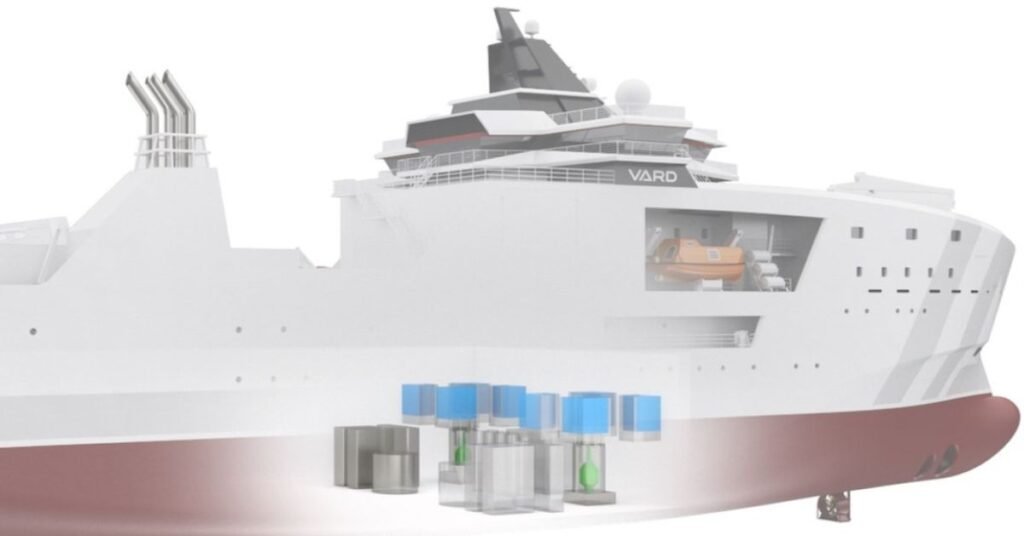
The Research Council of Norway has awarded NOK20 million, approximately US$2 million, in initial funding to a consortium developing nuclear propulsion for offshore vessels. The Marine Nuclear Propulsion System (MarNuPS) project, detailed by VARD on 17 November, aims to advance the technology towards integrated shore-based testing, with first deployment targeted for 2031–32.
What will the project test?
Led by Emerald Nuclear Norway, the consortium includes Vard Group, Vard Electro, Island Offshore, the Norwegian University of Science and Technology (NTNU), Imperial College London and Maskindynamikk.
An integrated test facility is planned at Stette, near Ålesund, in 2027. It will assemble a full-scale representation of the shipboard system, combining a gas-cooled reactor concept, supercritical carbon dioxide power generation, energy storage and control systems.
Electric heating will simulate the reactor’s heat during this phase. Active nuclear operation is intended to follow only after system performance and essential safety parameters have been demonstrated.
Tests will examine routine operation, sudden changes in power demand, stress conditions and crew interaction. Island Offshore aims to become the first offshore service vessel owner to install the system. Under Emerald’s proposed leasing model, the developer would retain reactor ownership, operation, maintenance and fuel-cycle responsibilities, while shipowners would purchase power.
How does MarNuPS build on earlier vessel studies?
The programme follows research into integrating nuclear power within commercial ship designs. In January 2026, VARD presented a construction-vessel concept developed under the NTNU-led NuProShip II project.
That study assessed a helium-cooled reactor as the vessel’s primary energy source, examining consequences for machinery layout, safety and overall performance. Participants included Vard Design, Vard Electro, Emerald Nuclear, Island Offshore and classification society DNV.
VARD said the concept was technically feasible within the study’s assumptions and supplier data. The work considered the redundancy needed for dynamic positioning, which enables offshore vessels to maintain position during operations, and examined energy-storage arrangements to balance power demand.
These were design-stage findings. NuProShip II also identified the need for an updated regulatory framework, greater industrial experience and public acceptance before civilian maritime nuclear propulsion could progress more widely. The two-year project is scheduled to conclude in 2026.
What wider research programme supports deployment?
NTNU also leads the Sustainable Applied and Industrialized Nuclear Technology centre, known as SAINT. Its stated objective is to undertake the research and innovation needed to support two or three nuclear-powered demonstration ships in the early 2030s.
The centre brings together approximately 30 organisations across the supply chain, linking academic research with industrial development. Its demonstration-vessel ambition is a research target, rather than confirmation that ships have been approved or ordered.
VARD previously reported that SAINT had received NOK96 million from the Research Council of Norway, alongside approximately NOK200 million in industry contributions in kind. The centre’s planned duration is eight years from January 2026. This funding relates to the broader research centre and is separate from the NOK20 million MarNuPS award.
How are international nuclear shipping rules developing?
The International Maritime Organization (IMO) is progressing regulatory work alongside industry research. In May 2026, its Maritime Safety Committee endorsed a work plan covering safety requirements for nuclear power and other technologies intended to reduce shipping emissions.
The nuclear work programme envisages adoption of a revised Nuclear Code and amendments to Chapter VIII of the International Convention for the Safety of Life at Sea in 2030. This remains a regulatory timetable, not approval of an individual reactor or vessel.
For MarNuPS, shore-based integration will provide an intermediate stage at which control systems, operating responses and safety assumptions can be tested before any nuclear-powered ship enters service.
Recent Posts
Marine
Clean Shipping Alliance seeks risk evidence behind Greenland’s scrubber discharge restrictions
EV
Lloyd’s Register adds FIRE (EV) notation to strengthen vehicle-carrier fire protection
Policy
Hong Kong and Piraeus sign green shipping corridor pact to support Asia–Europe decarbonisation