
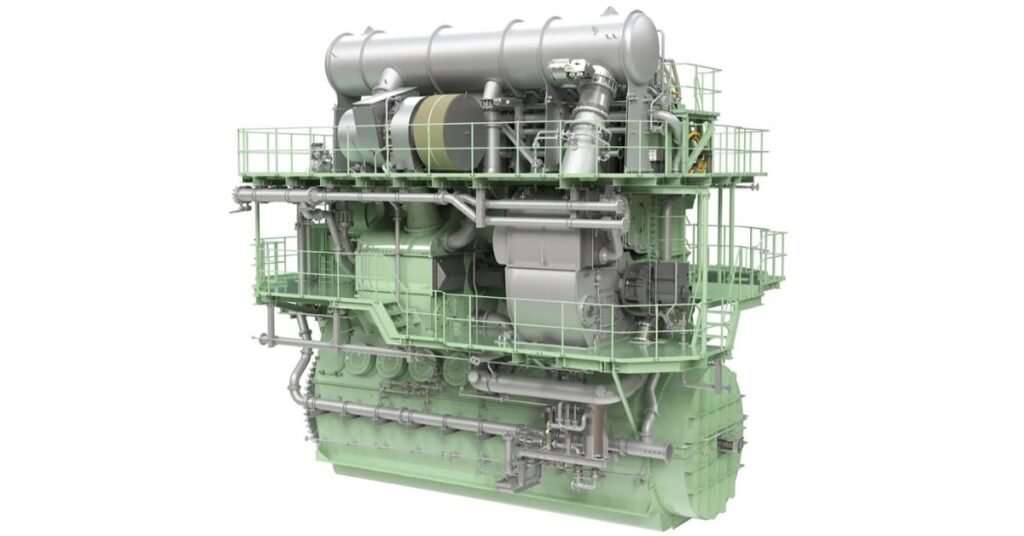
Everllence has secured the first order for its 8S50ME-GI Mk10.7 engine configuration, with two units selected for CLdN’s new roll-on/roll-off (RoRo) vessels being built in South Korea. Announced on 17 November 2026, the order extends the company’s latest two-stroke platform into a short-sea shipping application requiring fuel flexibility and efficient propulsion.
What does the engine order include?
Each of the two 6,700-lane-metre ships will receive one methane dual-fuel engine manufactured by Hyundai EMD. Testbed operation is scheduled for July 2028, followed by delivery to HD Hyundai Heavy Industries in September 2028 for installation.
The engines will incorporate Everllence’s EcoEGR exhaust gas recirculation system for Tier III emissions compliance. Equipment includes a single recirculation string, water-handling system and high-speed blower. The propulsion arrangement pairs a single main engine with a controllable-pitch propeller.
Bjarne Foldager, Head of Two-Stroke Business at Everllence, described the selection as a further commercial milestone for the Mk10.7 platform. Cameron Bowie, CLdN’s Chief Operating Officer for Shipping, linked the choice to fuel efficiency, dual-fuel flexibility and the companies’ established relationship.
How does the ME-GI technology work?
Everllence’s ME-GI gas-injection engine uses high-pressure fuel delivery and diesel-cycle combustion. It can operate on methane or conventional fuel oil, allowing operators to switch between fuels.
The manufacturer attributes the design’s low methane slip, meaning unburned methane escaping combustion, to its combustion process, compression ratio and combustion-chamber design. Everllence also states that the engine family is compatible with biomethane and synthetic natural gas, providing additional fuel options where suitable supplies are available.
Design updates across the ME-GI range include simplified piping and revised gas-control components. A new gas block allows an individual cylinder to stop operating on gas while continuing on fuel oil. These developments form part of the company’s work to simplify installation and improve operational reliability across its methane-fuelled engine portfolio.
When will CLdN’s new vessels enter service?
CLdN announced the shipbuilding contract on 22 September 2026. Construction is expected to begin in early 2028, with vessel deliveries scheduled for mid-2029. The ships will be its 15th and 16th orders from HD Hyundai Heavy Industries over a decade.
Compared with CLdN’s existing 5,000-lane-metre class, the new vessels will have an additional deck and more cargo space, with layouts adapted for trailers. Wide ramps providing direct access to upper decks are intended to accelerate loading and unloading.
The vessels will be capable of using marine diesel or liquefied natural gas (LNG). Space will also be reserved for the potential future installation of larger electric shaft generators and batteries.
CLdN expects fuel consumption per ship to remain broadly comparable with its smaller vessels. Combined with additional carrying capacity, it projects a 30–40% improvement in fuel efficiency per tonne-kilometre. This is a ship-design forecast, rather than a measured efficiency gain attributable solely to the engines.
How does the order build on Everllence’s engine portfolio?
The configuration enters a product family with more than a decade of commercial service. In October 2025, Everllence reported 1,010 ME-GI engine orders and more than 500 units operating at sea, following the technology’s commercial debut in 2015.
The company’s earlier ME-GI Mk2 design, introduced as standard in 2020, simplified the engine configuration. Everllence has said those design features will continue within the Mk10.7 platform, linking the latest generation to accumulated operating experience across container ships, bulk carriers, tankers and vehicle carriers.
Recent Posts
Marine
Clean Shipping Alliance seeks risk evidence behind Greenland’s scrubber discharge restrictions
EV
Lloyd’s Register adds FIRE (EV) notation to strengthen vehicle-carrier fire protection
Policy
Hong Kong and Piraeus sign green shipping corridor pact to support Asia–Europe decarbonisation