
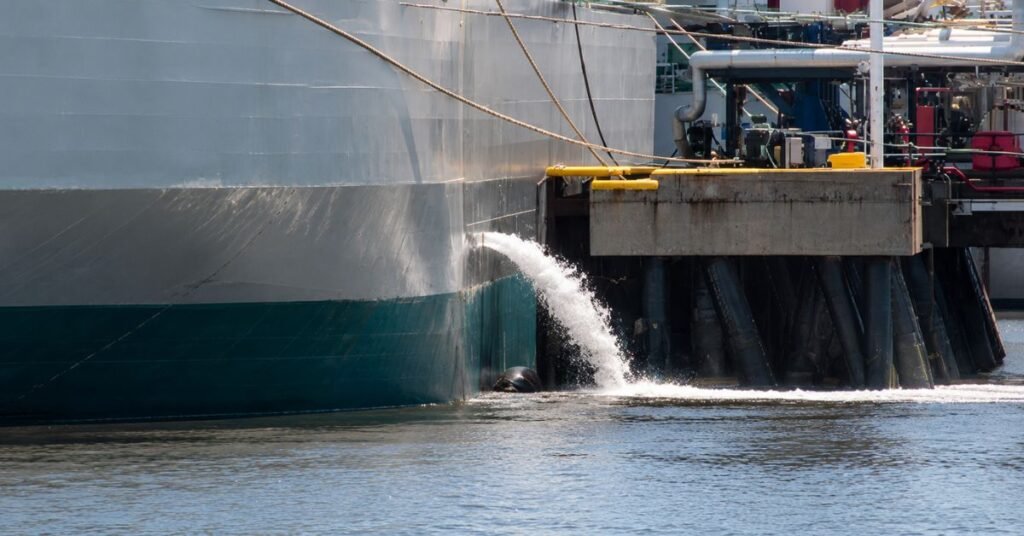
The Clean Shipping Alliance (CSA) has called on Greenland to publish the environmental assessment supporting its planned restrictions on ships’ scrubber wastewater discharges. Responding on 17 November, the industry organisation questioned the evidence underpinning the phased measures and urged authorities to assess different technologies and operating conditions separately.
Greenland’s parliament, Inatsisartut, has directed the government to introduce restrictions beginning in July 2027. Environmental organisations have welcomed the decision and called for wider action across Arctic waters.
What restrictions has Greenland proposed?
The adopted proposal calls for a ban on discharges from open-loop exhaust gas cleaning systems (EGCS), commonly known as scrubbers, from 1 July 2027. It would cover port areas, internal waters and territorial waters.
From 1 July 2029, the discharge prohibition would extend to all scrubber systems. The timetable therefore addresses wastewater releases from closed-loop and hybrid installations as well as open-loop equipment.
The parliamentary direction concerns discharges. It should not be interpreted as a blanket prohibition on vessels merely carrying scrubber equipment.
Why is the Clean Shipping Alliance challenging the decision?
CSA Executive Director Andreas Chrysostomou said protecting the Arctic environment was important, but questioned what specific risks Greenland had identified and how they had been evaluated.
“If Greenland has conducted an assessment to support its planned restrictions, we urge them to publish it,” he said.
The alliance cited International Maritime Organization (IMO) circular MEPC.1/Circ.899, which sets out methods for evaluating scrubber discharge risks. It argued that local receiving conditions, discharge composition, dilution and ecotoxicity should inform restrictions.
CSA also urged policymakers to compare the full environmental impacts of alternative fuel pathways. Its position is that switching away from scrubbers should not automatically be treated as delivering a better overall environmental outcome. These are the alliance’s arguments, rather than findings established for Greenland’s waters.
What does the IMO assessment framework provide?
The IMO’s Marine Environment Protection Committee approved its discharge-water risk and impact assessment guidelines in June 2022.
The organisation describes them as a recommended methodology for member states considering local or regional rules to protect sensitive waters from EGCS discharges. It also approved guidance on delivering scrubber residues and stored discharge water to port reception facilities.
These guidelines support environmental assessment and waste management. Their existence does not, by itself, establish whether a particular discharge is acceptable in Greenland’s marine environment.
How does Greenland’s approach compare with regional measures?
The OSPAR Commission, which oversees cooperation under the Convention for the Protection of the Marine Environment of the North-East Atlantic, adopted discharge controls in 2025.
Its decision covers open-loop discharges in ports and internal waters by July 2027 and discharges in any operating mode by July 2029. It permits implementation to be postponed by up to three years where a contracting party notifies the secretariat and explains its reasons.
OSPAR will examine extending the decision to territorial waters by 2027. Greenland’s proposed geographical coverage already includes those waters.
Why do environmental groups support the restrictions?
OSPAR identifies metals and polycyclic aromatic hydrocarbons in scrubber washwater as concerns, citing toxicity and effects on marine food webs.
The Clean Arctic Alliance welcomed Greenland’s decision. Its lead adviser, Dr Sian Prior, urged IMO members to pursue a global discharge prohibition, beginning with Arctic waters.
The disagreement centres on how to weigh marine pollution risks, local environmental conditions and the wider impacts of fuel choices as Greenland develops the implementing rules.
Recent Posts
Marine
Clean Shipping Alliance seeks risk evidence behind Greenland’s scrubber discharge restrictions
EV
Lloyd’s Register adds FIRE (EV) notation to strengthen vehicle-carrier fire protection
Policy
Hong Kong and Piraeus sign green shipping corridor pact to support Asia–Europe decarbonisation