
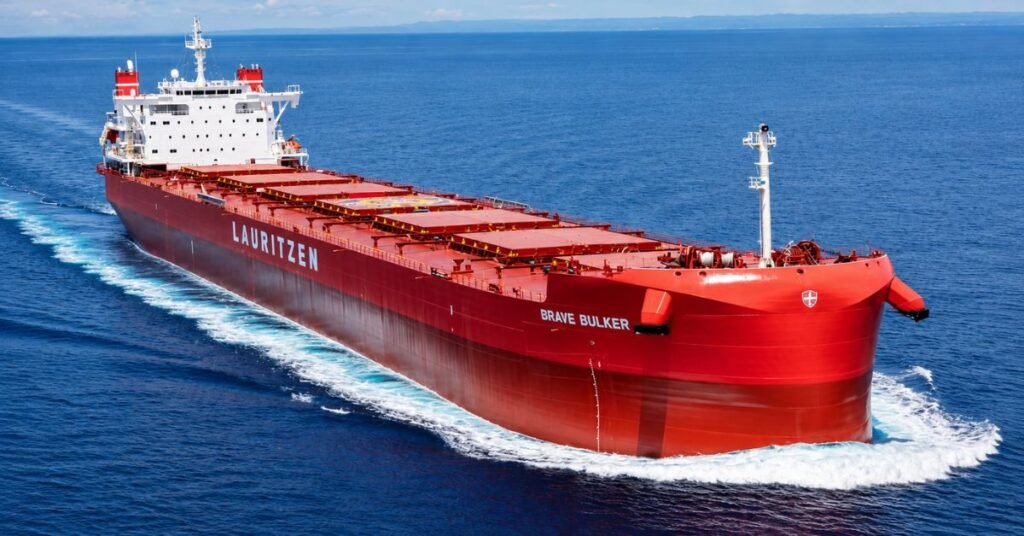
Lauritzen Bulkers has celebrated the delivery of Brave Bulker and named sister vessel Bold Bulker at Tsuneishi Shipbuilding’s Cebu yard in the Philippines, advancing a three-vessel methanol dual-fuel newbuilding programme backed by a long-term commercial arrangement with Cargill.
The ceremony on 17 November 2026 marked the naming and delivery celebration for Brave Bulker, while Bold Bulker underwent its naming ceremony. Lauritzen Bulkers Chief Executive Officer Martin Sato and Chairman Kristian Morch attended alongside project partners.
The Kamsarmax vessels form part of an investment programme initiated in 2023 to introduce alternative-fuel capability into dry bulk operations.
What is the delivery status of the two vessels?
Brave Bulker has been delivered, while Bold Bulker remains under construction. The latter was launched on 12 August 2026 and is scheduled for delivery in January 2027.
The ships’ dual-fuel propulsion enables operation on methanol or conventional marine fuels. This provides operational flexibility while methanol supply develops across international shipping routes.
The ceremony therefore represents different stages for the two vessels, with one entering the delivered fleet and the other progressing towards handover. Lauritzen has not disclosed Brave Bulker’s initial trading itinerary. engine.online
How did the Cargill partnership begin?
J. Lauritzen announced the initial project in April 2023 through a letter of intent for at least two methanol dual-fuel Kamsarmax bulk carriers. The vessels were described at that stage as having a deadweight capacity of approximately 81,200 tonnes.
The investment was structured through Lauritzen NexGen Shipping, an entity established by the group as a platform for further investment in lower-emission shipping assets.
Cargill committed to operating the initial vessels for a minimum of seven years. A third vessel was subsequently added to the programme, also with long-term Cargill employment.
The arrangement links investment in new propulsion technology with an established cargo operator’s commercial requirements, providing contracted employment for the vessels after delivery.
How does the design accommodate methanol?
Tsuneishi’s announcement of the Lauritzen order described a dual-fuel design capable of using methanol and heavy fuel oil. An independent, large-capacity methanol tank is positioned at the stern to preserve cargo-hold space and facilitate maintenance and cargo operations.
The design also incorporates hull-form improvements and an upgraded version of Tsuneishi’s AEROLINE technology, intended to reduce wind resistance and improve performance at sea.
This arrangement addresses a practical requirement for alternative-fuel bulk carriers: accommodating additional fuel-storage infrastructure while retaining the cargo-carrying characteristics expected from a Kamsarmax vessel.
Kamsarmax is Tsuneishi’s bulk carrier design category developed around the maximum vessel dimensions suitable for Guinea’s Port of Kamsar.
How is Tsuneishi’s methanol programme progressing?
Tsuneishi Heavy Industries Cebu separately announced the delivery of its third methanol dual-fuel Kamsarmax on 16 November 2026. Its published specifications list an overall length below 229 metres, a moulded breadth of 32.26 metres, a moulded depth of 20.15 metres and approximately 81,100 tonnes deadweight.
The shipbuilder had previously announced a methanol dual-fuel Kamsarmax delivery from Cebu in March 2026, demonstrating that production of the design is moving beyond its initial vessel.
For Lauritzen, the next scheduled milestone is Bold Bulker’s delivery in January. The three-ship programme combines long-term commercial employment with the ability to adopt methanol as fuel, although actual emissions performance will depend on the fuel used and its production pathway.
Recent Posts
Marine
Lloyd’s Register approves nuclear classification framework for ships and offshore units
Marine
IGFA forms three committees to support Hong Kong’s green marine fuel market
Methanol
Fratelli Cosulich lays keel for final tanker in four-vessel methanol-ready programme