
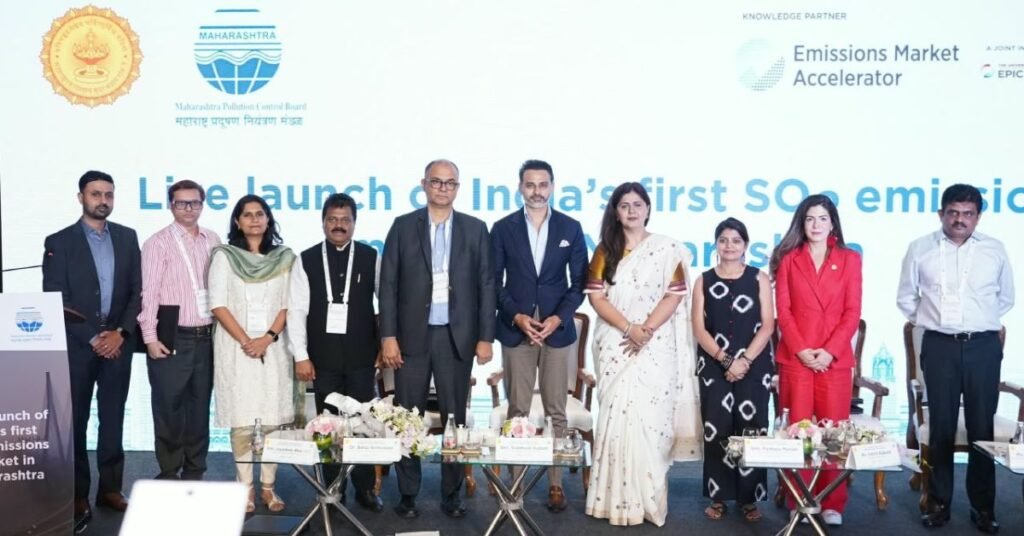
Maharashtra will begin operating India’s first sulphur dioxide emissions trading market on 1 December 2026, introducing a system intended to reduce industrial air pollution while giving participating plants flexibility in meeting compliance requirements.
Announced in Mumbai on 17 November, the market will initially cover 104 industrial facilities across 17 sectors, according to the Energy Policy Institute at the University of Chicago (EPIC). The Maharashtra Pollution Control Board (MPCB) will implement the scheme with support from the Emissions Market Accelerator (EMA).
How will the emissions market work?
The scheme will establish an overall limit on emissions from participating industrial plants. Facilities that reduce pollution below their permitted level can sell unused allowances to others facing higher reduction costs.
This creates a financial incentive for operators able to cut emissions relatively cheaply to make larger reductions. Other participants can purchase permits while remaining subject to the market’s collective emissions limit.
The mechanism concerns sulphur dioxide, a local air pollutant. It should therefore be distinguished from carbon markets addressing greenhouse gases such as carbon dioxide. Participation does not constitute a carbon-neutrality certification.
What preparation has Maharashtra undertaken?
MPCB began mock trading on 22 April 2026, providing a preparatory stage before the market’s operational launch. The state’s Department of Environment and Climate Change had also issued a government resolution supporting a pilot for selected industries.
EMA is a partnership between EPIC and the Abdul Latif Jameel Poverty Action Lab (J-PAL). Researchers working with Maharashtra include Michael Greenstone, Rohini Pande, Nicholas Ryan and Anant Sudarshan.
At the November announcement, Environment and Climate Change Minister Pankaja Munde emphasised industry participation and the use of technology to strengthen pollution monitoring. MPCB Chairman Siddhesh Ramdas Kadam similarly highlighted cooperation between regulators, industrial operators and research partners.
The partners describe the initiative as a statewide framework, although its initial coverage consists of specified participating facilities rather than every industrial establishment in Maharashtra.
Why is sulphur dioxide a priority?
Sulphur dioxide is released principally through fossil-fuel combustion at power plants and other industrial facilities. It can also react in the atmosphere to form fine particles.
The US Environmental Protection Agency explains that exposure can affect respiratory health, while the secondary particles formed from sulphur oxides can penetrate deeply into the lungs. Reducing industrial sulphur dioxide therefore addresses both direct exposure and its contribution to particulate pollution.
What does the Surat experience show?
Maharashtra’s programme builds on the particulate pollution market introduced in Surat, Gujarat, in 2019.
Researchers evaluated that pilot by comparing participating facilities with a control group operating under conventional pollution rules. EPIC reports that market participants reduced pollution by up to 30% while spending approximately 11% less on pollution control, with near-complete compliance.
Those findings provide evidence supporting market-based regulation, but they are results from Gujarat’s particulate programme, not measured outcomes for Maharashtra’s new sulphur dioxide scheme.
How will artificial intelligence support inspections?
Separately, MPCB and the University of Chicago Trust have signed a memorandum of understanding to develop a data-driven environmental inspection framework through EPIC India.
The proposed pilot will use artificial intelligence (AI) and machine learning to analyse MPCB data and help identify facilities more likely to be non-compliant. It will also include knowledge-sharing sessions for officers and inspectors.
Evidence from the pilot will inform decisions on wider implementation across Maharashtra. Together, the trading scheme and inspection initiative introduce financial incentives and more targeted regulatory oversight, with operational performance still to be established after launch.
Recent Posts
Power & Propulsion
Everllence 175D Marine Engine Targets 1,500 Hours of Unmanned USV Operation
Tugboats
Zhejiang’s First Fully Electric Tugboat Enters Service at Ningbo-Zhoushan Port
Marine
ABB to acquire Ziehl-Abegg for $2.65 billion, expanding HVAC and industrial cooling portfolio