
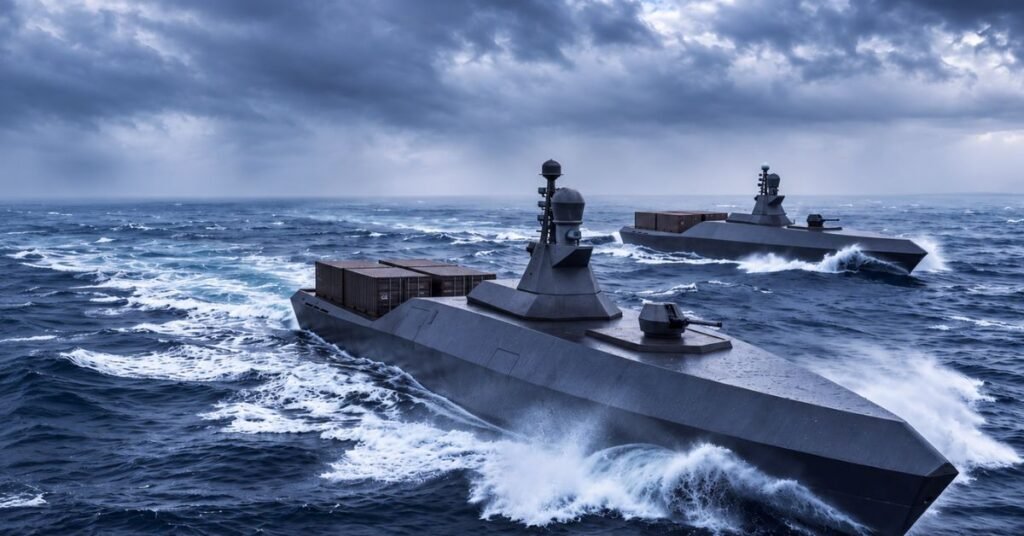
Everllence is extending the application of its 175D high-speed marine engine to the unmanned surface vessel (USV) market, with the engine set to be deployed in a prototype project designed to support up to 1,500 hours of unmanned operation.
Announced on 19 November 2026, the development targets the growing demand for propulsion systems capable of supporting extended missions without onboard crew intervention. The proposed operating duration of 1,500 hours is equivalent to more than two months of continuous operation.
Unmanned surface vessels are crewless platforms that can be remotely controlled, semi-autonomous or fully autonomous. They are used or being developed for a range of civilian, naval and government applications.
Growing interest in USVs reflects the increasing adoption of unmanned maritime capabilities by naval, coastguard and government operators. These vessels can extend operational reach, provide greater deployment flexibility and undertake missions without requiring personnel onboard.
As the segment develops, endurance, propulsion reliability and vessel availability are becoming important considerations. Longer mission profiles are increasing the need for engines capable of sustained operation with minimal onboard intervention.
Ruben Fernandez, Head of High-Speed, Four-Stroke Marine at Everllence, said: “Operators are looking for increasingly greater endurance due to longer mission profiles. With the capability to support up to 1,500 hours – equivalent to more than two months of continuous unmanned operation – we are meeting the most demanding market requirements. They also require efficiency to be able to operate with longest possible endurance. The 175D has demonstrated this capability across a wide range of demanding naval and governmental applications and we are pleased to bring these strengths to future unmanned vessel concepts.”
Everllence 175D Engine: Technical Characteristics and Applications
The 175D is a high-speed marine engine designed for naval, government and other demanding maritime applications. Its latest development milestone focuses on extending its operational capabilities to support long-duration unmanned vessel missions.
The engine incorporates extended maintenance intervals, operational reliability features and integrated automation capabilities intended to support high availability. These characteristics are relevant to USV operations, where onboard maintenance and crew intervention may not be possible during extended deployments.
The 175D is available in propulsion and generator-set configurations, with power outputs ranging from 1,440 kW to 4,400 kW. According to Everllence, its overhaul intervals and operational track record across naval and government applications provide the basis for its proposed use in next-generation unmanned maritime platforms.
The prototype project marks the company’s expansion of the 175D platform into the emerging USV segment, where endurance and operational autonomy are becoming increasingly important factors in propulsion system selection.
FAQs
How many hours can the Everllence 175D engine support unmanned operation?
The Everllence 175D engine is being developed for a prototype USV project targeting up to 1,500 hours of unmanned vessel operation, equivalent to more than two months of continuous operation.
What is the Everllence 175D marine engine?
The 175D is a high-speed marine engine available in propulsion and generator-set configurations, designed for naval, government and unmanned vessel applications.
What is the power output range of the Everllence 175D?
The engine is available in configurations ranging from 1,440 kW to 4,400 kW.
What makes the 175D suitable for unmanned surface vessels?
Its extended maintenance intervals, integrated automation capabilities, operational reliability and high-availability features are intended to support long-duration missions without onboard intervention.
What are unmanned surface vessels?
Unmanned surface vessels (USVs) are crewless vessels that operate through remote control, semi-autonomous systems or fully autonomous navigation. They have potential applications in civilian, naval and government operations.
Recent Posts
Power & Propulsion
Everllence 175D Marine Engine Targets 1,500 Hours of Unmanned USV Operation
Tugboats
Zhejiang’s First Fully Electric Tugboat Enters Service at Ningbo-Zhoushan Port
Marine
ABB to acquire Ziehl-Abegg for $2.65 billion, expanding HVAC and industrial cooling portfolio