
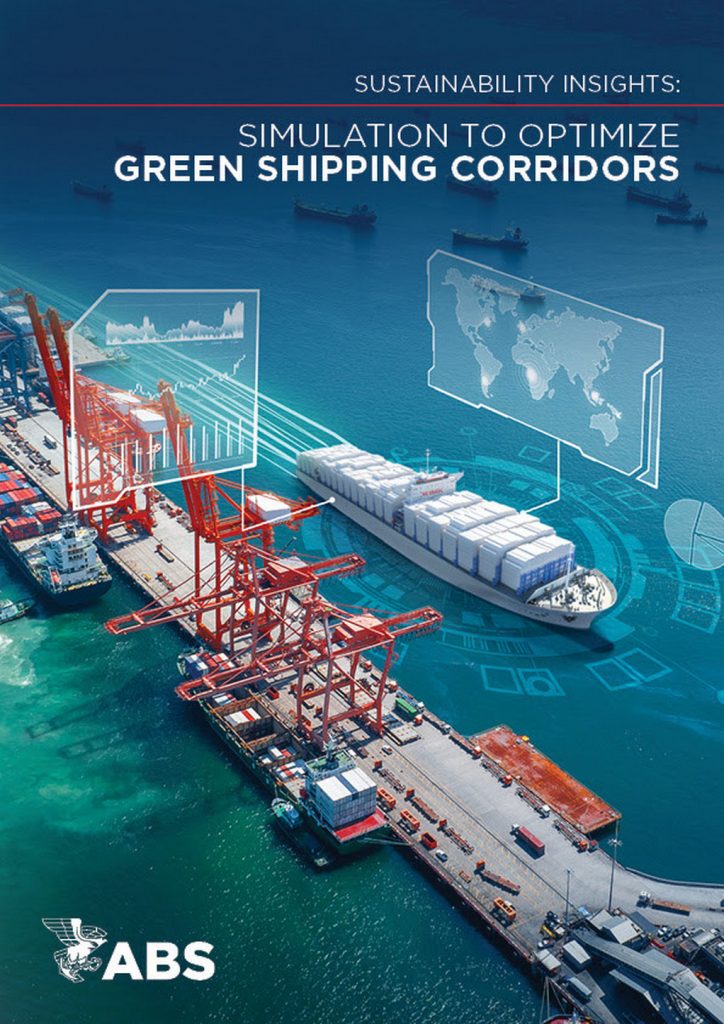
In a world first, ABS has launched a pioneering new Green Shipping Corridors Simulation service designed to support international design and development of clean energy initiatives.
The advanced modeling capability provides a detailed simulation of the complex nexus of stakeholders involved in corridor development, providing the data required to support policy and investment decisions.
“Green shipping corridors will be at the heart of any successful movement to decarbonize our industry. But these initiatives require advanced analysis beginning at the pre-feasibility stage through the full lifecycle of corridor development. With assets and operations from multiple stakeholders and a wide range of operational, policy, and regulatory issues to consider, simulation and optimization tools are ideal for providing critical analysis that accounts for uncertainties of the many variables affecting corridor design,” said Christopher Wiernicki, ABS Chairman, President and CEO.
“ABS’ simulation technology offers the fidelity of a digital twin, or digital sandbox if you prefer, shaping key decisions across the entire range of stakeholders by evaluating a range of transition path options and alternative future fuel scenarios to determine the best approach for a specific corridor. This includes macro-level corridor design issues with the stakeholder coalition and stakeholder-specific decisions by fuel suppliers, port authorities and terminal operations, vessel owners and operators, and cargo owners and shippers.”
Complementing the modeling and simulation service is a new ABS publication, An Approach to Green Shipping Corridor Modeling and Optimization, exploring two green shipping corridor case studies: the Singapore-Rotterdam containership initiative and the Australia-Japan iron ore bulk carrier proposal.
“Computer-based modeling and simulation is one of the most effective methods to address system complexities, and ABS is leveraging our extensive capabilities in advanced optimization and modeling to support clients and industry stakeholders to accurately evaluate the performance of potential green corridors,” said Dr. Gu Hai, ABS Vice President and the Head of ABS’ Global Simulation Center based in Singapore.
The outcomes of the studies provide a common model for data-driven decision making. The model is capable of generating a broad range of rich data including fleet fuel mix, newbuilding vessel investment needs, annualized port investments, fuel demand prediction in specific ports, fuel storage requirements at specific ports, and year-over-year fuel procurement for port bunkering stations and more.
Source: ABS
Recent Posts
Marine
Singapore’s Smart Port Challenge more than doubles submissions as 28 companies explore pilots
Biofuels
Hercules Angelica to carry Malaysian biodiesel cargo on maiden voyage
Methanol
US ethanol could help fill fuel gap for methanol-capable ships, study finds