

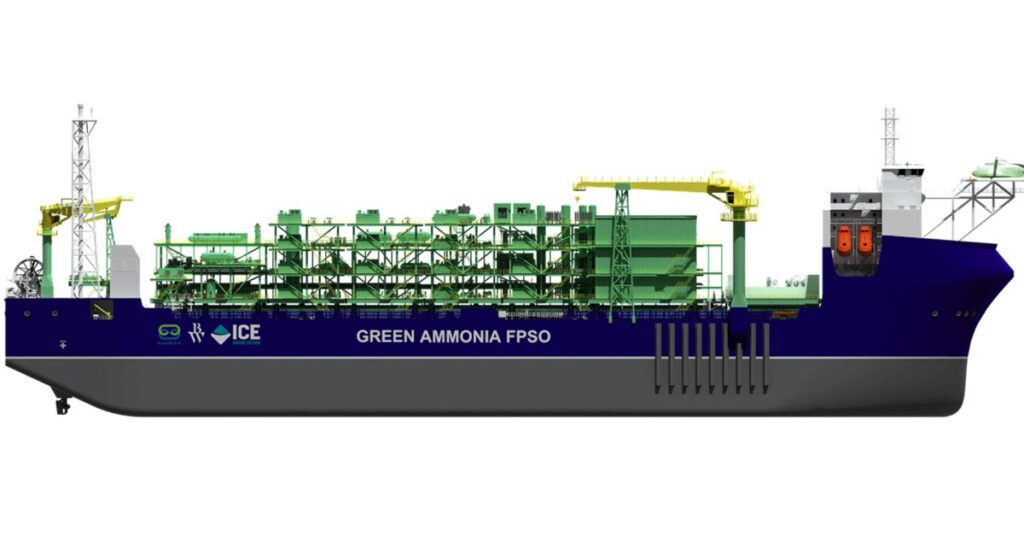
ABB has entered into a term sheet agreement with SwitcH2 to engineer and supply automation and electrification systems for a floating production, storage and offloading (FPSO) unit that will produce green ammonia from green hydrogen. The project aims to meet the growing demand for low-carbon marine fuels and advance offshore renewable energy production.
The FPSO facility will be located off the coast of Portugal and powered by certified renewable electricity from the national grid through Power Purchase Agreements (PPAs). It will incorporate a 300 MW electrolyzer capable of producing up to 243,000 tonnes of green ammonia annually.
Under the agreement, ABB plans to deliver a prefabricated eHouse, electrical distribution systems, and the ABB Ability™ System 800xA® Integrated Control and Safety System (ICSS) with full cybersecurity integration. These modular, ready-to-deploy systems are designed to enhance operational safety, efficiency, and reliability. The company’s automation platform will integrate with third-party systems, including electrolyzers and ammonia synthesis units.
“This collaboration represents a key step in advancing offshore production capabilities for next-generation marine fuels,” said Saskia Kunst, CEO of SwitcH2. “By integrating ABB’s advanced electrification and automation systems, we are demonstrating how technology-driven partnerships can accelerate innovation, shaping the future of energy at sea.”
The FPSO will use treated seawater to generate hydrogen through electrolysis. The hydrogen will then be combined with nitrogen extracted from the air to synthesize green ammonia. The ammonia will be condensed, stored onboard, and later transferred via a floating hose system to carrier ships for distribution. The product can be used directly as marine fuel or converted back into hydrogen for industrial applications.
Green ammonia is being recognized as a potential large-scale solution for decarbonizing hard-to-abate sectors such as shipping, which is responsible for around two percent of global greenhouse gas emissions.
“As with other hard-to-abate industries, we are committed to helping the marine sector operate leaner and cleaner. Our leading technologies in automation and electrification will enable this project to run with greater efficiently,” said Per Erik Holsten, President of ABB’s Energy Industries division. “Green ammonia offers a technically viable method for decarbonizing marine transport, and this FPSO concept showcases how renewable energy can be leveraged to unlock low carbon energy value chains.”
Front-end engineering and design (FEED) activities are scheduled to continue until mid-2026, with a Final Investment Decision (FID) anticipated in the third quarter of that year. Detailed engineering and construction are expected to begin in 2027.
Recent Posts
Ammonia
Reliance Industries Limited (RIL) has signed a binding long-term supply and purchase agreement (SPA) with Samsung C&T Corporation for the export of green ammonia over a 15-year period.
Bunkering
Ofiniti Raises $6.8 Million to Scale Digital Bunkering Platform for Global Shipping
Hydrogen
Hefring Marine and Ecomar Propulsion partner to deploy monitoring system on hydrogen-electric vessel