

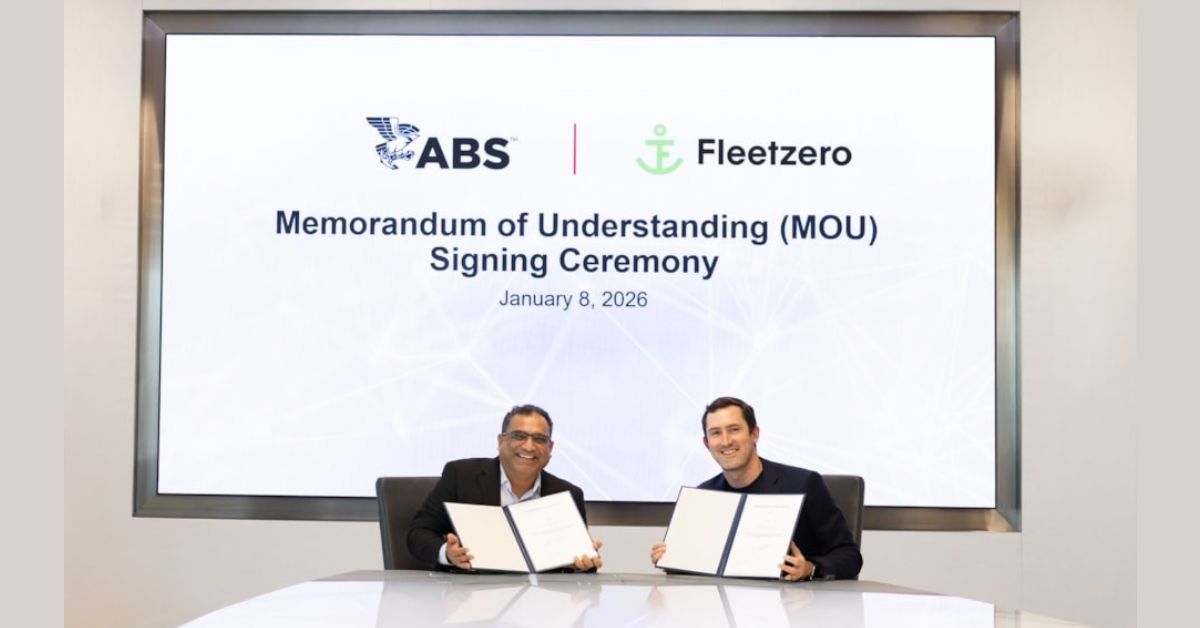
ABS and Fleetzero have signed a memorandum of understanding (MOU) to jointly examine the technical requirements for containerised battery systems intended for maritime applications.
Under the agreement, the two organisations will explore system designs and installation arrangements, alongside the development of testing methods and quality control processes. The objective is to support the safe deployment of container-based marine battery solutions as new commercial approaches emerge in the shipping sector.
Focus on safety and deployment challenges
The collaboration will address key challenges associated with marine battery adoption, including energy density limitations relative to conventional fuels and the safety considerations linked to high-capacity battery systems.
“ABS provides industry-leading guidance to support the adoption of marine battery systems. The next step is overcoming key barriers to deployment, most notably the constraints of energy density compared to conventional fuels and the associated safety challenges,” said Michael Kei, Vice President, Technology, ABS.
“We are proud to join Fleetzero in this effort to explore new approaches with safety as our guiding principle to support new energy efficiency technologies for the industry.”
Industry standards and zero-emission shipping
Fleetzero said the collaboration will contribute to the development of industry benchmarks for containerised battery systems, with a focus on performance and safety in marine environments.
“Fleetzero is proud to partner with ABS on innovative containerized battery solutions, delivering unprecedented energy density for marine use while improving safety standards,” said Steven Henderson, CEO and Co-founder of Fleetzero. “Through this agreement, we look forward to sharing our expertise to inform the advancement of industry standards, paving the way for Fleetzero to establish the new technology benchmarks needed to accelerate zero-emission shipping at a cost competitive with diesel.”
Recent Posts
Ammonia
Reliance Industries Limited (RIL) has signed a binding long-term supply and purchase agreement (SPA) with Samsung C&T Corporation for the export of green ammonia over a 15-year period.
Bunkering
Ofiniti Raises $6.8 Million to Scale Digital Bunkering Platform for Global Shipping
Hydrogen
Hefring Marine and Ecomar Propulsion partner to deploy monitoring system on hydrogen-electric vessel