

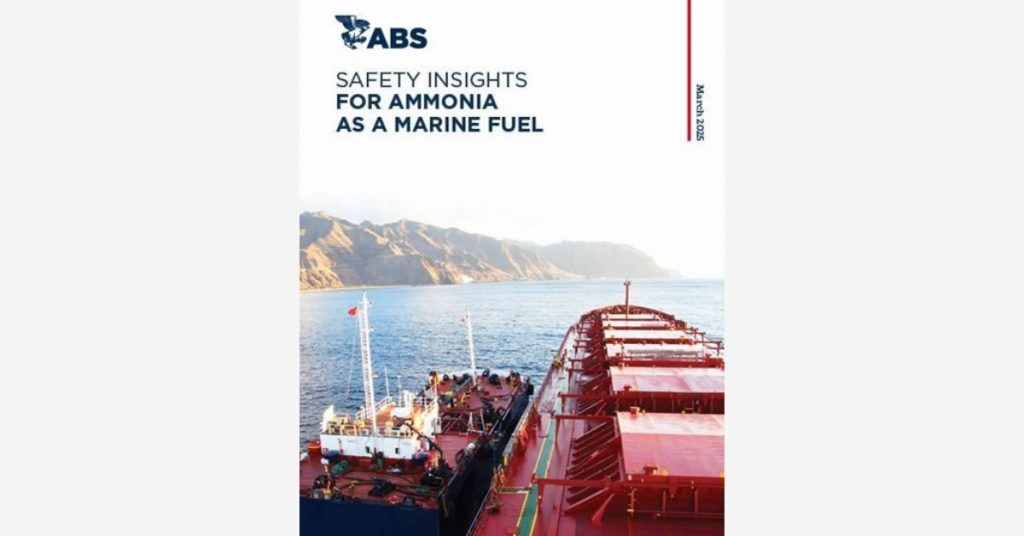
How does ammonia behave when it leaks in an engine room? How does a cloud of escaped ammonia disperse during bunkering operations? These and many other critical safety questions that must be understood if ammonia is to become widely adopted as a marine fuel are addressed in ABS’ latest research.
Safety Insights for Ammonia as a Marine Fuel brings together the findings of advanced ABS research into the performance of ammonia on board.
ABS performed computational fluid dynamics (CFD) simulations using advanced tools to quantitatively assess the risks associated with ammonia dispersion in accidental leakage scenarios. ABS engineers examined realistic bunkering situations such as ship-to-ship, terminal-to-ship and truck-to-ship, as well as ammonia dispersion from the vessel due to a leakage incident in the engine room.
In addition to CFD simulation analysis, ABS leveraged the latest industry best practices and advancements in software and hardware, including acoustic cameras for detecting and visualizing ammonia leakage, to provide a thorough, three-part framework for owners and operators evaluating ammonia as a cleaner fuel source:
Proactive regulatory engagement and risk anticipation
Development and implementation of a multifaceted safety framework, combining qualitative and quantitative risk assessments
Real-time monitoring and optimized emergency response
Download a copy of the ABS publication Safety Insights for Ammonia as a Marine Fuel: https://ww2.eagle.org/en/publication-flip/ammonia-safety.html
Recent Posts
Ammonia
Reliance Industries Limited (RIL) has signed a binding long-term supply and purchase agreement (SPA) with Samsung C&T Corporation for the export of green ammonia over a 15-year period.
Bunkering
Ofiniti Raises $6.8 Million to Scale Digital Bunkering Platform for Global Shipping
Hydrogen
Hefring Marine and Ecomar Propulsion partner to deploy monitoring system on hydrogen-electric vessel