

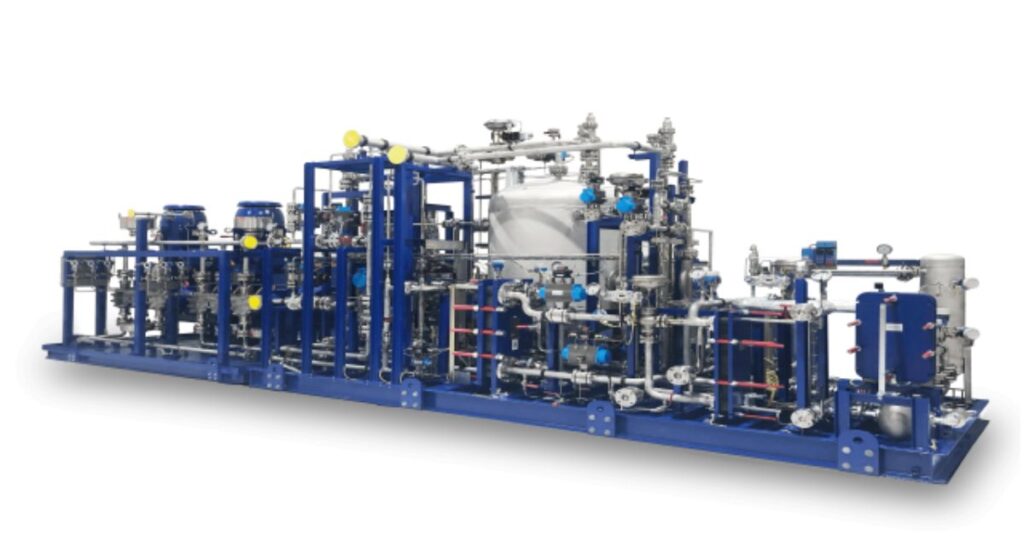
Alfa Laval has completed a certified Factory Acceptance Test (FAT) for its FCM Ammonia fuel supply system, marking a step toward commercial deployment of ammonia-fuelled marine engines.
The test, witnessed and certified by China Classification Society (CCS), verified that the fuel supply system meets required safety, functional and performance standards for integration with ammonia-fuelled two-stroke engines.
The system forms part of a broader industry effort to develop propulsion solutions based on ammonia, a fuel that is being evaluated as a long-term option for reducing carbon emissions in deep-sea shipping.
Certification milestone for ammonia fuel systems
The tested unit is the first of seven FCM Ammonia systems ordered by Tianjin Southwest Maritime for dual-fuel ammonia carriers. The Factory Acceptance Test confirms that the system has passed functional and safety verification procedures required for commercial shipbuilding applications.
The project includes collaboration across several marine industry stakeholders. CSSC Power Group Corporation (CPGC) acts as the system integrator and purchaser, while CCS conducted technical review and on-site verification in accordance with alternative fuel vessel guidelines.
Roberto Comelli, Europe E&S Manager for Marine Separation & Fuel Supply Systems at Alfa Laval, said:
“By completing the certified FAT for Alfa Laval’s FCM Ammonia, one of the first in the industry for a two-stroke dual-fuel ammonia application, we position ourselves as frontrunners supporting the safe adoption of ammonia in commercial shipping. This milestone confirms that our ammonia fuel supply technology has reached a new level of industrial maturity, and together with our partners, we are ready from design to production and will help the industry transition.”
Cui Yuwei, General Manager of the CCS Athens Branch, said:
“Full supply chain control is essential when introducing a new fuel into the marine environment, and it all starts with ensuring key component traceability and robust supplier qualification. The successful completion of this FAT signifies that the system has met the fundamental requirements for commercial application in terms of design safety, functional integrity, and production quality control. This is a significant step forward for the industry in enabling ammonia as a viable fuel for the next generation of commercial vessels.”
Integration into ammonia propulsion projects
The ammonia fuel supply system will support a propulsion configuration that includes a dual-fuel two-stroke engine supplied by WinGD. The vessels will be constructed by CSSC Huangpu Wenchong Shipbuilding for Tianjin Southwest Maritime.
The Factory Acceptance Test covered several verification stages, including hardware integration checks, validation of control and safety systems, simulation of operational and fault conditions, ammonia-handling procedures and documentation review under class supervision.
Alfa Laval said the project has also established a supply chain capable of delivering ammonia fuel supply systems in accordance with marine classification standards. The system tested at the company’s manufacturing facility in Monza, Italy, is intended to support future series production.
Next steps in vessel integration
Following the completion of the FAT and class approval process, the next phase will involve installation of the system on board the ammonia/LPG carrier under construction. Subsequent stages will include commissioning, fuel testing and sea trials, with additional units delivered as the vessel programme progresses. CCS will continue to oversee testing and certification during the remaining phases of the project.
Recent Posts
Ammonia
Reliance Industries Limited (RIL) has signed a binding long-term supply and purchase agreement (SPA) with Samsung C&T Corporation for the export of green ammonia over a 15-year period.
Bunkering
Ofiniti Raises $6.8 Million to Scale Digital Bunkering Platform for Global Shipping
Hydrogen
Hefring Marine and Ecomar Propulsion partner to deploy monitoring system on hydrogen-electric vessel