
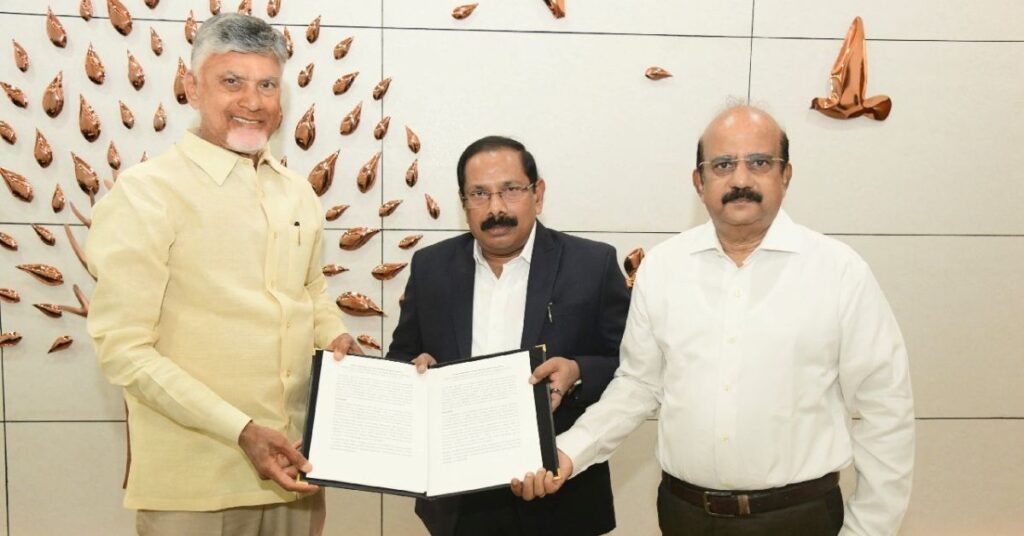
The Government of Andhra Pradesh has unveiled a comprehensive declaration to establish the Green Hydrogen Valley, positioning the state as India’s green hydrogen capital by 2030. Chief Minister N Chandrababu Naidu released the “Green Hydrogen Valley-Amaravati Declaration” on Monday, outlining a bold roadmap to develop the country’s largest ecosystem for green hydrogen production, innovation, and export.
The initiative aims to advance domestic research and development, scale up manufacturing capabilities, and build critical infrastructure for green hydrogen and its derivatives. The declaration was finalised following the Green Hydrogen Summit held in Amaravati last week, co-hosted by the Andhra Pradesh government and the New and Renewable Energy Development Corporation of Andhra Pradesh (NREDCAP).
Key Targets and Capacity Goals
By 2029, Andhra Pradesh intends to establish green hydrogen production capacity of 1.5 million metric tonnes per annum (MMTPA) and scale electrolyser manufacturing to 5 GW. The intermediate target is 2 GW by 2027. A major focus is on driving down production costs from the current Rs 460 per kg to Rs 160 to Rs 170 per kg by 2029.
To enable this growth, the state plans to create a Green Energy Corridor capable of evacuating 25 GW of renewable power by 2029.
Local Manufacturing and Innovation
The declaration underscores the importance of local manufacturing, setting a target for 60 percent of all electrolyser components and hydrogen storage solutions deployed in the state to be produced domestically by 2030. Andhra Pradesh will establish at least three new production facilities for electrolyser and storage equipment, collectively delivering a capacity of 4 to 5 GW.
To accelerate innovation, the state will allocate Rs 500 crore over five years to support at least 50 start-ups across the green hydrogen value chain. These start-ups will be part of a broader strategy to develop a robust ecosystem involving public-private partnerships, joint ventures with global technology firms, and knowledge-sharing platforms.
R&D and Skilling Ecosystem
SRM University-AP will serve as the nodal agency for a world-class research and testing facility dedicated to green hydrogen technologies. The state also plans to set up specialised research hubs and cross-disciplinary labs to support innovation in production, storage, and utilisation of green hydrogen.
A first-of-its-kind integrated green hydrogen skilling ecosystem will be developed in collaboration with universities and institutions. The program aims to train 200 specialists in its first year, scaling up to 2,000 annually by 2030 through technician certifications and engineering upskilling courses.
Strategic Advantages and Global Collaboration
Andhra Pradesh’s abundant renewable energy potential—through solar, wind, and pumped hydro—provides a natural advantage for green hydrogen production. Its extensive coastline positions the state as a strategic hub for exports to Southeast Asian markets. The state has also partnered with the World Economic Forum’s Centre for Energy and Materials to launch the first thematic centre under the Centre for the Fourth Industrial Revolution network. This collaboration aims to drive sustainable industrial growth and foster energy transition technologies.
Recent Posts
Ammonia
Reliance Industries Limited (RIL) has signed a binding long-term supply and purchase agreement (SPA) with Samsung C&T Corporation for the export of green ammonia over a 15-year period.
Bunkering
Ofiniti Raises $6.8 Million to Scale Digital Bunkering Platform for Global Shipping
Hydrogen
Hefring Marine and Ecomar Propulsion partner to deploy monitoring system on hydrogen-electric vessel