

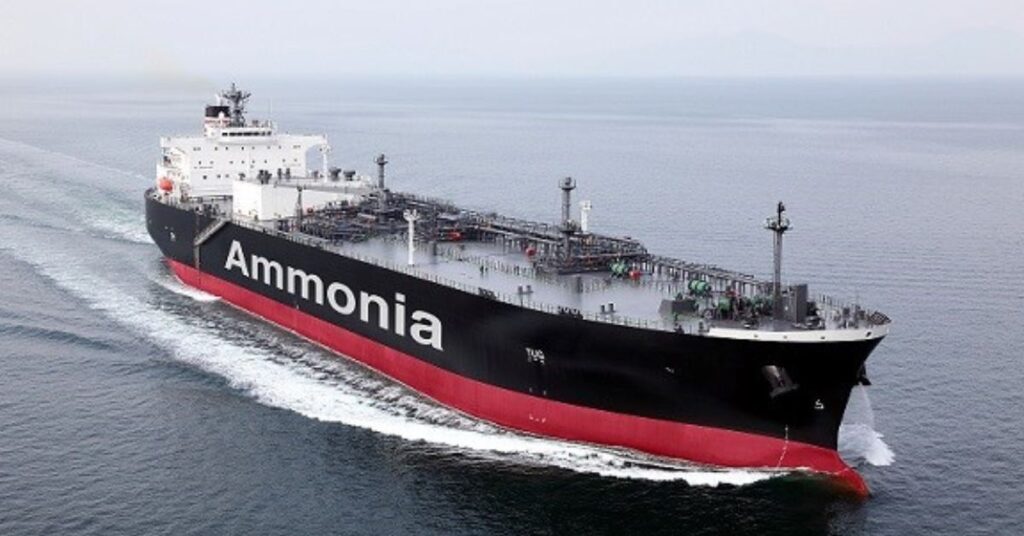
NYK Group has outlined a strategy positioning ammonia as its primary marine fuel to achieve net-zero emissions by 2050. The plan was presented by Takaya Soga, President and CEO of NYK, during his opening address at the World Maritime Merchants Forum 2025, held as part of Hong Kong Maritime Week.
According to the company’s outlook, the use of ammonia-fuelled vessels will begin this year and expand steadily through 2050. During the same period, LNG and LPG-fuelled ships are expected to peak around 2035 before transitioning toward ammonia-based propulsion. Methanol will also feature in NYK’s fleet strategy, though with a smaller projected role, with uptake beginning around 2030.
Ammonia Chosen as Principal Decarbonisation Route
Industry data shows LNG and methanol dominating alternative-fuel vessel orders—147 LNG-powered and 47 methanol-powered ships so far this year—while only five ammonia-fuelled vessels have been ordered. NYK’s decision therefore marks a notable shift in long-term fleet planning.
“The development and introduction of ammonia-fuelled vessels is positioned as our main scenario,” Soga said. He added that the company is advancing operational knowledge through real-world projects, including the ammonia-fuelled tugboat Sakuyake.
The Sakuyake completed a three-month demonstration voyage in March 2025, achieving up to a 95% reduction in GHG emissions. Soga said ammonia is recognised for producing zero harmful emissions during use, framing it as a strong option for deep-sea decarbonisation. However, he did not address industry concerns over ammonia’s toxicity—an issue often cited as a key challenge relative to alternatives like methanol and LNG.
Safety and Handling Experience Expanding
Soga highlighted NYK’s progress on ammonia safety management, referencing a ship-to-ship transfer completed between the NYK-owned ammonia carrier Berlian Ekuator and Eco Enchanted off the coast of Spain in September 2025.
“This achievement demonstrates the safety and the practicality of large-scale ammonia transportation,” he said.
Cost of Clean Ammonia Remains Main Obstacle
Despite operational advances, Soga identified cost as the primary barrier to scaling ammonia as a marine fuel.
“So the foundation for using ammonia as a marine fuel is in place, but the main barrier right now is cost,” he said. “Green ammonia, specifically blue or green ammonia, is still much more expensive than traditional options. On the other hand, currently, numerous grey ammonia plants exist globally.”
Soga noted that grey ammonia production infrastructure could underpin the development of blue and green ammonia in the future.
“To overcome the cost of the barrier, we need to accelerate clean ammonia development to enable mass production and drive down costs,” he concluded.
NYK’s strategy signals growing industry attention toward ammonia as a potential long-term solution for zero-carbon deep-sea shipping, even as debates continue over cost, safety, and competing fuel pathways.
Recent Posts
Ammonia
Reliance Industries Limited (RIL) has signed a binding long-term supply and purchase agreement (SPA) with Samsung C&T Corporation for the export of green ammonia over a 15-year period.
Bunkering
Ofiniti Raises $6.8 Million to Scale Digital Bunkering Platform for Global Shipping
Hydrogen
Hefring Marine and Ecomar Propulsion partner to deploy monitoring system on hydrogen-electric vessel