

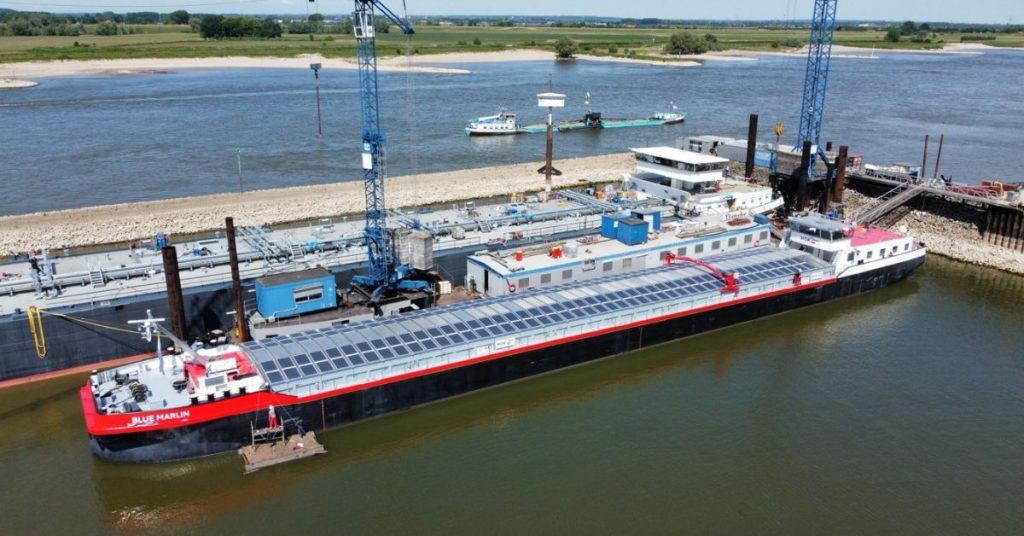
Dutch clean energy firm Wattlab has installed a pioneering solar energy system aboard HGK Shipping’s cargo vessel Blue Marlin, marking a significant advancement in sustainable inland waterway transport. The vessel is the first of its kind globally to utilise solar power not just for onboard systems, but also to directly assist propulsion.
The 110-metre-long Blue Marlin is equipped with 192 solar panels. Under optimal conditions, the panels can supply up to 35 kilowatts of power. The solar system has been fully integrated with the vessel’s high-voltage electric propulsion network—enabling a hybrid energy model that combines solar, battery, and diesel-generated power.
This development positions HGK Shipping, which operates a fleet of 350 vessels across Europe, at the forefront of maritime innovation. The company handles approximately 43 million tonnes of cargo annually, including dry bulk, gas, and chemical shipments.
David Kester, COO and co-founder of Wattlab, described the Blue Marlin as a technical milestone. “This is the first inland vessel where solar power is not only used for hotel loads, but also directly supports propulsion,” he said. “This integration opens up new possibilities for cleaner inland transport.”
Unlike the earlier MS Helios—another HGK vessel featuring 312 solar panels used exclusively for onboard systems—the Blue Marlin’s system is designed for full energy integration. It supports peak shaving, reducing reliance on additional diesel generators during high energy demand.
HGK Ship Management Lux S.à r.l. Director Tim Gödde noted that the new build demonstrates measurable progress in emissions reduction. “We’re proud to move beyond energy support to partial solar propulsion. Inland waterway shipping is already one of the more efficient transport modes, but this takes us a step closer to climate neutrality,” he said.
The solar system was installed at the De Gerlien van Tiem shipyard, with support from Blommaert Aluminium and Van Tiem Electro. According to Wattlab, installation and commissioning took just over a week. For future retrofits of similar scale, downtime is expected to remain under one week—highlighting commercial viability. Wattlab, which also develops solar solutions for coastal and deep-sea vessels, sees this as a model for broader adoption. “Shipowners are under increasing pressure from regulations and volatile fuel markets,” said Kester. “Scalable solar systems offer an effective tool for energy diversification and decarbonisation.”
Recent Posts
Ammonia
Reliance Industries Limited (RIL) has signed a binding long-term supply and purchase agreement (SPA) with Samsung C&T Corporation for the export of green ammonia over a 15-year period.
Bunkering
Ofiniti Raises $6.8 Million to Scale Digital Bunkering Platform for Global Shipping
Hydrogen
Hefring Marine and Ecomar Propulsion partner to deploy monitoring system on hydrogen-electric vessel