

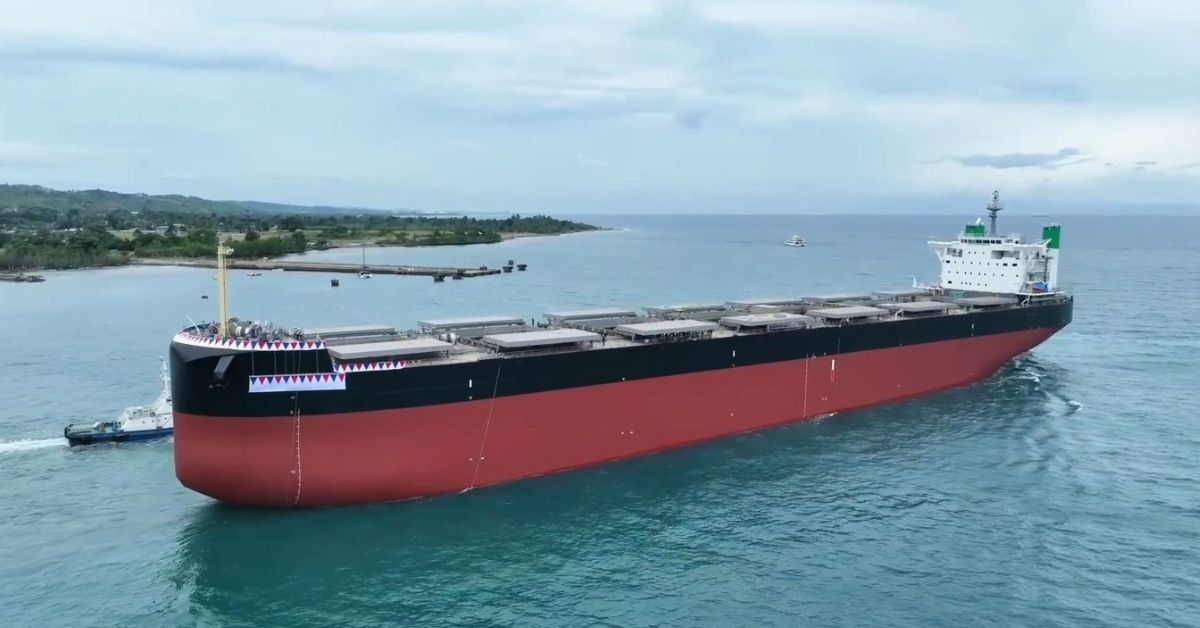
Cargill has launched the maiden voyage of Brave Pioneer, the first of five green methanol-capable dual-fuel dry bulk vessels chartered by the company, marking a new phase in its maritime decarbonisation efforts.
The vessel departed from the Philippines on January 15, 2026, and is scheduled to bunker green methanol in Singapore before continuing to Western Australia and onward to Europe. The deployment will be used to conduct operational trials focused on alternative fuel use in commercial dry bulk shipping.
Vessel design and fuel capability
Brave Pioneer was built by Tsuneishi Shipbuilding and is owned by Mitsui & Co.. The vessel is equipped to operate on both conventional marine fuels and green methanol, which is considered a lower-carbon alternative. According to Cargill, the use of green methanol can reduce carbon dioxide emissions by up to 70% compared with conventional marine fuels, depending on production pathways.
Operational trials and carbon accounting
During the maiden voyage, Cargill will evaluate green methanol bunkering readiness and operational performance under real trading conditions. The trials will also examine how environmental attributes linked to low-carbon fuels can be traced and verified through carbon accounting systems, as well as assess customer demand for lower-emissions freight services.
“Decarbonising global shipping requires a mix of technologies and the willingness to take bold steps before the entire ecosystem is ready,” said Jan Dieleman, President of Cargill’s Ocean Transportation business.
“Technologies like green methanol or wind-assisted propulsion come with uncertainty. But as an industry leader, we have a responsibility to test these innovations on the water, share what we learn, and help shape the systems and standards that will enable wider adoption.”
Expansion of low-carbon fleet
The launch of Brave Pioneer is the first step in a programme that will see four additional green methanol dual-fuel vessels join Cargill’s chartered fleet in the coming years. These vessels form part of Cargill’s broader approach to maritime decarbonisation, which includes wind-assisted propulsion, voyage optimisation, energy-efficiency retrofits and the evaluation of alternative fuels such as biofuels and ethanol. “We know the road to low carbon shipping will require a mix of solutions and green methanol is one part of that portfolio,” Dieleman said. “Our new fleet is about optionality and adaptability. These vessels are engineered to perform at a best-in-class level on conventional fuel today, while allowing us to switch to greener fuels as availability improves. It’s a practical way to future-proof ocean transport.”
Recent Posts
Ammonia
Reliance Industries Limited (RIL) has signed a binding long-term supply and purchase agreement (SPA) with Samsung C&T Corporation for the export of green ammonia over a 15-year period.
Bunkering
Ofiniti Raises $6.8 Million to Scale Digital Bunkering Platform for Global Shipping
Hydrogen
Hefring Marine and Ecomar Propulsion partner to deploy monitoring system on hydrogen-electric vessel