

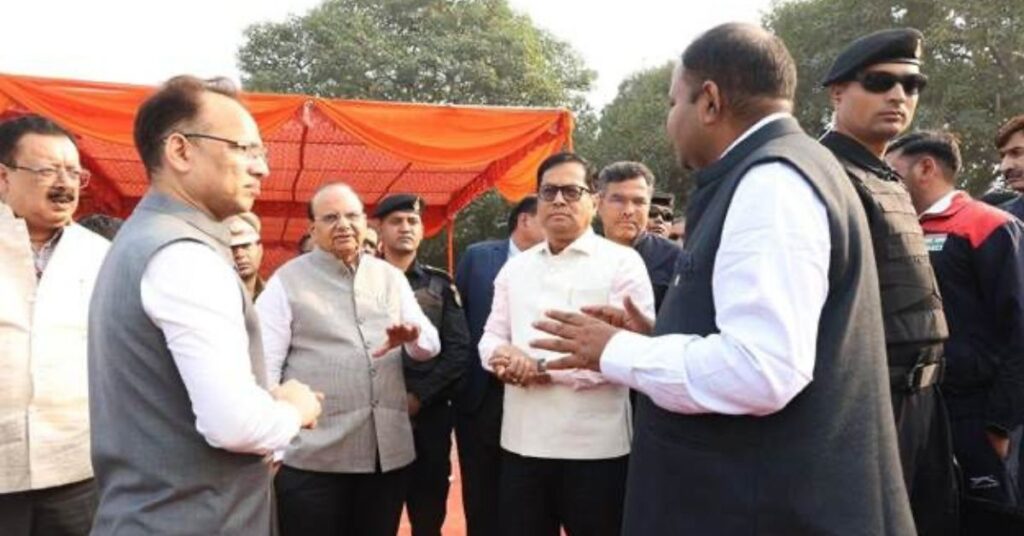
Delhi, November 2025 – The Union Minister for Ports, Shipping and Waterways (MoPSW), Sarbananda Sonowal, along with Delhi Lieutenant Governor Vinai Kumar Saxena and Delhi Tourism Minister Kapil Mishra, reviewed the progress of the Yamuna Boat Tourism and Ferry Infrastructure Development Project. The initiative aims to introduce recreational boat cruises and ferry services on the River Yamuna, enhancing sustainable tourism and urban water transport in the National Capital.
Located upstream of the Wazirabad Barrage between Sonia Vihar and Jagatpur, the ₹20-crore project is expected to provide residents and visitors with a green tourism experience while improving connectivity through eco-friendly river transport. The corridor will cover a 6–7 km round-trip stretch along National Waterway 110 (NW-110), which runs 1,080 kilometres from Delhi’s Jagatpur to Prayagraj in Uttar Pradesh.
“Under the dynamic leadership of Prime Minister Narendra Modi, India’s waterways have witnessed a transformational revival after decades of neglect. Eco-friendly cruise tourism on the Yamuna is a major milestone, paving the way for cleaner, greener and more efficient water transport that will boost connectivity and tourism in the heart of Delhi,” said Shri Sarbananda Sonowal.
To facilitate implementation, the Inland Waterways Authority of India (IWAI) has signed an MoU with Delhi government departments, including Irrigation and Flood Control, Delhi Development Authority (DDA), Delhi Jal Board (DJB), and Delhi Tourism and Transportation Development Corporation (DTTDC). The agreement focuses on developing cruise tourism along a four-kilometre stretch of NW-110.
The corridor will feature electric-solar hybrid boats with a capacity of 30–40 passengers, equipped with life jackets and public announcement systems. IWAI has installed two floating jetties at Sonia Vihar, each accommodating 50 passengers. Plans also include on-shore amenities such as parking, basic facilities, and recreational spaces.
“The development of inland water transport on the Yamuna opens an exciting new chapter for Delhi. Beyond enabling cleaner modes of travel, this project will enhance the experience of residents and tourists alike by adding a unique river-cruise dimension to the Capital’s tourism landscape. With eco-friendly boat services and modern passenger facilities, Yamuna will not only emerge as a vibrant recreational corridor but also as a dynamic water transport link that strengthens connectivity and economic opportunities in the heart of the city,” added Shri Sonowal.
The review meeting included Delhi ministers Pravesh Sahib Singh and Kapil Mishra, alongside senior IWAI officials including Sunil Kumar Singh, Chairman (I/C), IWAI.
Across India, IWAI is upgrading national waterways by developing terminals, improving fairways, installing night navigation aids, and modernising lock systems. Under the Harit Nauka initiative, electric catamarans have been launched in Varanasi and Ayodhya, with further deployments planned for Patna and Guwahati. India’s first indigenously built hydrogen fuel-cell powered vessel has also completed trials, advancing green mobility goals.
“Under the visionary leadership of Hon’ble Prime Minister Narendra Modi ji, the inland waterways sector—once neglected and overlooked for almost six decades—has undergone a transformational turnaround since 2014. What was long seen as an under-utilised asset is today revolutionising how India moves people and goods with speed, sustainability and efficiency,” Shri Sonowal said.
The inland waterways sector has seen significant growth over the past decade. The number of operational national waterways increased by 767%, cargo movement grew by 635%, multimodal terminals rose by 62%, and investments in national waterways increased by 233%. The National Waterways Act, 2016, and the Inland Vessels Act, 2021, have supported this expansion.
India currently has 111 national waterways spanning 20,187 kilometres across 23 states and four Union Territories. Thirty-two waterways are operational for navigation, with a target of 76 operational waterways by 2027. Cargo movement on national waterways reached a record 146 million tons between April 2024 and March 2025.
Recent Posts
Ammonia
Reliance Industries Limited (RIL) has signed a binding long-term supply and purchase agreement (SPA) with Samsung C&T Corporation for the export of green ammonia over a 15-year period.
Bunkering
Ofiniti Raises $6.8 Million to Scale Digital Bunkering Platform for Global Shipping
Hydrogen
Hefring Marine and Ecomar Propulsion partner to deploy monitoring system on hydrogen-electric vessel