

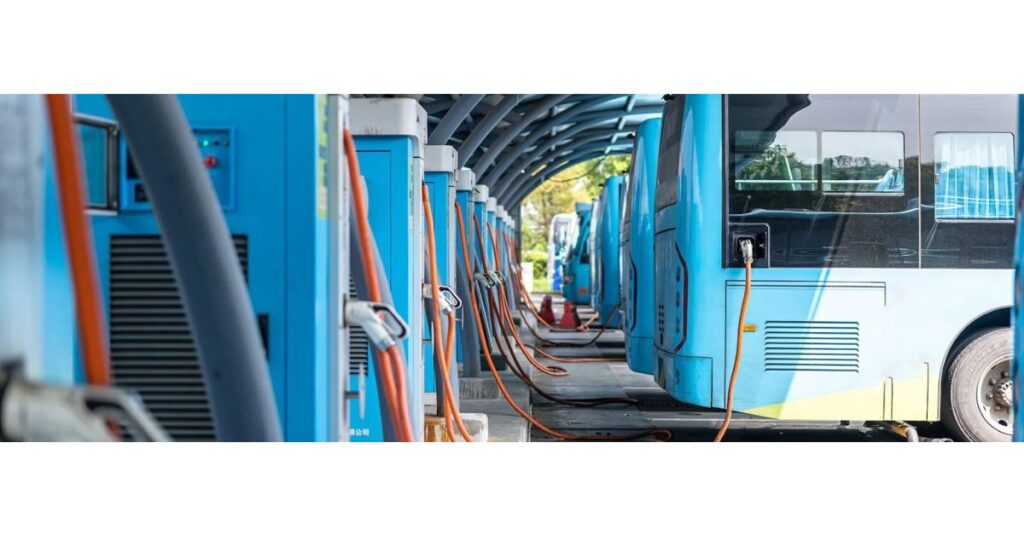
DNV has completed an independent technical due diligence for TPG Rise Climate, supporting the investor’s majority financing in Kinetic, Australasia’s largest mass transit operator, as the company advances its transition toward a zero-emissions fleet.
TPG Rise Climate’s Majority Stake in Kinetic
TPG Rise Climate recently announced the acquisition of a 70% equity interest in Kinetic, which operates more than 12,000 buses and 400 trains across Australia, New Zealand, and Europe. The investment aims to accelerate the company’s zero-emission strategy, focusing on electric bus deployment and depot electrification.
Kinetic also holds a 51% share in the Go-Ahead Group, a major UK-based bus and rail operator.
Scope of DNV’s Technical Due Diligence
Commissioned directly by TPG Rise Climate, DNV’s due diligence covered a wide range of technical, operational, and environmental factors linked to Kinetic’s decarbonisation roadmap.
The review included:
- Fleet transition planning and electric bus technology readiness
- Depot electrification and charging infrastructure design across more than 200 depots
- Energy and infrastructure integration, including power demand and grid interface
- Asset lifecycle assessments, warranty, and operations and maintenance (O&M) reviews
- Battery safety and replacement strategy for electric buses
- Financial model and risk assessments to evaluate technical assumptions and resilience
The analysis drew on DNV’s expertise in transport electrification, energy systems, and risk management to assess the feasibility and scalability of Kinetic’s zero-emission strategy.
Expert Commentary
Jasjeet Singh, Senior Principal Consultant and Head of Risk Management and Consulting, UK, DNV, said:
“This engagement reflects DNV’s expanding role in enabling low-carbon transport investment. Through rigorous technical due diligence, our team assessed the feasibility and scalability of Kinetic’s zero-emission transition strategy, providing TPG with a clear view of technical risks and opportunities across multiple geographies.”
Viken Chinien, Vice President and Head of Department, Markets and Risk, DNV, added:
“As investors accelerate funding into climate-aligned transport infrastructure, robust technical diligence is essential to ensure the credibility, resilience, and long-term sustainability of these platforms. This project demonstrates DNV’s capability to combine transport engineering, energy systems expertise, and risk management to support global investment decisions.”
Market Context
According to DNV’s Energy Transition Outlook 2025, electric vehicles (EVs) are expected to account for 50% of new commercial vehicle sales by 2039 globally. In Greater China, this milestone is projected to be reached by 2033, driven by strong policy incentives, while Europe is forecast to achieve majority EV share by 2038 under its Fit for 55 emissions-reduction framework.
Globally, the commercial vehicle fleet is projected to grow from 250 million to 440 million units by 2060, underscoring the scale of investment needed for sustainable mobility solutions.
Recent Posts
Ammonia
Reliance Industries Limited (RIL) has signed a binding long-term supply and purchase agreement (SPA) with Samsung C&T Corporation for the export of green ammonia over a 15-year period.
Bunkering
Ofiniti Raises $6.8 Million to Scale Digital Bunkering Platform for Global Shipping
Hydrogen
Hefring Marine and Ecomar Propulsion partner to deploy monitoring system on hydrogen-electric vessel