
Feasibility study planned for Mongstad refinery aims to convert waste into green methanol and capture 400,000 tonnes of CO₂ annually
Norwegian energy company Equinor and Mana, a subsidiary of NG Nordic, have entered into an early-stage strategic partnership to assess the development of the Nordics’ first large-scale waste-to-methanol project. The initiative, supported by NEXTCHEM, focuses on converting non-recyclable waste into low-carbon methanol while capturing and storing carbon emissions.
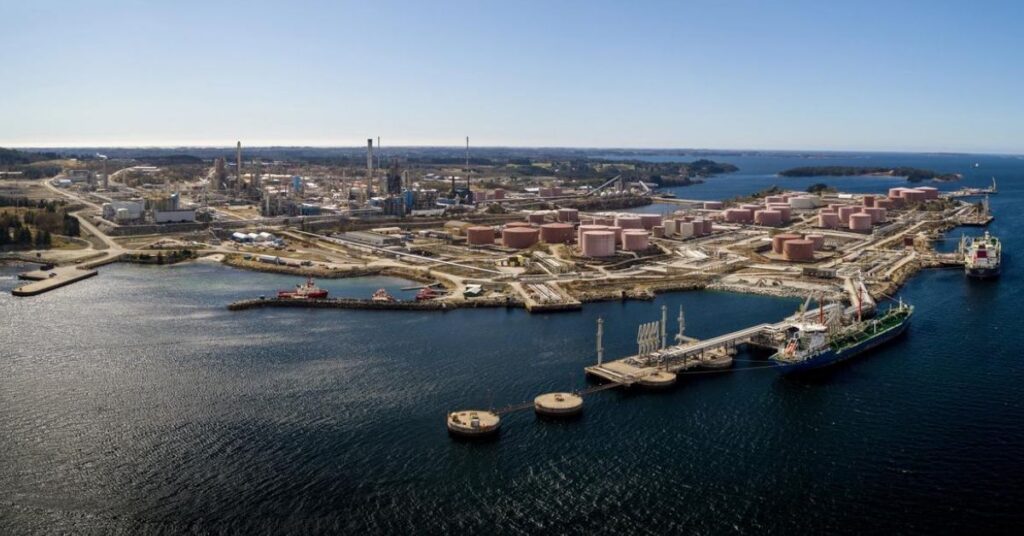
The proposed facility would be located at Equinor’s Mongstad complex in Norway. According to the project partners, the plan is to process around 550,000 tonnes of residual waste each year to produce 270,000 tonnes of methanol, while capturing and permanently storing 400,000 tonnes of CO₂.
Low-Carbon Methanol for Marine and Aviation Sectors
The methanol produced is expected to serve as a low-carbon alternative to marine bunker fuels, aligning with the FuelEU Maritime regulation and helping end users avoid ETS credit purchases and penalty costs. In later stages, the green methanol could also be used as a feedstock for Sustainable Aviation Fuel (SAF) production compliant with the FuelEU Aviation regulation.
The project remains in an early development phase. Equinor and Mana have appointed NEXTCHEM, through its subsidiary MyRechemical, to conduct a feasibility study scheduled for completion in spring 2026.
Feasibility Study and Technical Scope
As a technology integrator and service provider, NEXTCHEM will assess the technical and economic viability of the proposed waste-to-methanol process. The study will include an evaluation of waste gasification technologies and the purification of syngas for methanol synthesis.
Fabio Fritelli, Managing Director of NEXTCHEM, said:
“We are proud to support this early-stage strategic partnership to explore the potential to develop the Nordics’ first large-scale waste-to-methanol project at Mongstad, Norway. Northern Europe represents an ideal context for replicable and scalable industrial projects, with tangible environmental and industrial benefits.”
Pathway to Circular Carbon Solutions
If realized, the Mongstad project could represent a significant step in decarbonizing the regional energy and transport sectors, providing a circular carbon pathway for hard-to-abate industries. It also aligns with broader European efforts to reduce landfill dependency, utilize waste as feedstock, and advance carbon capture and storage (CCS) technologies.
Recent Posts
Ammonia
Reliance Industries Limited (RIL) has signed a binding long-term supply and purchase agreement (SPA) with Samsung C&T Corporation for the export of green ammonia over a 15-year period.
Bunkering
Ofiniti Raises $6.8 Million to Scale Digital Bunkering Platform for Global Shipping
Hydrogen
Hefring Marine and Ecomar Propulsion partner to deploy monitoring system on hydrogen-electric vessel