

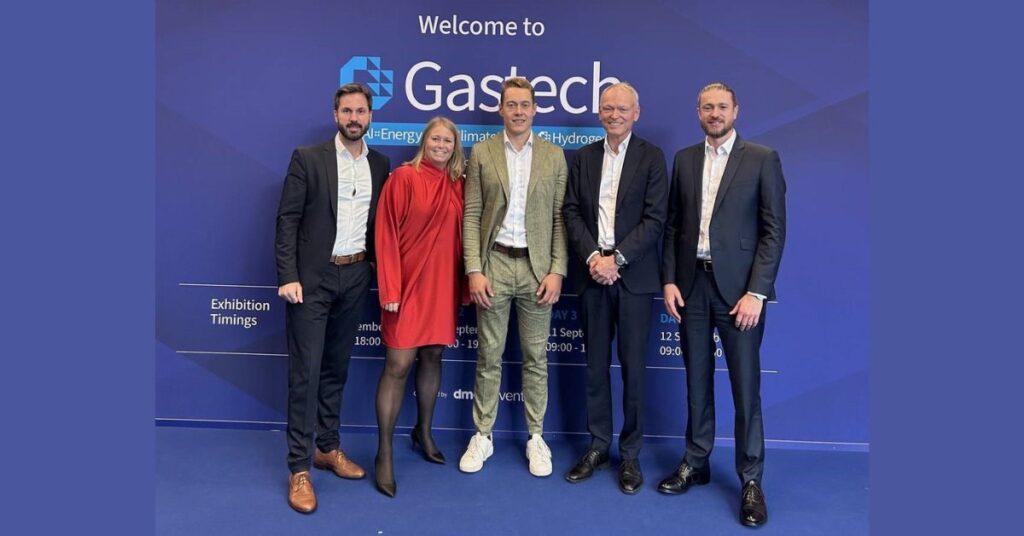
At GasTech 2025 in Milan, Everllence signed a Memorandum of Understanding (MoU) with ABB and OceanWings to jointly develop a new propulsion concept that integrates diesel-electric systems with wind-assisted propulsion.
The collaboration builds on Everllence’s and ABB’s existing DFE+ (Diesel-Electric with variable speed) system, which is designed to maintain high engine efficiency at partial loads, provide operational flexibility through multiple engines, and enable future integration of low-carbon energy sources such as batteries and fuel cells.
The partners intend to combine this platform with OceanWings’ wingsail technology, which uses Adaptive Trimming to optimise sail positioning in real time based on vessel-specific aerodynamics and external conditions.
Romain Grandsart, COO of OceanWings, said: “LNG carriers sail fast and spend typically 70% of their time at sea. This is ideal for harnessing wind and the full potential of OceanWings rigid wingsails. Combined with optimised propulsion, including a DFE+ highly efficient variable-speed concept engine, this unlocks high double-digit fuel savings and greenhouse-gas emissions reduction.”
Rune Lysebo, Head of Strategic Market Development at ABB Marine and Ports, added: “We at ABB believe that the flexibility of our hybrid electrical propulsion system is a good match with the variable power contribution from the wind. By utilising ABB’s advanced power and energy solution, we are able to optimise the operational efficiency of the vessel.”
Dominik Thoma, Global Manager LNG Cargo at Everllence, said: “While WAPS introduces highly variable propulsion demand due to fluctuating wind conditions, DFE+ propulsion offers precise load control and operational flexibility, making it exceptionally well-suited to harness the variable and intermittent power contributions of wind-assisted systems. In combination with smart power-management systems and adaptive trimming, we see significant potential for reduced emissions and OPEX.”
The initial focus of the collaboration will be on LNG carrier concepts, with further applications considered for other cargo vessels. According to the partners, the approach could be most effective for long-distance operations, ships with deck space to accommodate wingsails, and propulsion systems requiring high flexibility. The collaboration also aims to explore cost efficiencies in both operating and capital expenditures for future vessel designs.
Recent Posts
Ammonia
Reliance Industries Limited (RIL) has signed a binding long-term supply and purchase agreement (SPA) with Samsung C&T Corporation for the export of green ammonia over a 15-year period.
Bunkering
Ofiniti Raises $6.8 Million to Scale Digital Bunkering Platform for Global Shipping
Hydrogen
Hefring Marine and Ecomar Propulsion partner to deploy monitoring system on hydrogen-electric vessel