

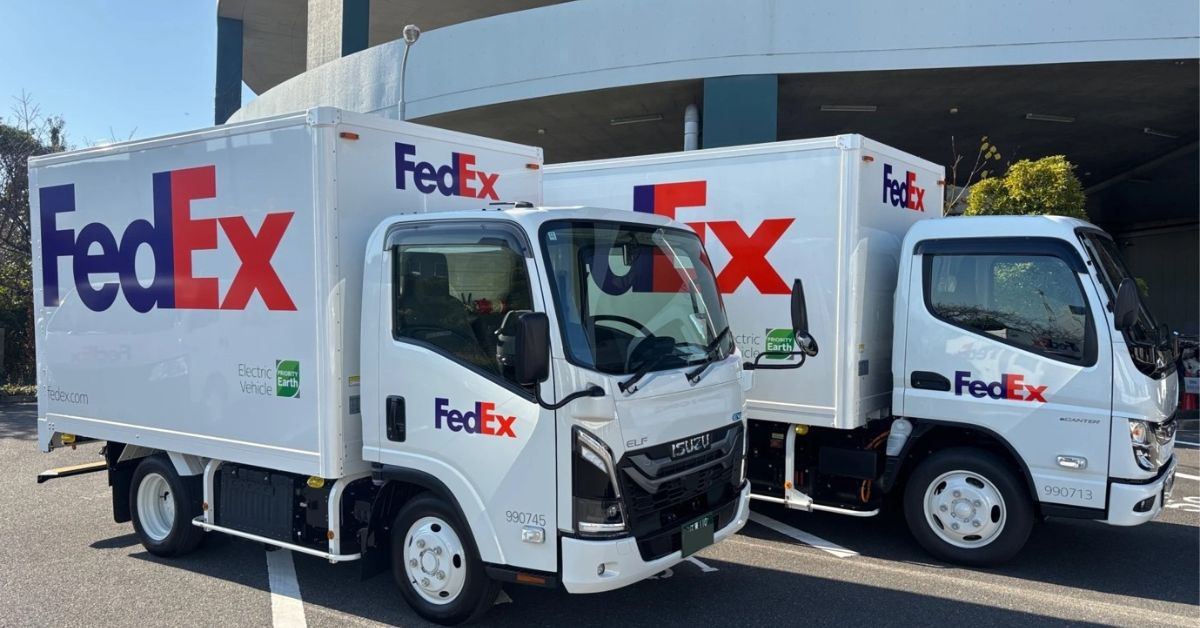
Federal Express Corporation has expanded its electric vehicle (EV) fleet in Japan with the deployment of 17 electric delivery trucks, as part of its ongoing efforts to reduce tailpipe emissions in last-mile operations.
The newly added vehicles will be used for parcel pickup and delivery across Tokyo, Kanagawa, and Osaka. According to the company, the deployment supports FedEx’s longer-term objective of achieving carbon-neutral operations by 2040 and forms part of the phased electrification of its global pickup and delivery fleet.
The EVs include models from Mitsubishi Fuso and Isuzu, specifically the eCanter and ELF EV platforms. Each vehicle has a payload capacity of approximately 1.5 tonnes and is intended for high-density urban delivery routes.
FedEx estimates that each electric truck will reduce tailpipe carbon dioxide emissions by around 3.3 metric tonnes per year, based on planned route distances compared with conventional diesel-powered vehicles.
“Our business strategy focuses on delivering reliable service to customers, and sustainability and efficiency are integral to how we operate,” said Kei Alan Kubota, Managing Director of FedEx Japan. “These new EVs will reduce emissions on high-density urban routes while helping us maintain the speed and quality our customers expect. We will continue to accelerate the adoption of low-emission technologies and contribute to cleaner air for local communities.”
The fleet expansion aligns with Japan’s national climate targets, which include a 60% reduction in greenhouse gas emissions by 2035 compared with 2013 levels, and the achievement of net-zero emissions by 2050. Logistics and transport operators are expected to play a key role in meeting these goals, particularly in urban freight and last-mile delivery segments.
FedEx said the Japan deployment reflects a broader strategy to introduce alternative fuel and electric vehicles across its international operations, as regulatory pressure and customer demand for lower-emission logistics services continue to increase.
Recent Posts
Ammonia
Reliance Industries Limited (RIL) has signed a binding long-term supply and purchase agreement (SPA) with Samsung C&T Corporation for the export of green ammonia over a 15-year period.
Bunkering
Ofiniti Raises $6.8 Million to Scale Digital Bunkering Platform for Global Shipping
Hydrogen
Hefring Marine and Ecomar Propulsion partner to deploy monitoring system on hydrogen-electric vessel