

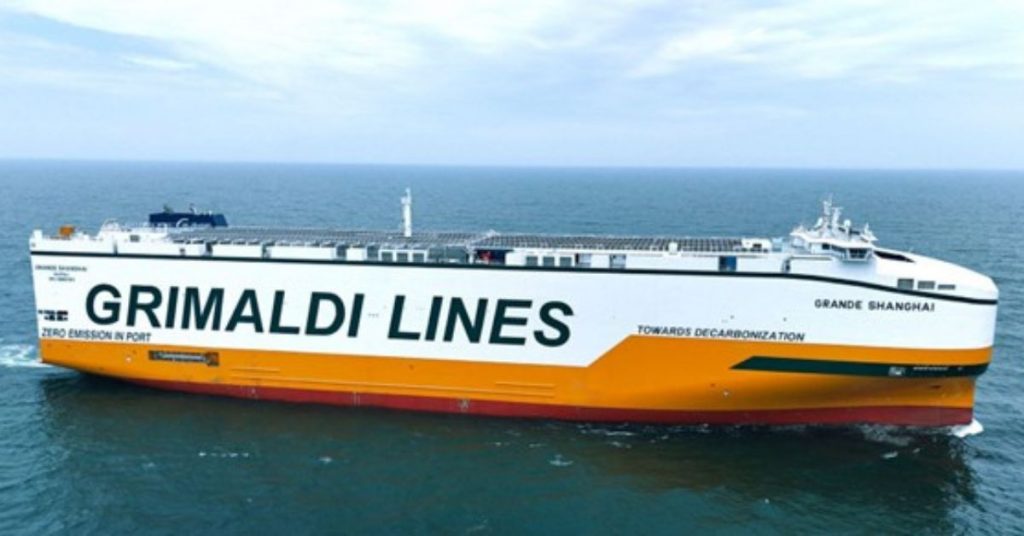
The Grimaldi Group has officially named and launched its first ammonia-ready pure car and truck carrier (PCTC), Grande Shanghai, at a ceremony held on July 21 at the China Merchants Heavy Industries shipyard in Haimen, China.
The newly built vessel marks the first in a series of ten next-generation PCTCs ordered by the Italian shipping company. Designed in collaboration with naval architects Knud E. Hansen, Grande Shanghai is equipped with the Ammonia Ready class notation from the Italian classification society RINA, indicating that the vessel can be retrofitted in the future to run on ammonia, a zero-carbon fuel alternative.
With a capacity to carry 9,000 car equivalent units (CEU), the 220 metre long and 38 metre wide ship features a gross tonnage of 93,145 tonnes and a service speed of 18 knots. The final five vessels in the series will have an increased capacity of 9,800 CEU.
According to Grimaldi, the Grande Shanghai can accommodate both electric and internal combustion vehicles across its 14 decks. The vessel is designed to achieve a 50 percent reduction in fuel consumption per transported unit compared to older generations of car carriers.
In addition to the Ammonia Ready notation, Grande Shanghai has received several environmental and comfort-related certifications, including Green Plus, Green Star 3, Comfort Vibration, and Comfort Noise Port.
The vessel is equipped with a range of advanced technologies aimed at enhancing energy efficiency and reducing emissions. These include 5 megawatt hours of lithium battery storage, 2,500 square metres of solar panels, and cold ironing capabilities for using shore power when docked.
The ship’s energy optimisation features comprise a silicon-based hull coating to minimise drag, smart systems for ventilation and air conditioning, and an electronically controlled engine fitted with exhaust gas cleaning equipment to reduce sulphur oxide and particulate matter emissions. A selective catalytic reduction system ensures nitrogen oxide emissions remain below IMO Tier III limits.
Additional innovations include an air lubrication system, an improved hull form, and a gate rudder with twin foil blades mounted on either side of the propeller. This marks the first use of such a rudder design on a PCTC vessel.
Recent Posts
Ammonia
Reliance Industries Limited (RIL) has signed a binding long-term supply and purchase agreement (SPA) with Samsung C&T Corporation for the export of green ammonia over a 15-year period.
Bunkering
Ofiniti Raises $6.8 Million to Scale Digital Bunkering Platform for Global Shipping
Hydrogen
Hefring Marine and Ecomar Propulsion partner to deploy monitoring system on hydrogen-electric vessel