

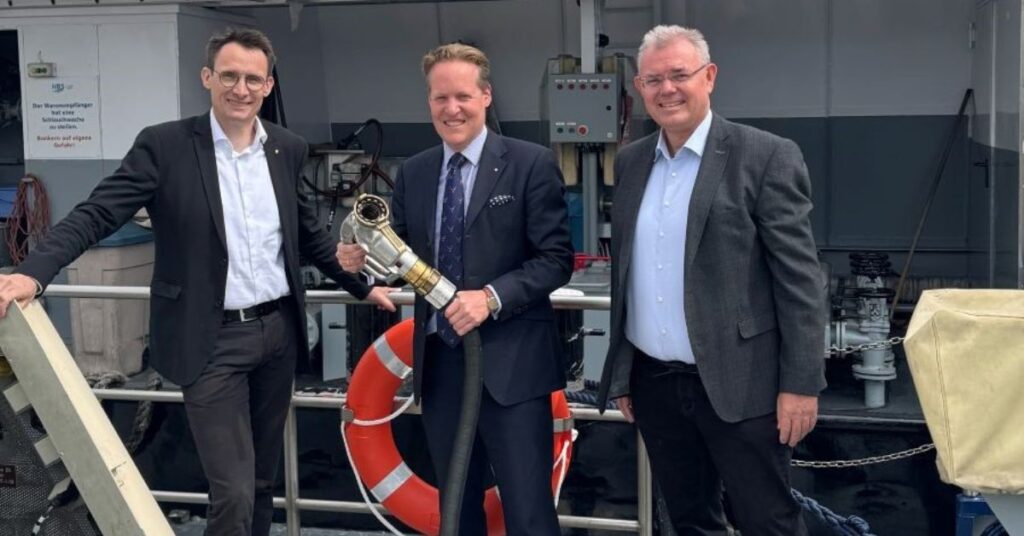
Flotte Hamburg, a subsidiary of the Hamburg Port Authority, has initiated a pilot program to test hydrotreated vegetable oil (HVO 100) as an alternative marine fuel.
The trial is being conducted in partnership with Friedrich G. Frommann GmbH & Co. and will involve Shell-supplied HVO 100. Three vessels from Flotte Hamburg will participate in the initial testing phase. These include the Hafenkapitän, which will be the first conventionally powered vessel in the fleet to operate in an almost carbon-neutral manner, as well as the survey vessel Deepenschriewer III and the transport and inspection vessel Neßsand.
HVO 100, made entirely from food waste and free of palm oil, complies with the European Union’s Renewable Energy Directive (RED II). It is projected to reduce greenhouse gas emissions by at least 80 percent compared to conventional fuels.
According to the Port of Hamburg, HVO 100 has been selected as a transitional solution while more vessels undergo electrification. The Hamburg Fleet has already adopted synthetic fuels such as gas-to-liquid (GTL) in previous low-emission initiatives.
Karsten Schönewald, Managing Director of Flotte Hamburg, stated that while the long-term strategy remains focused on electrification and new propulsion technologies, alternative fuels like HVO 100 will play a key role in achieving interim emission reduction goals.
If successful, the pilot could lead to a broader application of HVO 100 across the fleet.
Recent Posts
Ammonia
Reliance Industries Limited (RIL) has signed a binding long-term supply and purchase agreement (SPA) with Samsung C&T Corporation for the export of green ammonia over a 15-year period.
Bunkering
Ofiniti Raises $6.8 Million to Scale Digital Bunkering Platform for Global Shipping
Hydrogen
Hefring Marine and Ecomar Propulsion partner to deploy monitoring system on hydrogen-electric vessel