
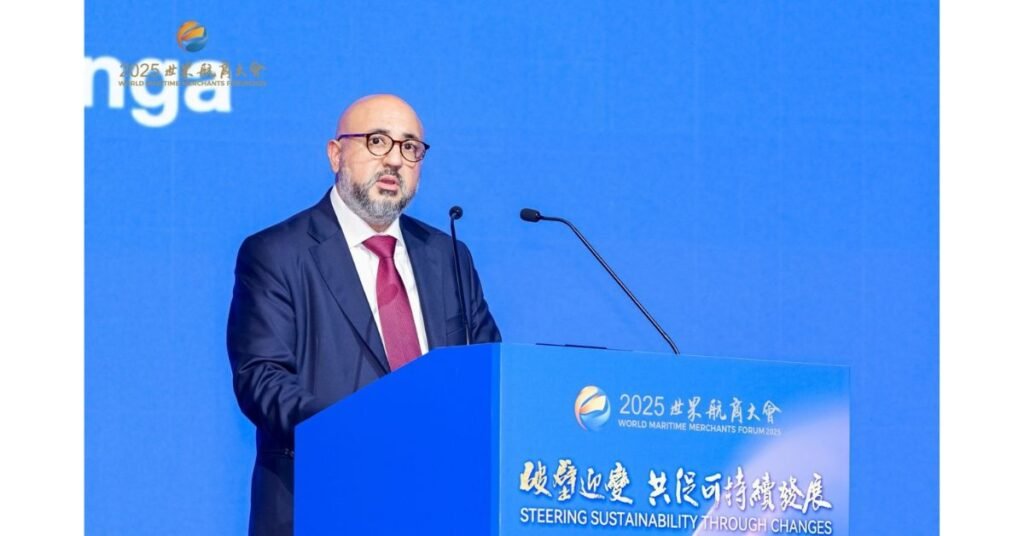
At the World Maritime Merchants Forum during Hong Kong Maritime Week 2025, Angad Banga, Chief Operating Officer of The Caravel Group and Chairman of the Hong Kong Shipowners’ Association, called for coordinated and timely investment to accelerate the maritime sector’s shift toward net-zero emissions.
Delivering a keynote titled “Unlocking Global Maritime Capital: Hong Kong’s Role in Leading the Green Transition”, Banga warned against delaying action following the International Maritime Organization’s decision to postpone its Net-Zero Framework. “If we wait for perfect clarity, we will lose ground,” he said, adding that the delay “creates a leadership opportunity — and Hong Kong is ready to lead.”
Hong Kong’s Position in the Energy Transition
Banga highlighted Hong Kong’s dual role as an international maritime centre and major financial hub. He noted that the city’s position between China and global markets gives it the ability to facilitate investment in decarbonisation and test new financial instruments, including sustainability-linked loans, stablecoins and the digital yuan.
Hong Kong shipowners control nearly 10% of the global merchant fleet by deadweight, and the city hosts four of the world’s ten largest ship management companies. Banga reiterated the importance of readiness for alternative fuels such as ammonia, hydrogen, methanol, biofuels and LNG, supported by the Hong Kong Government’s Action Plan on Green Maritime Fuel Bunkering.
By the end of Hong Kong Maritime Week, the city is expected to conclude three LNG bunkering operations alongside cargo handling. “Our location in the Greater Bay Area, near Mainland China’s renewable fuel production hubs, gives us a unique advantage as one of the most practical and efficient green fuel supply centres,” Banga said.
Financing and Policy Needs
Banga emphasised the scale of financing required for maritime decarbonisation and the role Hong Kong could play. The city ranks third globally in the Global Financial Centres Index and handles more than 70% of global offshore renminbi payments. In 2025, 80 companies listed in Hong Kong and around US$60 billion was raised through IPOs and other capital market instruments.
He cautioned that investment must be supported by aligned regulatory frameworks to prevent uncertainty and avoid stranded assets. “Shipping is the backbone of global trade, and decarbonisation is creating new markets for fuels, technologies, and services — all of which require capital,” he said.
Banga pointed to inconsistencies among regulatory systems, from CII and EEXI to the EU ETS and FuelEU Maritime, describing them as a “patchwork” that slows investment decisions.
Digital Finance and Innovation
Banga also addressed Hong Kong’s growing green finance and fintech ecosystem. The Hong Kong Government has issued HK$240 billion in green bonds since 2018, and the Core Climate carbon marketplace — launched in 2022 — links capital with emissions-reduction projects.
He noted that stablecoins “may offer potential benefits for traceable cross-border transactions by reducing settlement times and currency risk,” while integration with China’s digital yuan could enhance transparency and efficiency, subject to regulatory safeguards.
Closing his address, Banga underscored the need for cooperation: “There is no greater cause for collaboration between government and industry than this.”
Key Points
- Angad Banga urges rapid investment and coordinated action on maritime decarbonisation.
- Hong Kong positioned as a bridge between China’s fuel production and global maritime markets.
- Alternative fuel readiness includes ammonia, methanol, hydrogen, biofuels and LNG.
- Hong Kong’s capital markets raised nearly US$60 billion in 2025.
- Regulatory fragmentation remains a challenge for investment and long-term planning.
Stablecoins and digital yuan could support cross-border maritime finance.
Recent Posts
Ammonia
Reliance Industries Limited (RIL) has signed a binding long-term supply and purchase agreement (SPA) with Samsung C&T Corporation for the export of green ammonia over a 15-year period.
Bunkering
Ofiniti Raises $6.8 Million to Scale Digital Bunkering Platform for Global Shipping
Hydrogen
Hefring Marine and Ecomar Propulsion partner to deploy monitoring system on hydrogen-electric vessel